

A True HEPA filter catches 99.97% of tiny particles down to 0.3 microns, meeting strict government standards. A HEPA-type filter is a loose marketing term for cheaper materials that capture far fewer pollutants and let fine dust pass through.
2. Do HEPA-type filters remove allergens and pet dander?
They capture larger dust bunnies and visible pet hair, but they fail to trap microscopic allergens like fine smoke, mold spores, and dust mite debris that trigger severe asthma and allergy attacks.
3. Are HEPA-type filters worth buying to save money?
While they have a lower upfront price tag, they require more frequent replacements and offer poor filtration efficiency, making them a false economy for anyone dealing with indoor air quality issues.
4. How can I tell if a replacement filter is certified True HEPA?
Check the product specifications for exact laboratory certification standards like DOE or European EN 1822 compliance, rather than trusting vague packaging phrases like “HEPA-grade” or “HEPA-like.”
Walking down the appliance aisle, it is easy to grab the cheapest air purifier replacement filter and assume it will keep your indoor air clean. Many budget-friendly options use clever marketing terms like “HEPA-style” or “HEPA-like” to look medical-grade, but they leave tiny allergy triggers floating right back into your living room.
Understanding what separates a certified True HEPA filter from a generic HEPA-type alternative saves you money and protects your household from dust, pollen, and pet dander. Let’s break down how these filters actually perform behind closed doors so you can make the right call for your home and health.
The Core Difference: What Makes a Filter “True HEPA”?
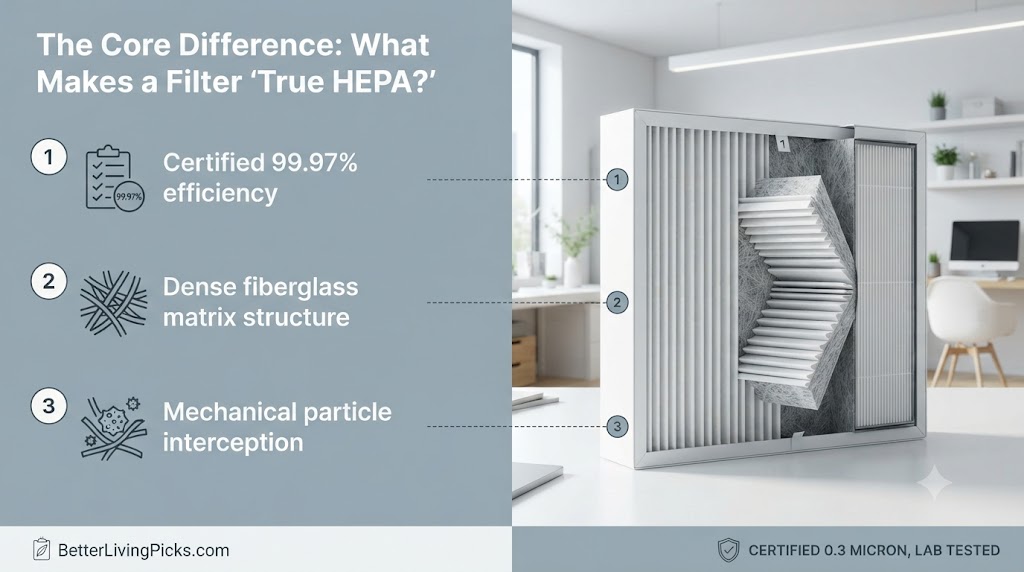
Defining the 99.97% Standard
A filter earns the coveted “True HEPA” title through rigorous laboratory testing rather than arbitrary factory marketing guidelines. Specifically, the material must demonstrate the ability to trap 99.97% of airborne particles that measure down to the notoriously difficult size of 0.3 microns.
That specific 0.3-micron threshold is chosen because physical scientists refer to it as the Most Penetrating Particle Size (MPPS). Particles larger than 0.3 microns get easily trapped by direct impact, while particles significantly smaller move in erratic zig-zag paths and crash into fibers through diffusion. The 0.3-micron size slips through the cracks most easily, meaning a filter that conquers this size dominates all others.
Furthermore, industrial standards require these filters to maintain this high performance continuously during peak operational loads. When you examine certified laboratory specifications, you will notice that True HEPA materials are tested using specialized aerosol generators that spray controlled particle sizes. This ensures that every batch leaving the manufacturing floor meets government and international safety benchmarks without exception.
Materials and Construction Quality
True HEPA filters utilize an intricate, dense mat of randomly arranged fiberglass threads. These fibers are compressed densely together to create a microscopic labyrinth that forces incoming air to twist, turn, and squeeze through narrow passages.
When airflow pushes through this heavy-duty web, microscopic contaminants have nowhere to hide and get permanently snagged. This robust physical construction means the filter requires a strong internal system fan to pull air through without burning out the motor.
The manufacturing process itself is precise, involving wet-laid fiberglass paper sheets that are folded into deep accordion pleats. These pleats maximize the total surface area exposed to airflow, allowing the filter to process large volumes of air despite its tight weave. Without this deep pleating structure, a fiberglass mat would instantly choke off a fan and stall air circulation completely.
The Physics of Mechanical Filtration
Unlike cheaper alternatives that rely on weak static charges to pull dust from the air, True HEPA relies purely on mechanical interception. Impact, interception, and diffusion work together continuously within the fiberglass web.
Over time, even as a True HEPA filter collects loads of physical debris, its collection efficiency actually increases slightly because the narrowing gaps catch even more particulate matter, right up until the point of total saturation.
Direct impact handles heavier dust chunks, interception catches mid-sized particles brushing against fiber walls, and diffusion captures ultra-fine particles tumbling through random molecular collisions. This three-tiered mechanical trap operates completely independently of electrical current, meaning performance remains utterly stable over years of service.
Unpacking “HEPA-Type” Filters: Marketing vs. Reality
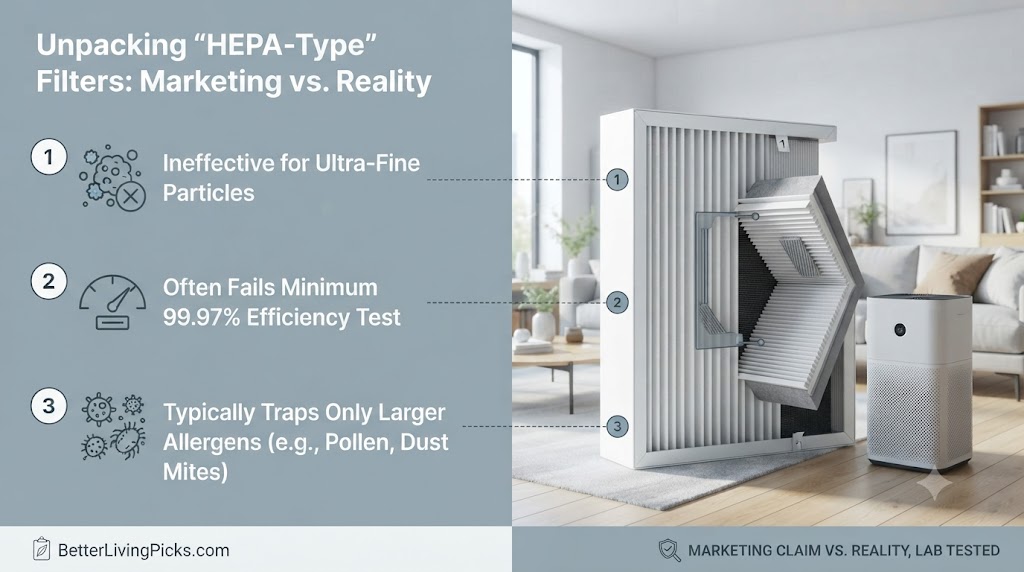
What Percent of Particles Do They Catch?
HEPA-type filters typically skip expensive fiberglass in favor of cheaper paper, cotton, or blended synthetic materials. Because the structural weave is much looser and less uniform, these budget filters usually only capture about 85% to 99% of particles down to 2 microns.
That massive gap in filtering efficiency means microscopic pollutants slip right through the gaps in the loose weave and cycle back into your living space, leaving your room vulnerable to lingering allergens.
When independent testing laboratories evaluate standard HEPA-type filters, they consistently find that particles measuring under 1 micron bypass the material entirely. Because many hazardous indoor pollutants like smoke and bacteria fall below this 1-micron mark, a HEPA-type filter provides zero meaningful protection against them.
The Hidden Loophole in Labeling
Manufacturers frequently take advantage of consumer trust by using slippery terms like “HEPA-like,” “HEPA-style,” “99% efficient,” or “HEPA-grade.” Because these specific phrases are completely unregulated by independent governing bodies, companies face no legal penalty for slapping them on sub-par boxes.
If a packaging box does not explicitly state that it meets official True HEPA standards under strict testing guidelines, you are likely buying a standard mesh filter that will struggle against fine indoor dust.
Shopppers often fall into this trap because retail displays intentionally place budget replacements right next to medical-grade options. Always inspect the fine print on the back of the packaging to confirm whether the manufacturer lists explicit certification compliance or merely uses clever advertising adjectives.
The Problem with Electrostatic Dependence
Many HEPA-type filters attempt to make up for loose physical weaves by coating their materials in an electrostatic charge. This temporary charge attracts passing dust particles like a magnet when the filter is brand new.
However, as humidity rises in your home or as heavy dust loads coat the fibers, that static charge rapidly decays. Once the charge fades, the filter’s collection efficiency drops dramatically, leaving you with little more than a basic window screen.
Electrostatic enhancement is a cheap manufacturing shortcut designed to pass initial baseline efficiency tests without incurring the high material costs of genuine fiberglass mats. Once household cooking vapors, oil droplets, and general moisture coat the fibers, the electrostatic attraction vanishes, rendering the budget filter virtually useless long before its scheduled replacement date.
Real-World Performance: Dust, Allergens, and Pet Dander

How True HEPA Handles Microscopic Triggers
In a normal home environment, microscopic triggers like active mold spores, fine wildfire smoke, and dried dust mite feces float invisibly in the breathing zone. A certified True HEPA filter locks these fine irritants away permanently within its dense fiberglass layers so they cannot escape back out.
Homeowners dealing with severe allergies or chronic asthma notice an immediate drop in morning congestion, throat irritation, and coughing once they upgrade to a verified system.
Because microscopic allergens are light enough to remain suspended in indoor air currents for hours, capturing them requires continuous, high-efficiency filtration. A True HEPA system scrubs the air volume repeatedly throughout the day, ensuring that even newly stirred allergens get trapped on their very first pass through the purifier unit.
Where HEPA-Type Filters Fall Short
HEPA-type filters often look remarkably clean on the surface because they trap large dust clumps, lint, and pet hair quite easily. However, they lack the fine structural density needed to capture the microscopic particles that actually trigger severe respiratory flare-ups.
If you live in an older home with chronic dust issues, reside near a dusty construction zone, or own heavy-shedding pets, a HEPA-type filter leaves your indoor air largely uncleaned.
Visitors to your home might not notice the difference visually, but allergy sufferers will feel the physiological impact within hours. When fine dander and mold fragments bypass a loose filter, they settle directly onto mucosal linings, triggering sneezing fits, watery eyes, and disrupted sleep patterns despite the air purifier running constantly.
Impact on Vulnerable Household Members
Infants, elderly family members, and individuals with compromised immune systems are deeply sensitive to poor indoor air quality. Relying on a weak HEPA-type filter gives a false sense of security while fine particulate matter continues to circulate.
Installing a True HEPA solution creates a reliable barrier that protects the most vulnerable members of your household from airborne contaminants day and night.
Children’s developing lungs are particularly susceptible to fine particulate pollution and organic allergens. Providing a clinically clean breathing environment inside the bedroom drastically reduces pediatric respiratory distress episodes and helps maintain stable, restful sleep cycles year-round.
Airflow and Energy Efficiency Trade-Offs

Resistance and Motor Strain
Because True HEPA filters feature such a tight, dense weave, they naturally create high resistance to continuous airflow. Your air purifier or whole-house HVAC fan has to work much harder to pull air through the thick material without slowing down.
If an air purifier or furnace blower is not engineered to handle a True HEPA filter, dropping a dense replacement in can strain the motor, overheat components, and reduce overall airflow output.
Engineering balance is critical here. High-end air purifiers feature matched fan curves designed specifically to overcome the static pressure drop inherent to True HEPA media. Attempting aftermarket modifications without checking system compatibility often results in premature motor failure or burned-out control boards.
Noise Levels in Daily Operation
To successfully overcome the intense physical resistance of a dense True HEPA filter, internal fans often need to run at higher speeds and higher RPMs. This mechanical demand can lead to a noticeably louder hum in quiet bedrooms compared to looser HEPA-type filters that let air rush through freely.
Many modern appliance manufacturers solve this acoustic challenge by designing larger surface-area accordion pleats that maintain quiet airflow while keeping True HEPA efficiency entirely intact.
Selecting a purifier equipped with a DC brushless motor and multi-speed sound insulation allows you to enjoy maximum filtration efficiency while keeping ambient bedroom noise levels comfortably below conversational whisper thresholds.
Balancing Air Changes Per Hour (ACH)
Air purification depends heavily on how many times a room’s entire volume of air passes through the filter every hour. A restrictive filter can sometimes lower airflow rates if the fan isn’t powerful enough, which lowers your total room air changes.
When shopping for systems, always verify that the unit’s fan motor is robust enough to push air through a True HEPA barrier without sacrificing room-wide air circulation performance.
Maintaining at least four to five complete air changes per hour in a standard bedroom ensures that contaminants generated by human activity or indoor movement get captured before they can settle onto floors or enter the upper breathing zone.
Cost Analysis: Upfront Price Versus Long-Term Value
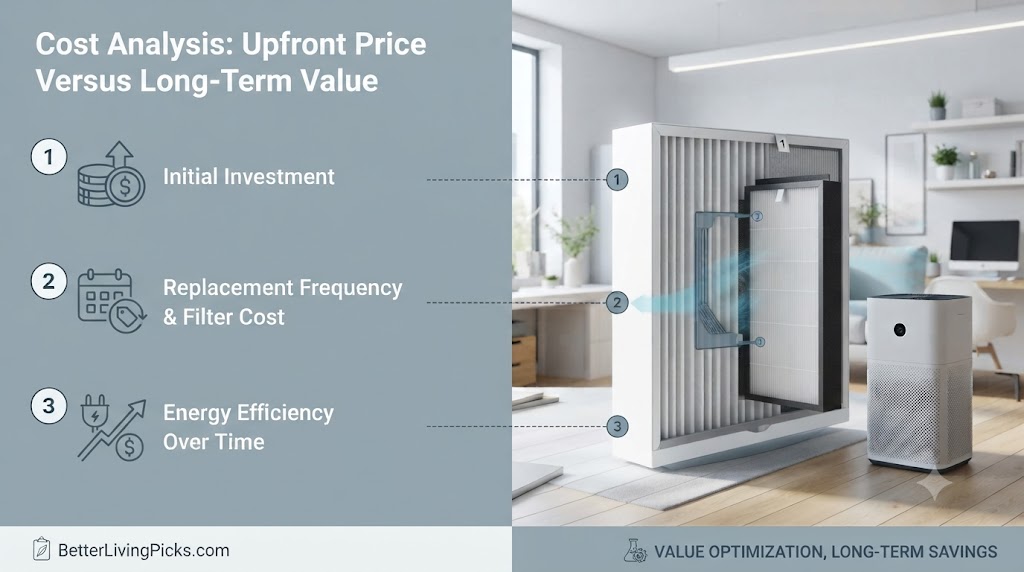
Replacement Frequency for Both Types
HEPA-type filters often cost half as much as certified True HEPA replacements down at the local home improvement store checkout. However, because they load up with large debris faster or let fine dust clog their inner layers unevenly, you often find yourself swapping them out much more frequently.
True HEPA filters hold their structural integrity and filtering capacity much longer under heavy daily dust loads.
Cheap synthetic filters tend to collapse or sag inward once they accumulate moderate amounts of moisture and dust. This structural deformation creates open bypass channels around the edges of the filter frame, completely nullifying even their modest 90% efficiency ratings and forcing an immediate replacement purchase.
Calculating the True Cost of Ownership
Buying cheap filters year-round adds up remarkably fast, especially if your indoor air quality does not actually improve and your allergy symptoms persist. Investing in a verified True HEPA filter means fewer annual replacement cycles and much better protection for your respiratory health.
When you factor in potential medical savings from reduced allergy flare-ups, doctor visits, and medication purchases, the True HEPA option easily pays for itself over time.
Breaking down the annual expenditure reveals that purchasing two high-quality True HEPA filters per year often costs less than buying four or five cheap synthetic replacements that degrade prematurely and require constant troubleshooting.
Evaluating Energy Consumption Costs
Because True HEPA filters demand more work from fan motors, some consumers worry about rising utility bills. In reality, the difference in electrical draw between running a standard fan versus a high-efficiency motor is negligible on a monthly utility statement.
Choosing a properly matched system ensures maximum filtration efficiency without triggering an unexpected spike in your household energy consumption.
Modern ECM and brushless fan motors adjust their torque automatically to maintain steady cubic feet per minute (CFM) output, meaning energy usage stays strictly optimized regardless of filter saturation levels.
Frequently Asked Questions
Can I wash and reuse a True HEPA filter?
Most True HEPA filters are made of delicate fiberglass and paper pleats that will dissolve or lose their structural integrity if washed with water. Always check the manufacturer manual, as vacuuming or washing usually ruins the filter unless it is specifically labeled as a washable permanent model.
Do HEPA filters remove odors and cooking smoke?
Standard HEPA filters trap physical particles like smoke ash, but they cannot capture gaseous odors, volatile organic compounds, or cooking smells. You need an additional activated carbon layer integrated into the filter assembly to neutralize household odors.
Are HEPA filters safe to use in home HVAC systems?
Installing a thick True HEPA filter into a standard residential furnace system can severely restrict airflow and damage your blower motor. Most standard HVAC systems can only safely handle up to a MERV 13 rating unless the ductwork was specifically engineered for HEPA filtration.
Why do some filters say “99% efficient” instead of 99.97%?
That missing 0.07% is the defining line between a marketing trick and a certified standard. Manufacturers use 99% claims when their product fails official laboratory testing for 0.3-micron capture efficiency, meaning it lets through nearly thirty times more particles than a true standard.
Do HEPA-type filters help with pet allergies at all?
They catch floating clumps of fur and heavy dander flakes that drop near the floor, which helps surface cleaning routines. However, they will not clear the microscopic pet dander proteins floating continuously in the breathing zone that trigger allergic reactions.
Final Thought
Choosing the right filter doesn’t have to be confusing once you look past catchy packaging labels. Sticking with certified True HEPA options ensures your air purifier actually removes the microscopic dust and allergens making you sneeze. Skip the loopholes, protect your indoor air, and breathe easier every single day.

