
Place the mirror directly opposite a window or a bright open doorway. Test the angle by holding a small mirror first to see exactly where the reflected light beam lands on your dark hallway wall.
2. Does mirror size change the brightness?
Yes, larger mirrors capture more light, but the angle is more important than size. A small mirror tilted perfectly will always outperform a giant, poorly positioned one that is just facing a blank wall.
3. How do I avoid distracting glare?
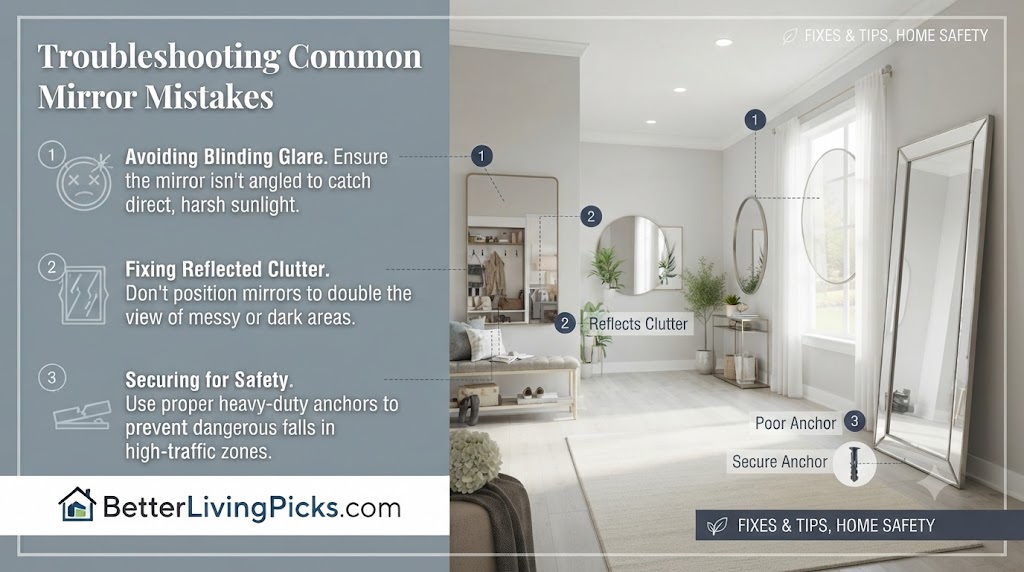
Avoid placing mirrors where they reflect direct, harsh sun rays, as this creates blinding glare. Instead, aim for ambient light—the soft, diffused glow that enters from windows, which spreads light evenly without irritation.
4. Is there a trick for long, narrow hallways?
Use a series of smaller mirrors staggered on opposite walls. This creates a “light relay” effect, bouncing the beam from one mirror to the next, effectively carrying the daylight much deeper into the hallway.
Most homes have that one hallway that feels like a tunnel. It stays dark regardless of how bright it is outside, making the entire house feel smaller and gloomier than it actually is.
You don’t need to knock down walls or add expensive skylights to brighten up these forgotten spaces. By using mirrors as a tactical tool to redirect existing natural light, you can completely change the atmosphere of your home for just a few dollars.
The Physics of Light Reflection in Your Home
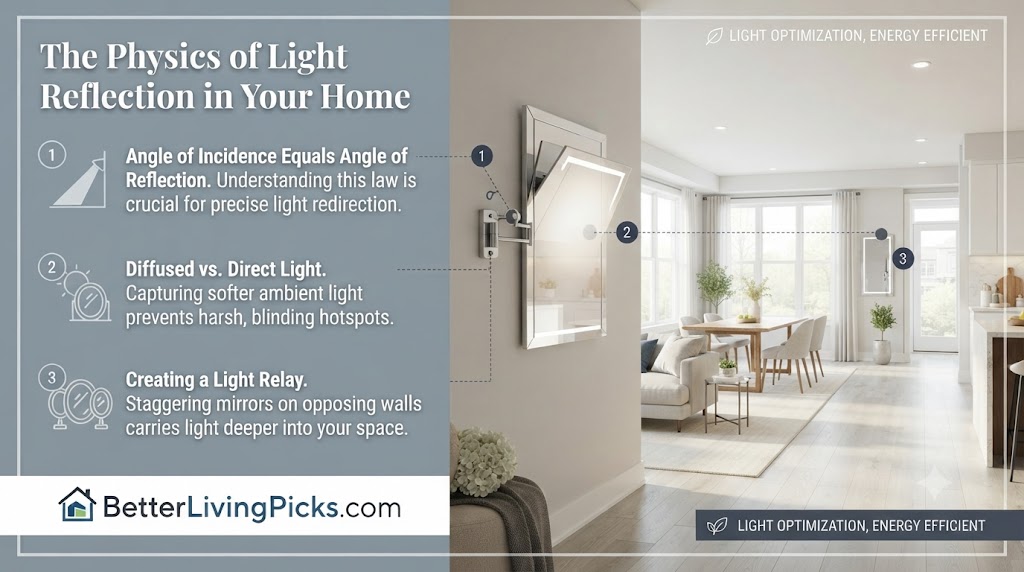
To effectively brighten a hallway, you must understand how light moves. Light is a wave, and when it strikes a smooth, reflective surface, it follows the law of reflection. This means the angle of incidence equals the angle of reflection.
If you place a mirror flat against a wall, it will only capture light that is directly parallel to the wall’s surface or hitting it from a narrow angle. To “throw” light into a dark space, you are essentially aiming a flashlight beam, but using the sun as your bulb.
Understanding Angles of Incidence
Most people hang mirrors simply to look at themselves. When you are using mirrors for illumination, your mindset must shift from vanity to geometry. Go to your hallway during the brightest part of the day and look toward the nearest light source.
If you cannot see the window from the hallway, you need the mirror to act as a bridge. Imagine you are playing billiards. You want to hit the “cushion” (your mirror) so the light (the ball) banks into the “pocket” (the dark hallway). If you mount a mirror perfectly flat, you may be missing the light beam entirely. You might need a wall-mounted mirror with an adjustable arm or a small shim behind one edge to tilt it just enough to catch the incoming light.
Why Mirror Size Matters More Than You Think
There is a common misconception that a larger mirror always equals more light. While a massive, floor-to-ceiling mirror certainly has a higher potential to capture light, it also carries the risk of overwhelming a narrow hallway.
When you place a mirror in a cramped space, it can create a “funhouse” effect, where the depth perception feels off, making residents dizzy or uncomfortable. For light redirection, focus on placement over surface area. A medium-sized, high-quality mirror placed at the perfect height will move more light than a poorly positioned oversized one. If you have a narrow hallway, stick to slimmer, vertical mirrors. They bounce enough light to make a difference without making the hallway feel even more claustrophobic.
Choosing the Right Mirrors for Maximum Impact
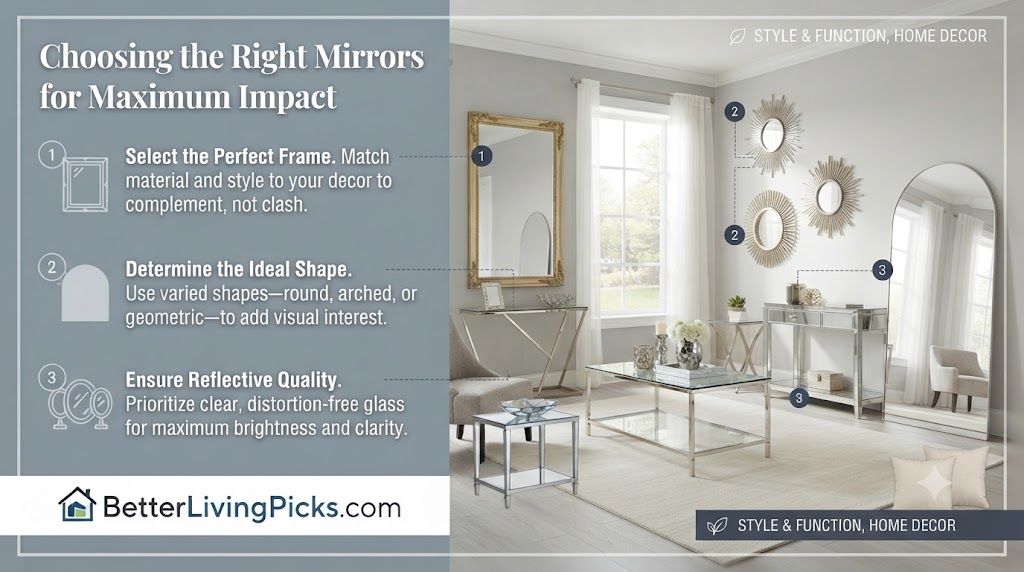
Selecting the right glass is just as important as where you hang it. Not all mirrors are created equal, and the wrong choice can actually dim your efforts.
Flat vs. Beveled Mirrors: What Works Better?
Flat, non-beveled mirrors are your best friend for this project. They provide a crisp, direct reflection that moves light efficiently from point A to point B.
Beveled mirrors have edges that are cut at an angle. While they offer a more sophisticated, decorative look, the beveled edge actually acts like a prism. It scatters the incoming light, causing it to disperse rather than focusing it into your dark hallway. If your primary goal is pure, functional brightness, stick to flat, non-beveled edges. You can always opt for a stylish frame to add the aesthetic value you want without sacrificing the utility of the glass.
Placement Factors: Avoiding Glare and Hotspots
Brightness is the goal, but “glare” is the enemy. If your mirror catches direct, high-noon sunlight, it will create a “hotspot”, a single, blindingly bright patch on your floor or wall that is actually difficult to look at.
Instead, aim to capture diffused light. This is the light that hits your room after passing through thin curtains or bouncing off off-white walls. It is much softer and spreads out more evenly. If you find your mirror is creating an irritating glare, move it just an inch or two to the left or right, or tilt it slightly downward. Even a minor adjustment changes the entire feel of the room from “blinding” to “glowing.”
The Importance of Backing and Quality
Always check the silvering on the back of the mirror. Cheap, mass-produced mirrors often have thin silvering that degrades over time, leading to dark spots or a hazy, yellowed reflection.
In a hallway where you are relying on the mirror to act as a primary light source, those dark spots will become very obvious. Invest in a high-quality glass mirror with a thick silver coating. It will last longer, provide a clearer reflection, and do a significantly better job at maximizing the amount of light that actually enters the dark zone.
Step-by-Step: Bouncing Light into Your Dark Hallway
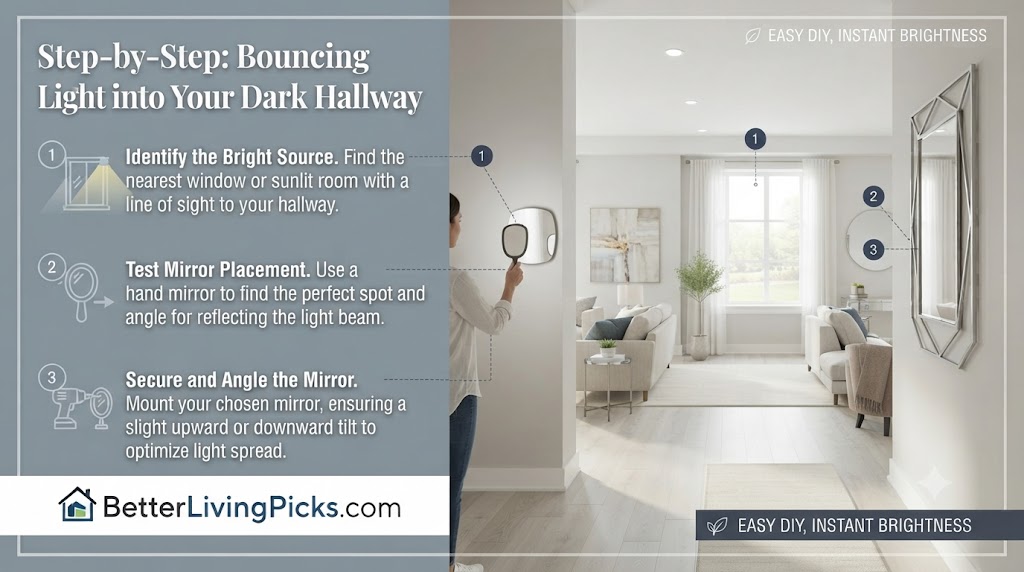
This project requires patience. Don’t go drilling holes in your walls until you have tested the light movement throughout the entire day.
Mapping Your Light Source
- Identify the brightest window that has a line of sight to the hallway opening.
- Use a piece of painter’s tape to mark the spot on the wall where you think the mirror should go.
- Grab a hand mirror and stand where you plan to mount the final mirror. Tilt it until you see the window in the reflection and the beam hits the dark wall at the end of the hall.
Testing Positions Before Drilling
Hold the mirror in that spot for 30 minutes while the sun moves. You want to see if the reflected light stays on the hallway wall or if it shifts too quickly as the sun moves across the sky.
If the light leaves your target area within 10 minutes, you need to adjust the mirror’s angle or choose a different wall. A slight tilt toward the ceiling often helps keep the light beam active for longer periods during the day, as the sun travels from east to west.
Securing Mirrors Safely
Most people make the mistake of using standard picture-hanging hardware for heavy mirrors. Don’t do it. Mirrors are heavy, and if they fall, the shattered glass creates a dangerous mess.
- Use heavy-duty wall anchors: Always check the weight rating on the package and buy one size up.
- Double-check the level: Even a slightly crooked mirror will look obvious in a narrow hallway because the light beam will be skewed to the side.
- Consider adhesive strips: For lighter decorative mirrors, high-quality, heavy-duty Command strips are a life-saver, especially if you’re in a rental and can’t put holes in the walls. Just ensure you clean the wall with rubbing alcohol first to maximize the bond.
Troubleshooting Common Mirror Mistakes
Even with a perfect setup, you might run into issues. These are the most common headaches and how to fix them quickly.
Fixing “Dead Zones” in the Reflection
If you have a mirror up but the hallway still feels “off,” it’s likely reflecting a dark piece of furniture or a blank, non-reflective wall. A mirror only reflects what it sees. If it sees a dark, unlit corner, it will simply double that darkness.
Try repositioning the mirror to face a doorway that leads to a brighter room or a window. You will be surprised at how much extra ambient light that pulls in. If you cannot move the mirror, try changing what is in front of it. Placing a bright, colorful piece of art or a lighter-colored console table in front of the mirror’s “view” will make the reflected light appear warmer and brighter.
Avoiding Distortion in Long Hallways
In very long, narrow hallways, a single mirror often isn’t enough. It will just bounce the light to one spot and then the light “dies.” This is where the “light relay” comes in.
Place one mirror at the entrance and a second mirror further down on the opposite wall. The first mirror hits the second, and the second bounces the light down the rest of the hall. It’s a game of geometry, but it is the only way to light up a long, dark stretch without running new electrical lines. You may need to angle these carefully to ensure the light doesn’t just hit the opposing wall and stay there.
Managing Reflections of Yourself
Sometimes, a mirror placed for light will end up catching your reflection every time you walk down the hall. If this is distracting or just plain weird, it means your angle is too direct. A slight upward tilt will push the light into the hallway while directing the mirror’s reflection toward the ceiling, where you don’t have to look at it constantly.
Advanced Techniques for Brighter Hallways
If you have mastered the basics and want to push the brightness further, try these advanced strategies.
Combining Mirrors with Reflective Decor
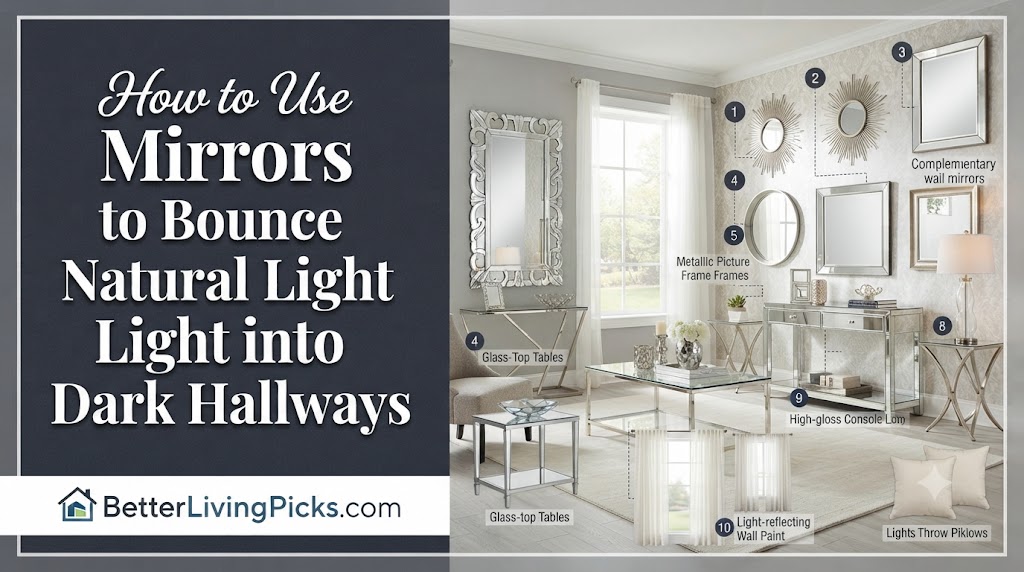
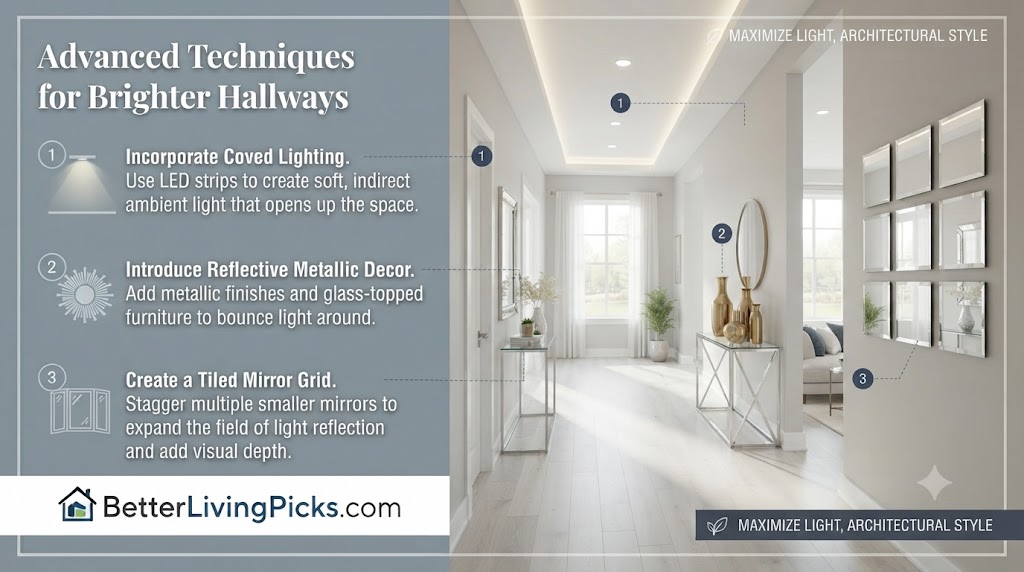
Mirrors are not the only things that can bounce light. If you have a mirror in your hallway, try adding other reflective surfaces around it. Think of glass-topped tables, metallic picture frames, or glossy light fixtures. These elements act as “secondary reflectors,” catching the light that the mirror has bounced into the room and spreading it further.
Painting the Opposite Wall
If you want your mirror to work twice as hard, paint the wall it is reflecting a lighter, reflective color. A high-gloss or semi-gloss white paint will capture the reflected light from the mirror and disperse it throughout the hallway. A matte paint will absorb the light, effectively killing the progress you made with your mirror. By pairing a light-colored wall with a well-placed mirror, you create a feedback loop of illumination.
Using Mirror Sets
Instead of one large mirror, try a grid of smaller square mirrors. This is particularly popular in modern interior design. By tiling these mirrors, you can slightly tilt each one to aim at different parts of the hallway. This covers more ground and ensures that as the sun moves throughout the day, at least one of the mirrors is always capturing light.
Frequently Asked Questions
Can I use multiple small mirrors instead of one big one?
Yes, and it often looks better. A gallery wall of smaller, varied mirrors can be just as effective as one large mirror at moving light around. Plus, it’s easier to adjust the angles of individual small mirrors to catch light from different sources throughout the day.
Does the frame of the mirror affect light reflection?
Yes, bulky, dark, or ornate frames can absorb light or create shadows around the edges. If your goal is maximum brightness, choose a frameless mirror or one with a very thin, metallic, or reflective frame. This keeps the focus on the glass and avoids adding “visual weight” to the hallway.
Will a mirror make a small hallway look cluttered?
It depends on what it is reflecting. If the mirror is reflecting a cluttered entryway or a pile of shoes, it will double the clutter and make the space feel chaotic. Keep the area being reflected neat, and the mirror will make the space feel open, airy, and twice as large.
What is the best height to hang a hallway mirror?
Aim for eye level. If you are standing in the hallway, the center of the mirror should be about 57 to 60 inches from the floor. This is the standard gallery height, and it usually aligns perfectly with incoming window light, ensuring the reflection isn’t hitting the floor or the ceiling unnecessarily.
Can I use mirrors in a hallway with zero natural light?
Mirrors need a light source to reflect. If there is absolutely no natural light in your hallway, a mirror will only reflect the artificial light from your ceiling fixtures. While it will make the space look slightly brighter, it won’t have the same “natural” effect as reflecting daylight. Consider adding a small LED wall sconce opposite the mirror to amplify that light.
How often should I clean the mirrors for best results?
Dust is the enemy of reflection. A hazy, dusty mirror will absorb light instead of bouncing it. Wipe your mirrors down with a streak-free glass cleaner at least once a month. If you notice the hallway looking dim, a quick wipe with a microfiber cloth is often all you need to restore the shine.
Brighten Your Path
Using mirrors to capture natural light is one of the most rewarding low-cost home improvements you can make. It takes a little bit of trial and error to find the sweet spot, but once you nail that angle, your home will feel completely different. Stop walking through dark tunnels in your own house and start playing with the light, you’ll be surprised at how much brighter your day-to-day life feels.

