
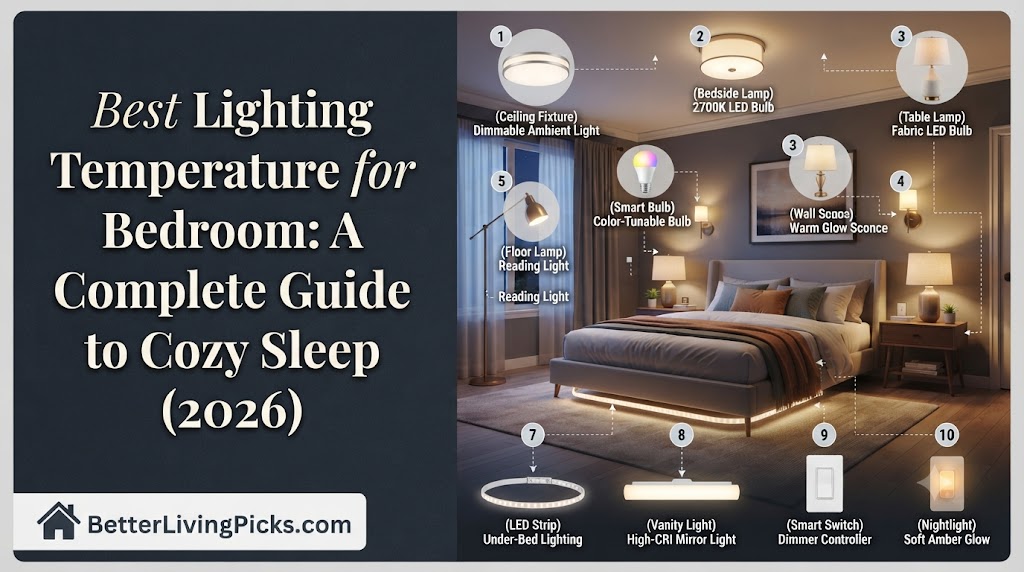
The absolute sweet spot for a cozy bedroom is 2700K (Warm White). This temperature mimics the soft, golden glow of a traditional incandescent bulb, which promotes relaxation and prevents sleep disruption.
2. Should I use 2700K or 3000K?
Go with 2700K if your goal is maximum comfort and “coziness.” Choose 3000K if you prefer a slightly crisper, modern look that still feels warm but provides better clarity for reading or grooming tasks.
3. Why avoid “Daylight” bulbs in the bedroom?
Avoid 5000K+ (Daylight) bulbs because they emit high levels of blue light. This tricks your brain into thinking it is still daytime, suppressing melatonin production and making it significantly harder to fall asleep.
4. Can I mix different color temperatures?
Avoid mixing temperatures in the same room. Using one 2700K lamp next to a 4000K overhead light creates a jarring, unbalanced aesthetic that makes the space feel messy rather than intentional and relaxing.
Have you ever walked into your bedroom, flipped the light switch, and felt like you just stepped into a sterile doctor’s office? That harsh, blinding glare is the fastest way to kill the mood and wake up your brain when you should be winding down. Most people don’t realize that the bulb in the socket is doing more than just illuminating the room, it’s actively working against your body’s natural rhythm, suppressing your internal cues for rest.
Choosing the right color temperature isn’t just about design aesthetics; it’s about signaling to your brain that it’s time to transition from the chaos of the day to the peace of the night. If you’ve been dealing with “hospital lighting” at home, you aren’t alone. It’s a common mistake, but it’s an easy one to fix once you understand how the Kelvin scale works and how to manipulate light to create a genuinely restorative environment.
Understanding Kelvin: Why Lower is Usually Better for Sleep
How the Kelvin Scale Works
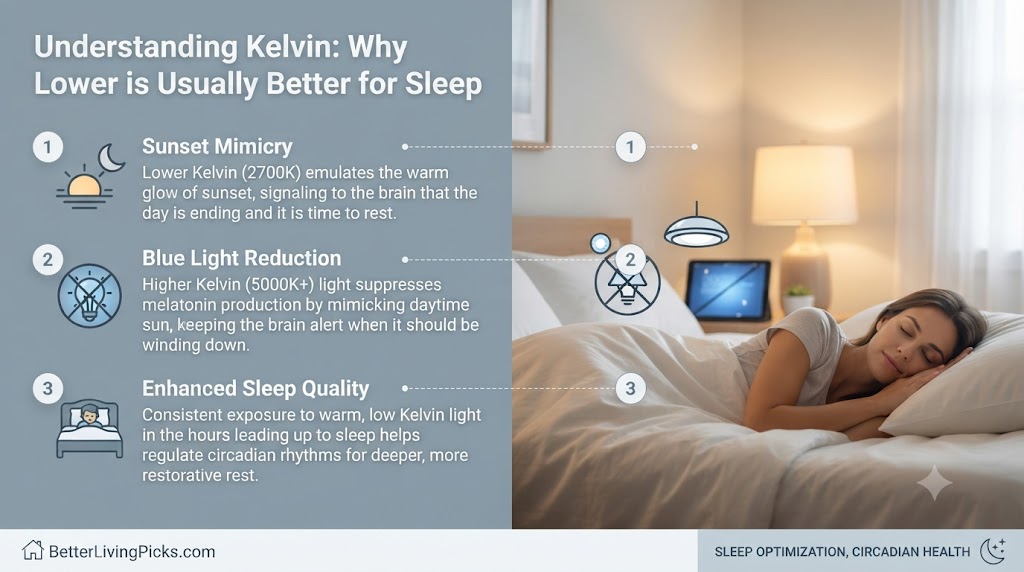
To master bedroom lighting, you have to stop thinking about brightness and start thinking about “color heat.” The Kelvin (K) scale is used to measure the color temperature of light. The lower the number, the warmer and more orange-red the light appears. The higher the number, the closer the light moves toward blue and white.
It is common to confuse “bright” with “blue.” A 5000K bulb isn’t necessarily brighter than a 2700K bulb; it is simply “cooler” in tone. Understanding this scale is the first step in reclaiming control over your bedroom environment. When you look at the packaging for a light bulb, always look for the Kelvin rating rather than just the lumen (brightness) count.
The Biological Impact of Blue Light
Our bodies are hardwired to associate the spectrum of the midday sun with alertness. High Kelvin light, anything above 4000K contains a significant amount of blue light. In nature, blue light signals to our biological clock that the sun is high in the sky and it is time to be active.
When you bathe your room in this light at 10:00 PM, you are effectively telling your brain to stop producing melatonin. This is the hormone that signals to your body that it is time to wind down. Suppressing this hormone doesn’t just make it harder to fall asleep; it degrades the quality of your REM sleep. Even if you “eventually” fall asleep, your body may struggle to reach the deeper stages of rest because your hormonal signals were blocked by a simple light bulb.
The Battle of the Temperatures: 2700K vs 3000K
Why 2700K (Warm White) Wins for Cozy Spaces
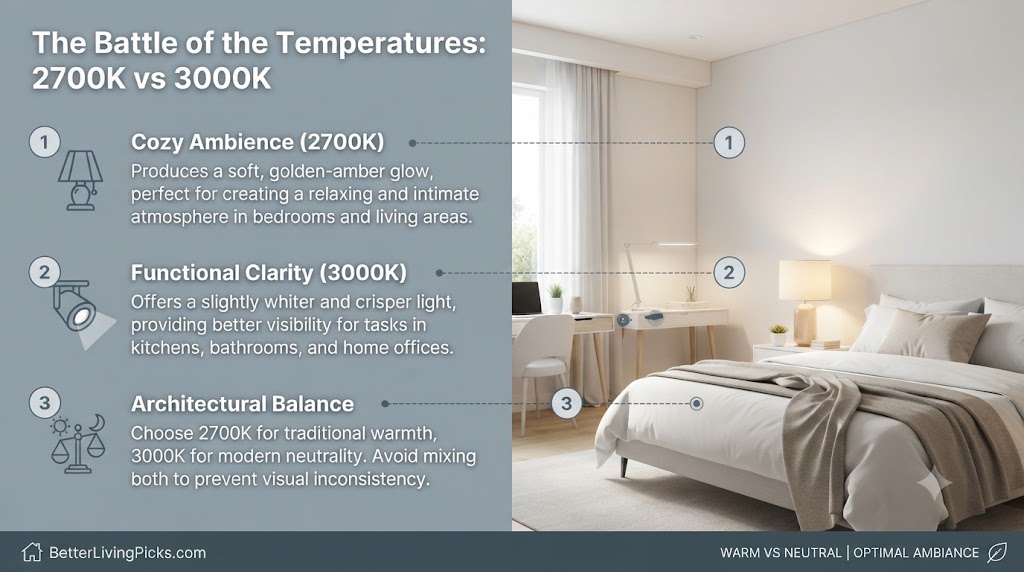
2700K is considered the residential gold standard for bedrooms. This temperature perfectly replicates the glow of old-school incandescent bulbs. This quality is vital for a bedroom because it softens harsh edges.
Think about how wood, fabrics, and skin look under a sunset. That is effectively 2700K. It makes textures look richer and hides imperfections on walls or furniture. If your primary goal is to create a sanctuary where you can escape the stress of the day, 2700K is the safest and most effective choice. It feels welcoming, intimate, and profoundly calm.
Where 3000K (Soft White) Might Actually Fit
3000K is often described as “Soft White.” It is just a tiny bit cooler than 2700K, which gives it a slightly more modern, neutral appearance. If your bedroom is decorated in cool tones, think light grays, blues, or stark white minimalism, a 2700K bulb might actually look too yellow or “dirty” against those colors.
In these specific modern spaces, 3000K bridges the gap. It keeps the room feeling bright and clear without sliding into that clinical, hospital-like feel of a 4000K bulb. It provides better visibility for things like choosing clothes, reading, or applying skincare, while still maintaining enough warmth to be acceptable for a bedroom setting.
Avoiding Common Bedroom Lighting Mistakes
The Problem with Mix-and-Matching Temperatures
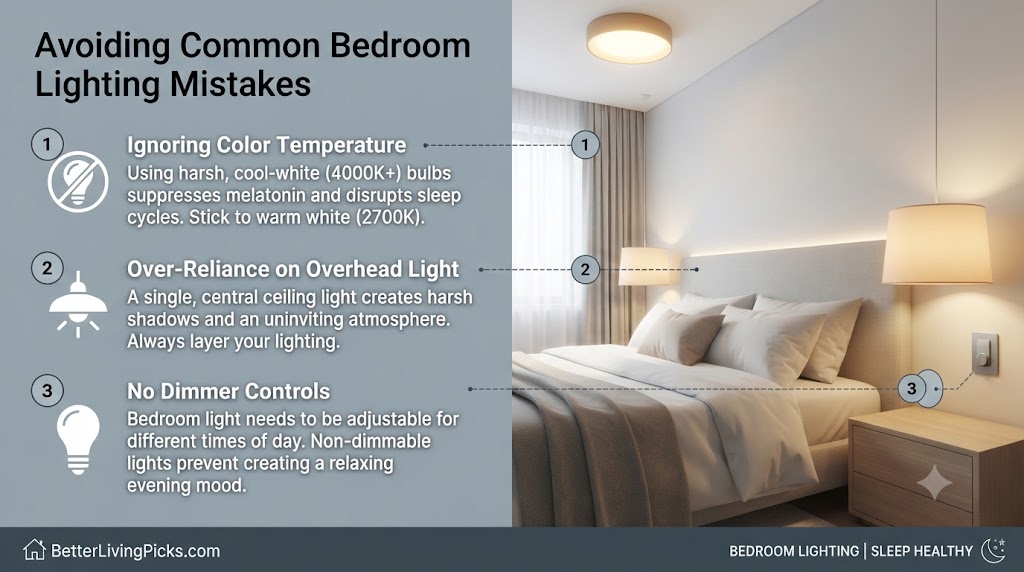
One of the most frequent mistakes I see in home design is the “temperature mismatch.” This happens when someone puts a warm bedside lamp next to an overhead light that is a cool, daylight blue.
Your eyes are incredibly sensitive to these differences. When you have two different light sources in the same room with different Kelvin temperatures, the brain becomes distracted. The room feels “off” or cluttered, even if the furniture itself is arranged perfectly. It is impossible to achieve a truly relaxing environment if your lighting is fighting itself. Always choose a single temperature for the room and stick to it across all fixtures.
Why You Should Ditch the “Daylight” Bulbs
Daylight bulbs, often labeled as 5000K or 6500K, have their place. They are excellent in garages, basements, or dedicated home offices where you need extreme clarity. They are a total disaster in the bedroom.
These bulbs wash out colors, make wood furniture look flat and lifeless, and most importantly, mthey keep your brain wired. Using daylight bulbs in a bedroom is essentially the architectural equivalent of drinking a double espresso right before bed. If you have these currently installed, the single most impactful change you can make to your sleep quality is swapping them out for 2700K or 3000K alternatives immediately.
The Over-Reliance on Overhead Lighting
Many bedrooms are built with a single, central light fixture on the ceiling. Using this as your primary light source is almost always a mistake because it creates unflattering, harsh shadows from above. Instead, focus on “low-level” lighting. Think about lamps on nightstands or floor lamps that hit the room at eye level or below. This softer light distribution is significantly more relaxing.
How to Layer Lighting for a Cozy Atmosphere
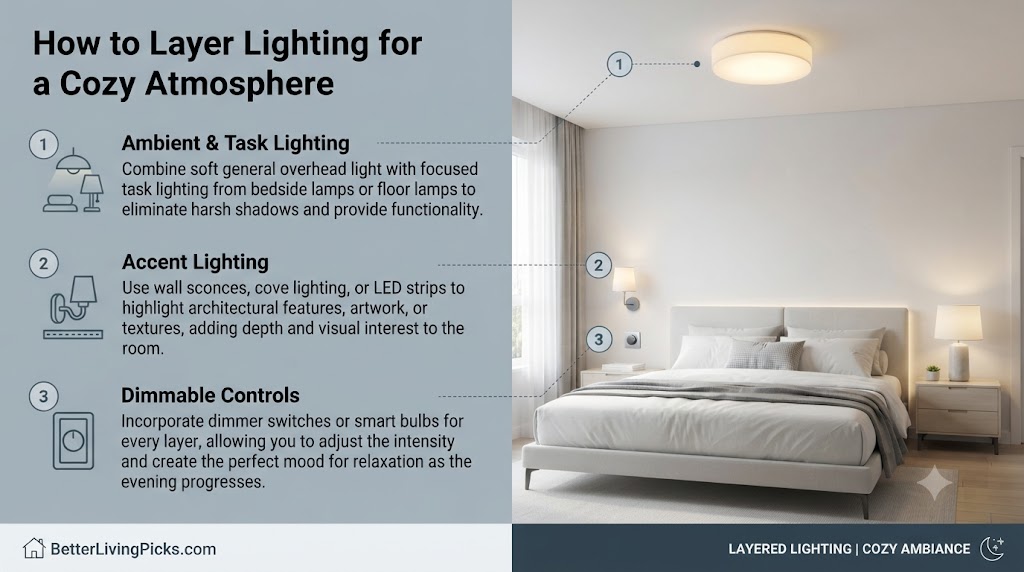
Ambient, Task, and Accent Lighting Basics
You shouldn’t rely on just one type of light. To make a bedroom truly feel like a hotel suite, you need to use three distinct layers:
- Ambient Lighting: This is your general “fill” light. It should be soft and even, ideally provided by a dimmable ceiling fixture or indirect wall sconce set at a low intensity.
- Task Lighting: This is focused light for specific jobs. Think reading lamps on the bedside table or a dedicated light for a vanity or desk. These should be adjustable so you don’t keep your partner awake while you read.
- Accent Lighting: This is about mood and visual interest. LED strips hidden behind a headboard or under a bed frame provide a subtle glow that defines the room’s architecture without being distracting.
By separating these layers, you can control the room’s mood. You can keep just the accent lights on while getting ready for bed, or use all three while cleaning or organizing.
The Importance of Dimmable Bulbs
Even if you have the perfect 2700K bulb, it might be too intense during those late-night hours. Dimmability is not a luxury; it is a necessity for a bedroom.
If your current fixtures aren’t dimmable, look for “dimmable LED” bulbs that work with your existing switch, or invest in a smart dimmer switch. Being able to lower your light output by 30% to 50% as you approach your bedtime ritual helps your eyes adjust and cues your body that the day is ending. This simple transition is often the missing link in a solid nighttime routine.
Choosing the Right Bulb Type (LED vs. Incandescent)
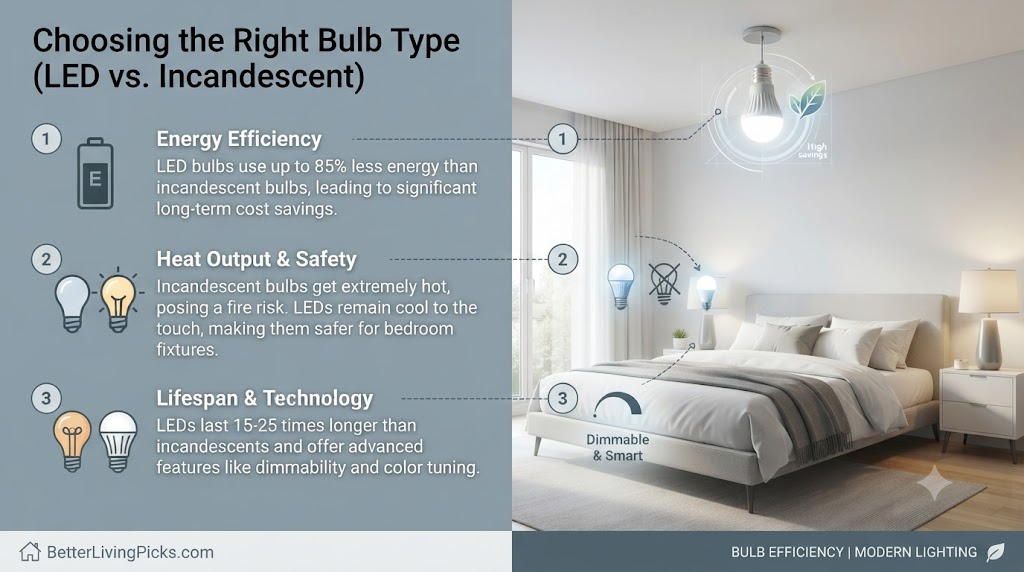
Energy Efficiency vs. Light Quality
For years, people avoided LEDs because the early versions were cold, blue, and flickered. That era is long gone. Modern LED bulbs are now superior to the old incandescent options in almost every metric.
The biggest advantage is the consistency of color temperature. Old incandescents would shift in color as they aged or as you dimmed them. High-quality LED bulbs hold their color temperature stable. When shopping, look for two things:
- Kelvin Rating: Explicitly stated as 2700K or 3000K.
- CRI (Color Rendering Index): Try to find bulbs with a CRI of 90+. This ensures that your skin tones and furniture colors look vibrant and accurate, rather than gray or washed out.
The Rise of “Warm Dim” Technology
If you really love the way old light bulbs would turn deep orange/red when dimmed, look for LED bulbs labeled “Warm Dim.” These are specifically engineered to drop in color temperature as you dim them. They start at 2700K at full brightness and shift down to 2200K (a deep, sunset gold) when dimmed low. This is the absolute peak of bedroom lighting, offering both functionality and deep, cozy ambiance.
Frequently Asked Questions
What does “CRI” mean, and does it matter for my bedroom?
CRI stands for Color Rendering Index. It is a scale from 0 to 100 that measures how accurately a light source reveals the true colors of objects. A low CRI makes everything look dull, grey, or slightly “off.” In a bedroom, you want a CRI of 90 or higher. This makes sure your bedding, decor, and skin look natural and warm, which is essential for feeling comfortable in your private space.
Can I use smart bulbs to change the temperature?
Yes, smart bulbs are arguably the best investment you can make for a bedroom. They allow you to schedule your lighting so that it is bright and crisp during the morning hours (to help you wake up) and gradually shifts to a very warm, dim 2200K glow as the night progresses. This supports your circadian rhythm far better than any static light bulb ever could.
Do I need to match the Kelvin of my bedside lamps to my ceiling light?
Yes, it is highly recommended. Mixing different light temperatures creates visual tension. Even if both lights are technically “warm,” a 2700K bulb will look very different next to a 3000K bulb. The slight discrepancy will be obvious to your eye and will make the room feel disjointed. Pick one temperature and standardize your entire room around it.
Is “Warm White” the same thing as 2700K?
Most of the time, yes. “Warm White” is a marketing term used by manufacturers to describe the 2700K-3000K range. However, it is not a technical standard. Two different brands might label their bulbs as “Warm White,” but one might be 2700K and the other might be 3000K. Always check the physical box for the specific Kelvin number printed on the back before you finalize your purchase.
Why does my room look “yellow” with 2700K bulbs?
If your room feels excessively yellow or “muddy,” it is usually a reflection of the room’s color palette. If your walls are painted a warm cream or tan, 2700K light will bounce off those walls and intensify the yellow tones. If this bothers you, you are a perfect candidate for 3000K bulbs, which will provide a cleaner, more neutral appearance while still staying within that cozy, low-Kelvin range.
What is the most common mistake people make with bedroom lighting?
The single most common mistake is relying on a single, harsh, overhead light source. Bedroom lighting should be layered and positioned at various heights. When you only use a ceiling light, you create deep, unflattering shadows and an atmosphere that feels more like an interrogation room than a bedroom. Always supplement overhead light with task and accent lights placed at eye level.
Creating Your Perfect Sanctuary
Getting the lighting right in your bedroom is one of the easiest and most cost-effective ways to improve your daily routine. By switching to 2700K bulbs and focusing on layered, dimmable light, you transform a place where you just “go to sleep” into a space where you actually want to spend time to unwind.
Don’t be afraid to experiment with different lamp placements to see what creates the best atmosphere in your specific layout. Once you get that warm, soft glow dialed in, you’ll wonder why you ever lived with that harsh, blue-tinted overhead lighting for so long. Remember, your bedroom is your retreat, treat the lighting with the same level of care you give to your mattress or your bedding.

