
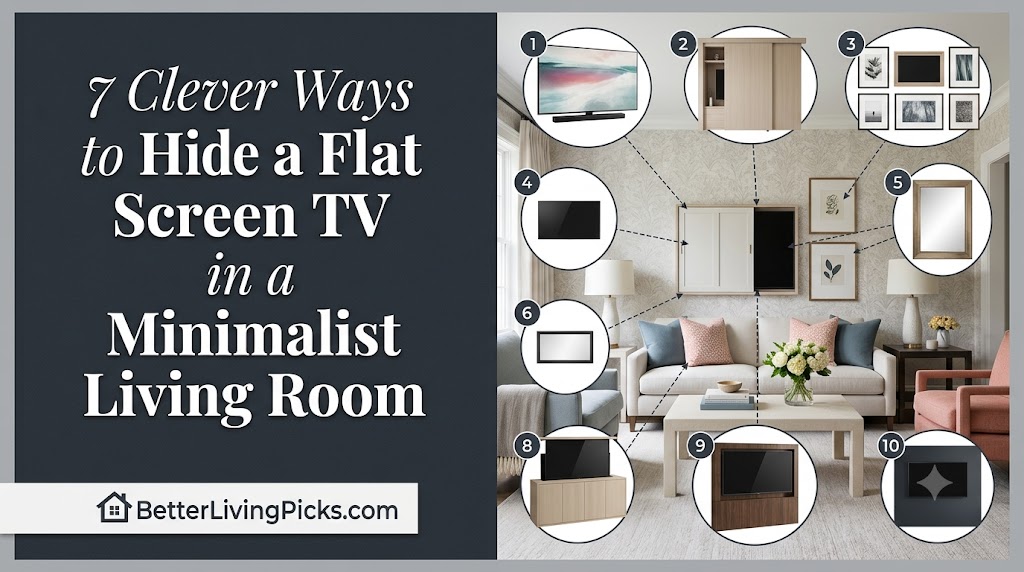
Walking into a room that feels serene, intentional, and organized is one of the greatest joys of home design. Then, you look at the focal wall and see a giant, black glass rectangle staring back at you. That TV screen is often a major mood killer for a minimalist space, disrupting the visual flow and drawing all the energy away from your carefully curated decor. It creates a “black hole” effect that screams technology in an otherwise quiet, peaceful environment.
Custom cabinetry with pocket doors remains the gold standard. It allows you to completely enclose the TV and media components behind a flush wall surface, maintaining a perfectly clean minimalist line.
Yes, you can use sliding wall panels or art-mode TVs. These options allow you to mask the black screen with fine art, making the television look like a deliberate design choice.
Paint the wall behind your TV a dark, moody charcoal or matte navy. This drastically reduces the contrast between the screen and the wall, helping the TV blend into the background.
Ventilation is essential. Electronics generate significant heat; ensure your cabinet or enclosure has adequate airflow, or you risk damaging your components and shortening the lifespan of your television.
The good news is that you don’t have to sacrifice your entertainment to maintain your aesthetic standards. Achieving a high-end, minimalist look doesn’t mean your TV has to disappear entirely, but it does require a bit of strategy. Hiding a TV isn’t about massive, expensive renovations or building secret rooms. It’s about leveraging clever design tricks and spatial awareness to make your tech work for your room, not against it. In the following sections, we will break down exactly how to hide, camouflage, or integrate your TV so you can reclaim your living room’s tranquility.
1. The Art of Camouflage: Integrating with Gallery Walls
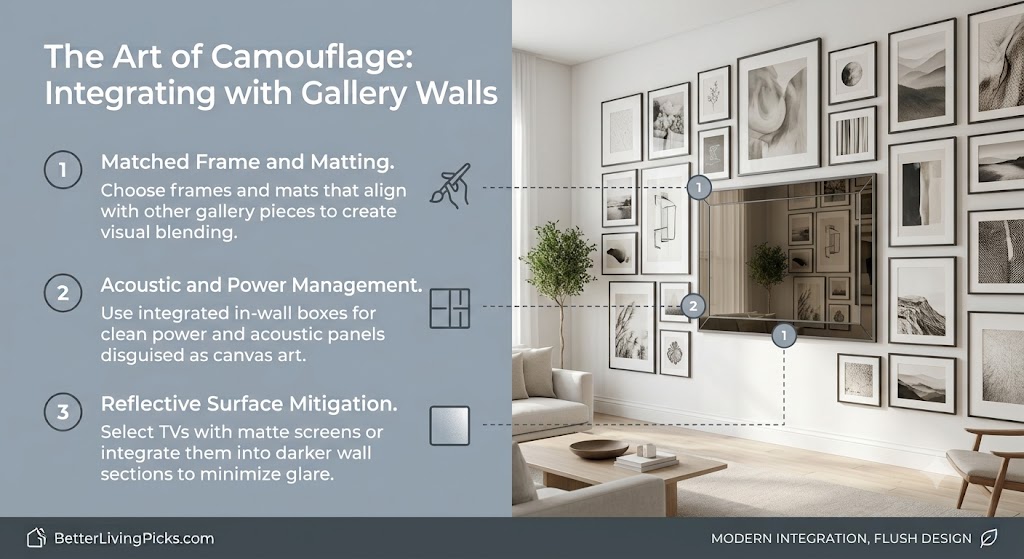
When you cannot hide the TV behind a door or a panel, you must change how it is perceived. In minimalist design, a standalone black rectangle is an eyesore. However, when treated as part of a curated arrangement, it becomes an anchor.
The “Gallery Wall” approach is highly effective if done with restraint. Instead of letting the TV be the only focal point, surround it with framed prints, sketches, or abstract photography that feature black frames. By creating a cluster, your eye doesn’t just rest on the screen it travels across the entire composition.
- Choose dark art: Incorporate pieces with deep tones so the TV doesn’t stand out as the darkest element in the room.
- Mind the spacing: Keep the spacing between frames tight to maintain a clean, modern aesthetic.
- Uniformity is key: Use identical black frames for every piece to ensure the wall feels cohesive rather than cluttered.
Avoid the temptation to fill every inch of space. Minimalism is about the “negative space” as much as it is about the objects. If you have too much happening on the wall, you’ve simply swapped one type of visual clutter for another.
2. Custom Cabinetry with Pocket Doors
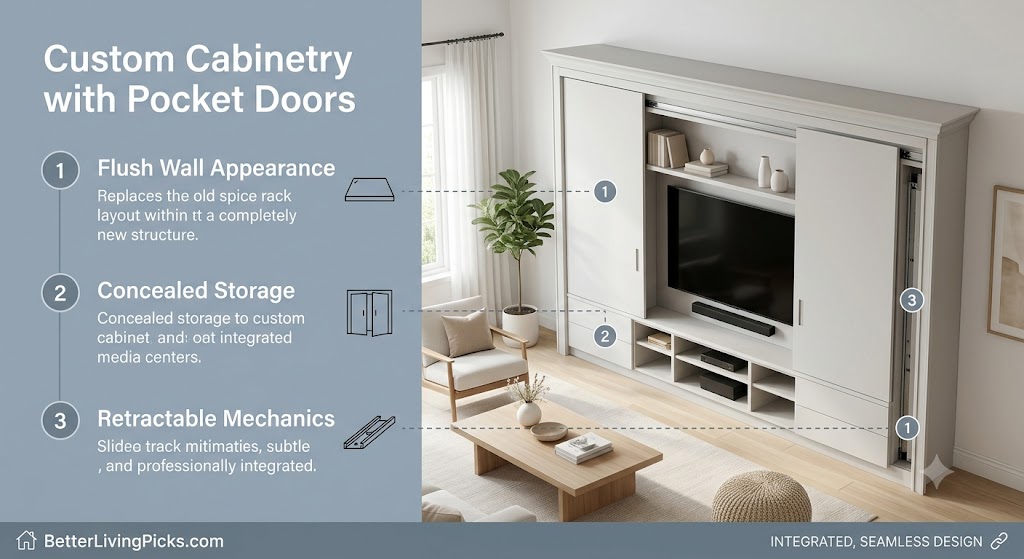
For the ultimate minimalist, nothing beats the power of a “hidden wall.” Custom cabinetry that runs the length of a wall can store your TV, soundbar, and streaming boxes, all while looking like a high-end feature wall.
The secret here is the hardware: pocket doors. Unlike standard swinging doors, pocket doors slide back into the sides of the cabinet frame. When you want to watch a movie, you slide them in; when the TV is off, you pull them out and close them. The result is a seamless transition between a “media room” and a “living room.”
- Avoid visible handles: Use touch-latch mechanisms so the cabinet surface remains completely flat.
- Depth considerations: You need at least 14 inches of interior depth. This covers the TV mount extension, the unit itself, and the necessary breathing room for airflow.
- Material selection: Choose a finish that matches your wall color to make the cabinet feel like part of the architecture itself.
One common mistake is trying to save money on the door tracks. If you use cheap hardware, the doors will get stuck or sag over time. Invest in high-quality ball-bearing slides to ensure the doors glide smoothly every single time.
3. Motorized Art Lifts and Rolling Panels
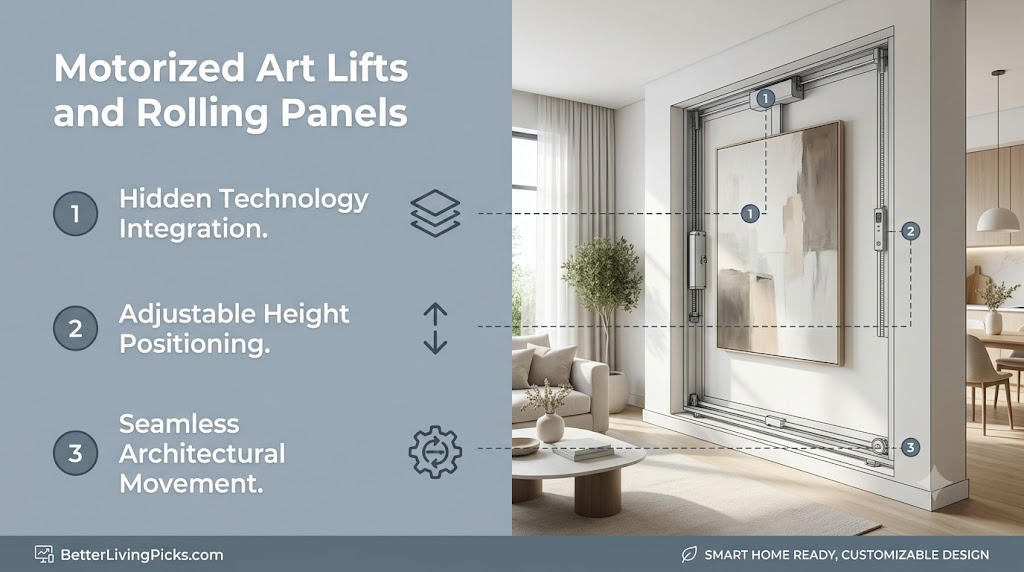
If you love the idea of hidden tech but don’t want a massive cabinet, look into motorized wall solutions. This is where high-tech meets high-design.
You can purchase or build a track system where a physical piece of art or a decorative panel sits over the TV. With a simple remote or a smart-home integration, the panel either slides to the side, rolls up, or drops down to reveal the screen.
- Rolling panels: These are great for wall-mounted TVs. You can use a lightweight, high-quality print on canvas to act as the “door.”
- Motorized lifts: These are built into console tables. The TV sits inside the unit, and with a press of a button, it rises up. This is perfect for rooms where you don’t want to drill into the wall or cover your wall-space with art.
Real-world challenge: Wiring. A motorized lift requires a power source inside your console. Make sure you plan your electrical outlets behind the furniture piece before you finish your floors or walls. Having an ugly extension cord running across the floor defeats the entire purpose of a minimalist upgrade.
4. Low-Profile Media Consoles with Hidden Compartments
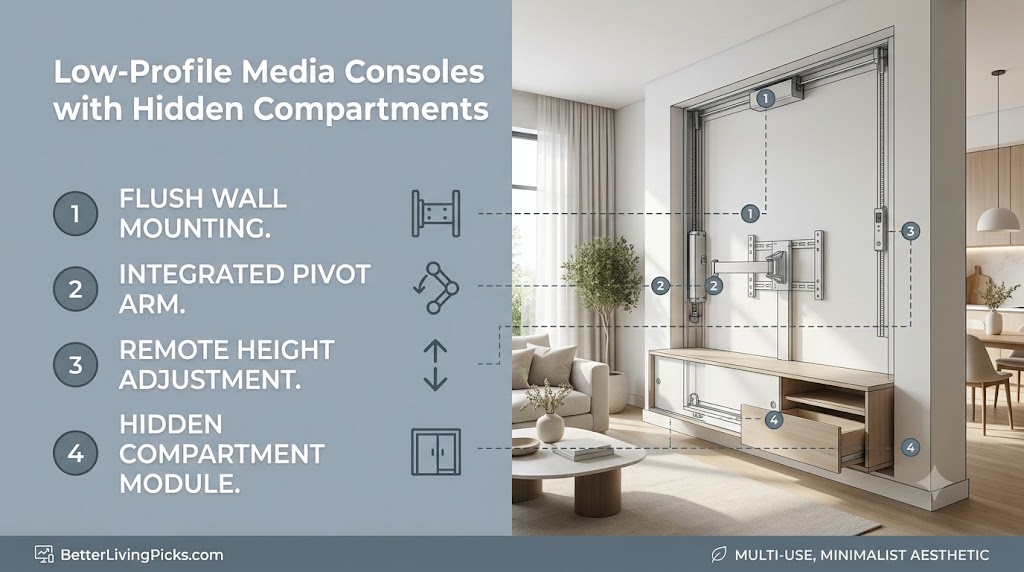
Minimalist furniture is all about silhouette. Many media consoles fail because they have open shelving, which displays all your wires and devices. This is the opposite of a minimalist aesthetic.
Look for a solid-wood or matte-finish sideboard that features closed storage. The best designs have “IR repeater” compatibility, which allows your remote signals to pass through the solid doors so you don’t have to keep them open to control your devices.
- The “Floating” Look: A wall-mounted, floating console is the ultimate minimalist hack. It creates a lighter visual footprint in the room by leaving the floor visible underneath.
- Cable management: Use a console that has a built-in cable spine. You want one entry point at the wall and one exit point at the TV, with everything else hidden inside the furniture cavity.
If you struggle with mess, use simple Velcro cable ties to bundle your HDMI and power cords. Never leave them loose. The cleaner the interior of your console, the less likely you are to have “tech creep,” where gadgets slowly start appearing on top of your furniture.
5. Smart Screen Technology: The “Frame” Approach
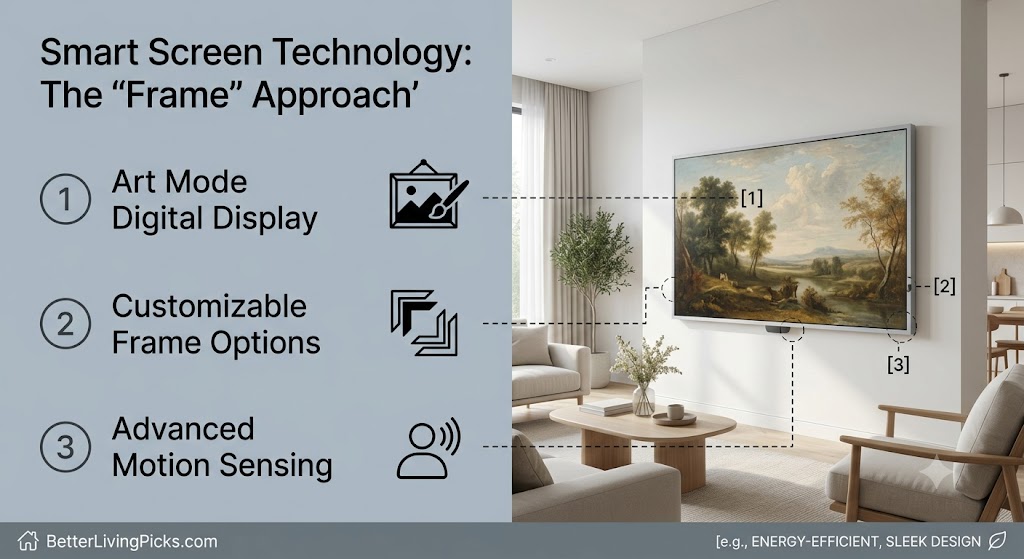
Sometimes, the best way to hide a TV is to change its identity. In the last few years, major manufacturers have released screens specifically designed to mimic art.
These TVs come with a “matte” screen that doesn’t reflect light like a standard glossy screen. When the TV is off, it displays a high-resolution image of a painting, a photograph, or a graphic texture. It sits flat against the wall, often with a customizable magnetic frame that makes it look like an actual piece of gallery art.
- The benefit: No moving parts, no motors, and no bulky cabinets required.
- Installation tip: Use a recessed outlet box. This allows the power plug to sit inside the wall, letting the TV sit truly flush against the drywall.
If you are going for this option, spend the extra money on a professional installation that hides the “One Connect” box in a nearby closet or an adjacent cabinet. If you have a bulky box sitting on the floor under the TV, the art illusion immediately breaks.
6. Behind the Mirror: The Magic Trick
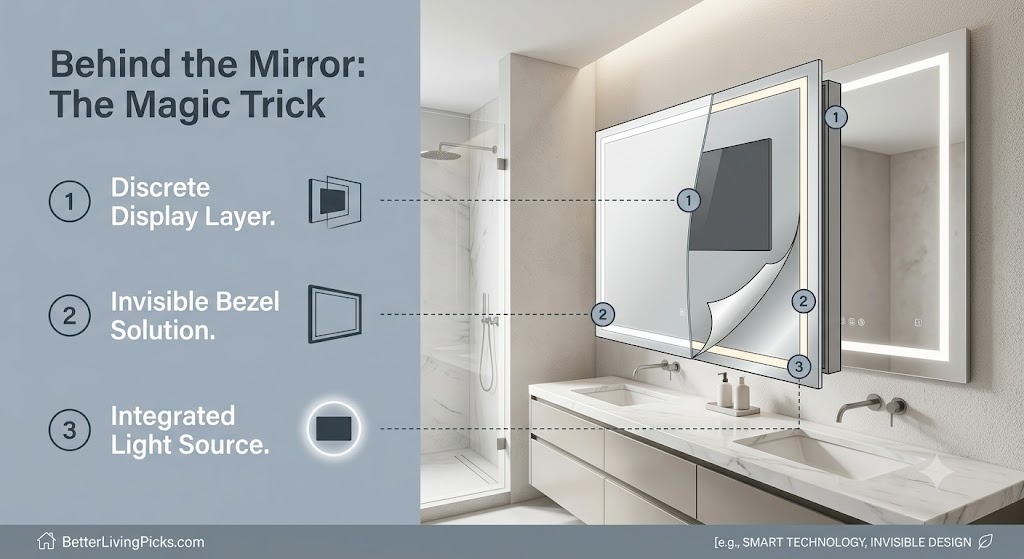
Mirror-integrated TVs are a high-end designer secret. They use a special type of reflective glass that is “two-way” it acts as a mirror until you turn the TV on, at which point the screen shines through the glass.
This is perfect for smaller living rooms or formal spaces where a giant TV feels like it’s overwhelming the furniture. A mirror makes the room feel larger, which is the perfect antidote to the “black hole” effect of a standard TV.
- Lighting is everything: You must be careful with placement. If you put a mirror-TV opposite a window, the glare will make it impossible to see the screen during the day.
- The frame: To keep it minimalist, choose a very thin, metal frame or go frameless. Avoid ornate, heavy frames that clash with the modern, thin nature of the LED technology behind the glass.
These units are heavy and expensive. Don’t try this as a DIY project unless you are very comfortable with structural mounting and advanced electrical work. Always hire a professional to ensure the unit is balanced and correctly wired.
7. Strategic Drapery and Partition Walls
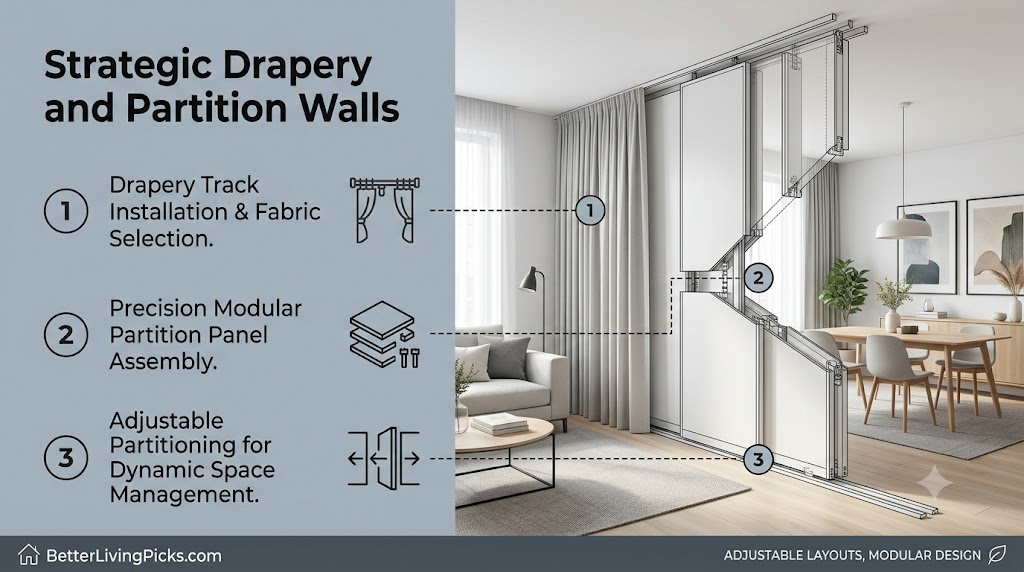
If you want the most “organic” solution, consider using fabric. Floor-to-ceiling curtains can be used as a soft architectural element that covers the entire wall, including the TV.
This creates a warm, texture-heavy focal point. When you aren’t watching TV, the curtains are closed, hiding everything. When you are ready for a movie, you slide the curtains open.
- Acoustics: This is a bonus. Curtains act as a sound absorber, improving the audio quality in your living room by reducing echo.
- Installation: Use a ceiling-mounted track system. It looks much cleaner and more architectural than a wall-mounted rod.
This works exceptionally well in open-plan spaces. If your living room is connected to your kitchen, a wall of curtains can help define the living zone, giving you a sense of separation while keeping the room feeling airy and light.
Frequently Asked Questions
Can I hide a large TV without custom carpentry?
Yes. You can use large-scale floor mirrors, wall-mounted sliding art tracks, or heavy curtains to cover a large screen. None of these options require permanent construction, and they work well for renters or those on a budget.
How do I handle ventilation for hidden electronics?
This is the most common mistake. Always ensure there is at least two inches of space around the TV and your media boxes. If you are building custom cabinets, install small vents on the sides or back to allow heat to escape, or leave the back of the cabinet open.
What is the best way to manage cables in a minimalist setup?
Use a combination of cable management sleeves and adhesive clips on the back of your furniture. If you are mounting a TV, use an in-wall cable management kit to route wires directly behind the drywall so they are completely invisible.
Do art-mode TVs look realistic enough for minimalist spaces?
Yes. Modern versions use matte displays that eliminate glare, making them look like a physical canvas rather than a glowing screen. They are highly effective at blending into minimalist spaces where natural light might otherwise cause unwanted reflections.
How much depth is required for a motorized TV lift?
You generally need a cabinet depth of about 10 to 12 inches to accommodate the lift mechanism and the TV itself. Always measure your specific TV’s total thickness including the mount before buying or building the furniture to ensure it fits comfortably.
Is it better to hide the TV or integrate it as art?
Hiding the TV is better for a truly “blank slate” aesthetic where no technology is visible. Integrating it as art is better if you use the TV daily and want a solution that looks intentional without the hassle of opening and closing doors or panels.
Final Thought
Minimalism isn’t about owning nothing; it is about making sure that the things you do own don’t take over your mental or visual space. Your TV is a tool for entertainment, not a sculpture that should define your living room 24/7. By taking the time to hide your screen or integrate it into your decor, you are reclaiming your home as a sanctuary. Pick the method that fits your budget and your style, whether that is a simple custom cabinet or a high-tech art screen and enjoy the peace of mind that comes with a clean, clutter-free space. You’ve put in the work to design a home you love; make sure the technology inside it honors that vision.

