
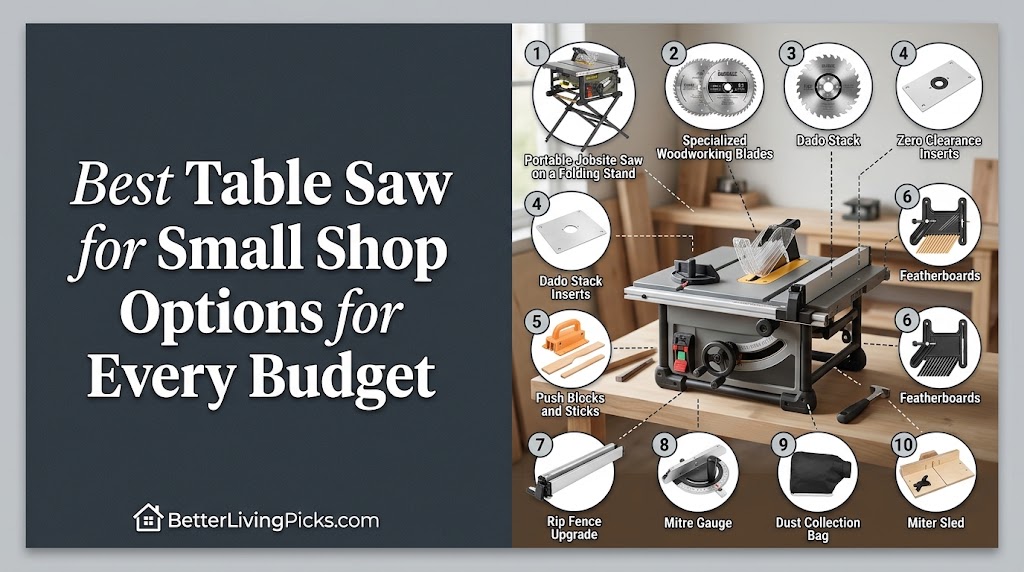
The DeWalt DWE7491RS offers the ideal balance of ripping capacity (32.5 inches), exceptional rack-and-pinion fence accuracy, and an integrated scissor-folding rolling stand that stores vertically in small spaces.
2. Can a jobsite table saw handle fine woodworking?
Yes, provided you upgrade to a high-tooth blade (50T or 60T combination blade), calibrate the fence parallel to the miter slot, and use zero-clearance inserts for tear-out prevention.
3. Is a 10-inch table saw better than an 8-1/4-inch table saw?
A 10 inch benchtop table saw handles thicker stock (up to 3-1/8 inches at 90 degrees) and accepts standard dado stacks, whereas 8-1/4 inch saws offer superior portability but limited depth of cut.
4. How do I store a table saw in a tight workspace?
Opt for a table saw with rolling stand featuring a gravity-rise collapse mechanism. This allows upright vertical storage against a garage wall when the tool is not actively running.
If you are working out of a single-car garage, a shared driveway, or a cramped basement, finding the best table saw for small shop setups is the single most important decision you will make for your workspace. Space is at a premium, and every square inch demands maximum utility. You need a machine that offers dead-accurate rip cuts, robust fence alignment, and sufficient motor torque to rip through hardwoods, without requiring a permanent 4×8-foot footprint on your floor.
Modern compact saws have evolved beyond cheap construction-site throwaways. Today’s top options feature rack-and-pinion fences, folding rolling stands, integrated dust collection ports, and high-efficiency motors designed specifically for space-constrained woodworkers. In this guide, we evaluate the leading options across all price points to help you select the ideal table saw for your small garage workshop.
Quick Picks / Verdict Summary Table
After extensive testing on cabinet sheet goods and 8/4 hardwood, the DeWalt DWE7491RS remains the undisputed standard for small garage workshops. Its rack-and-pinion fence eliminates fence drift, while the rolling mobile stand folds down smoothly in seconds for compact vertical wall storage.
| Model | Category | Rip Capacity | Motor Specs | Weight & Mobility | Key Advantage |
| DeWalt DWE7491RS | Overall Best for Small Shops | 32.5 in | 15 Amp / 4,800 RPM | 90 lbs (With Rolling Stand) | Rack-and-Pinion Fence accuracy & vertical storage |
| SawStop PCS 1.75HP (PCS175-TGP36) | Premium / Cabinet Pick | 36 in | 1.75 HP / 110V | 362 lbs (Needs Mobile Base) | Flesh-sensing safety brake & zero flex table |
| Skil TS6307-00 | Best Value / Budget Pick | 25.5 in | 15 Amp / 4,600 RPM | 53 lbs (Integrated Folding Legs) | Best budget table saw for woodworking with dado support |
| Bosch GTS15-10 | Best Heavy-Duty Contractor Saw | 25 in | 15 Amp / 4,500 RPM | 60 lbs (Stand Sold Separately) | SmartGuard system & smooth bevel adjustment |
| DeWalt DWE7485 | Ultra-Compact Benchtop | 24.5 in | 15 Amp / 5,800 RPM | 46 lbs (Carrying Handles) | Maximum portability & small tabletop footprint |
Dynamic Feature Analysis for Small Shop Table Saws
Selecting a table saw when shop space is severely constrained requires evaluating specific hardware tradeoffs that woodworkers in larger shops rarely have to consider.
                      +---------------------------------------+
                      |   SMALL GARAGE WORKSHOP REQUIREMENTS  |
                      +---------------------------------------+
                                          |
        +---------------------------------+---------------------------------+
        |                                 |                                 |
        v                                 v                                 v
+---------------+                 +---------------+                 +---------------+
| FOOTPRINT &   |                 | FENCE & CUT   |                 | DUST & POWER  |
| MOBILITY      |                 | ACCURACY      |                 | MANAGEMENT    |
+---------------+                 +---------------+                 +---------------+
| • Folding     |                 | • Rack-and-   |                 | • 2.5" Port   |
|   Rolling     |                 |   Pinion      |                 |   Vacuum      |
|   Stands      |                 |   Telescoping |                 |   Connection  |
| • Vertical    |                 | • 24"-32" Rip |                 | • 15 Amp /    |
|   Storage     |                 |   Capacity    |                 |   120V Circuit|
| • Sub-60 lb   |                 | • Parallel    |                 | • Dado Stack  |
|   Options     |                 |   Alignment   |                 |   Acceptance  |
+---------------+                 +---------------+                 +---------------+
Footprint & Storage Efficiency
In a small garage workspace, a machine must either roll away or tuck under a workbench. A portable jobsite table saw with an integrated scissor or gravity-rise stand allows you to set up out in the driveway or center garage bay and then tuck the machine completely flat against a wall when parking a vehicle.
Fence System and Rigidity
The single biggest point of failure on inexpensive table saws is a sloppy fence that deflects under pressure. A telescoping rack-and-pinion fence locks in parallel at both the front and rear rail simultaneously via gear teeth. This eliminates the need to measure front and back blade distances with a tape measure before every single rip cut.
Blade Diameter and Arbor Capability
While an 8-1/4 inch saw is lighter and easier to store, a 10 inch benchtop table saw provides critical advantages: deeper cut capacity at 90 degrees (up to 3-1/8 inches) and a longer arbor shaft engineered to handle stacked dado blades for joinery work.
In-Depth Reviews: Best Table Saws for Small Garage Workshops
1. DeWalt DWE7491RS — Overall Best for Small Garage Workshops
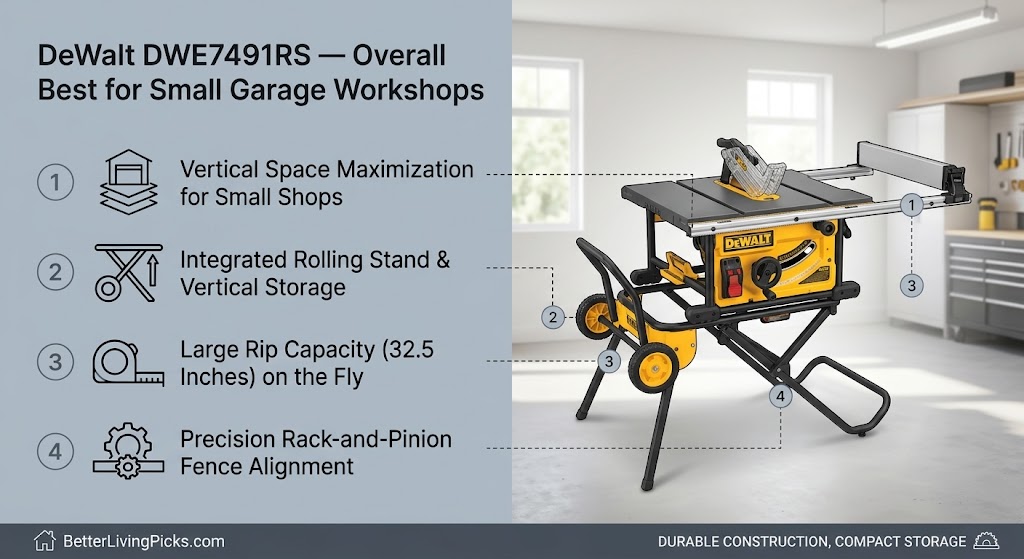
The DeWalt DWE7491RS stands out as the definitive bench-mark machine for space-conscious woodworkers who refuse to compromise on power or ripping capacity.
- Performance & Rip Capacity: Powered by a 15-amp high-torque motor running at 4,800 RPM, it easily slices through pressure-treated lumber and 8/4 hardwoods. The telescoping fence system provides an impressive 32.5-inch rip capacity to the right of the blade, enabling you to break down 4×8 sheet goods down the center without a full-sized cabinet saw.
- Mobility & Setup: The star feature for small garage shops is the table saw with rolling stand. The heavy-duty tubular steel stand features a spring-loaded foot lever mechanism that collapses the unit upright onto large rubber wheels in seconds.
- Fence System: The rack-and-pinion design ensures smooth, micro-adjustable, perfectly parallel movement across the entire rail span.
Key Specs
- Blade Diameter: 10 Inch
- Rip Capacity: 32.5 in. (Right), 22 in. (Left)
- Depth of Cut at 90°: 3-1/8 in.
- Weight: 90 lbs (including stand)
- Dado Capacity: Yes (Up to 13/16 in.)
Practical Pros & Cons
- Pros: Exceptional fence accuracy; large 32-1/2″ rip capacity; stand stores vertically.
- Cons: Included stock 24T blade is rough; throat plate requires upgrading for thin-kerf zero-clearance work.
2. Skil TS6307-00 — Best Budget Table Saw for Woodworking
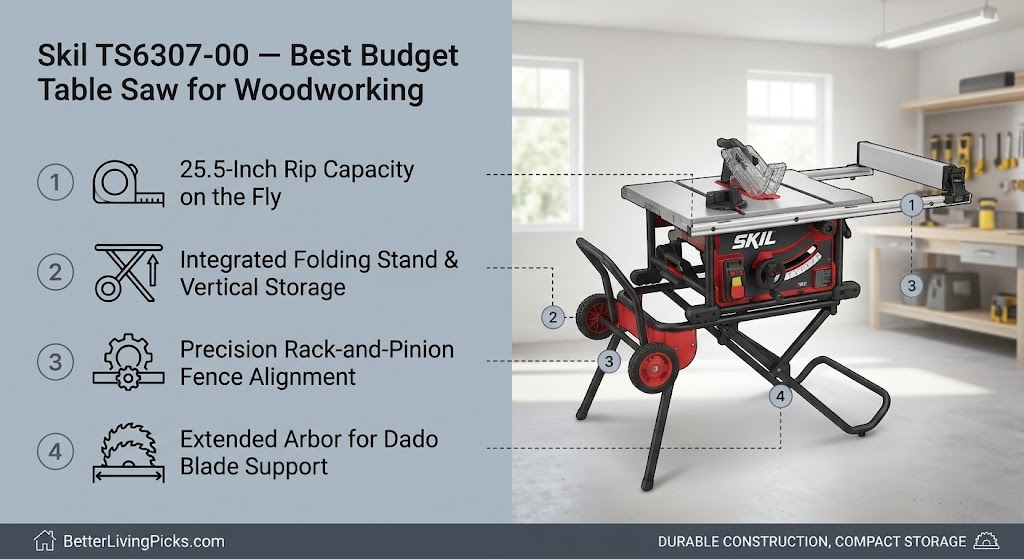
For garage woodworkers managing a strict tool budget, the Skil TS6307-00 delivers features typically reserved for jobsite saws costing twice as much.
- Fence & Build Quality: Skil equipped this unit with a rack-and-pinion fence system, making it the most accurate best budget table saw for woodworking in its price tier. It eliminates manual alignment guesswork.
- Integrated Legs: Instead of requiring a separate rolling base purchase, the TS6307-00 features folding legs built directly into the frame. They fold neatly into the base casting for simple shelf or floor storage.
- Versatility: Unlike many budget jobsite models that restrict you to standard single blades, this 10-inch saw features an arbor extended enough to run stacked dado blades for lap joints and cabinet dadoes.
Key Specs
- Blade Diameter: 10 Inch
- Rip Capacity: 25.5 in.
- Depth of Cut at 90°: 3-1/2 in.
- Weight: 53 lbs
- Dado Capacity: Yes (Up to 5/8 in.)
Practical Pros & Cons
- Pros: Outstanding rack-and-pinion accuracy at a low price point; integrated folding leg set; accepts 10″ blades and dadoes.
- Cons: Stamped aluminum table top can scratch softer woods; dust shroud requires strong shop vac pressure.
3. SawStop Professional Cabinet Saw (PCS175-TGP36) — The Ultimate Safety Choice
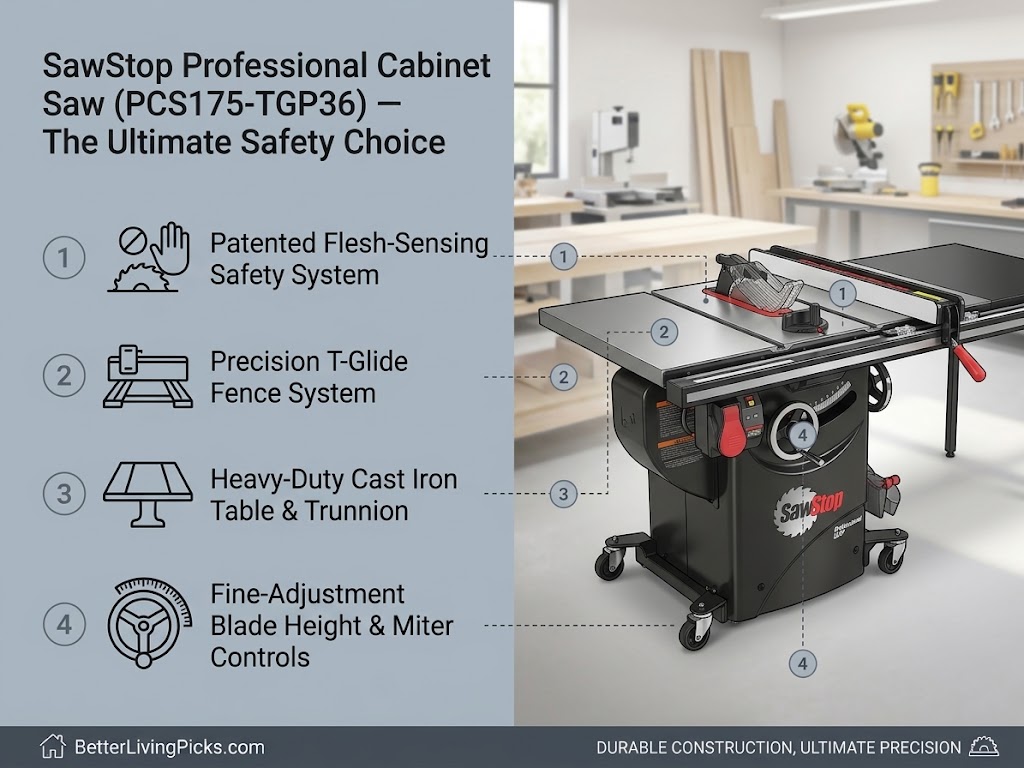
If you want absolute precision, heirloom durability, and patented flesh-sensing safety technology in a 110V-compatible machine, the SawStop PCS is the premier choice—provided you add an industrial mobile base.
- Flesh-Sensing Safety Technology: SawStop’s proprietary safety system carries an electric signal on the blade. Upon contact with human skin, the signal changes, triggering an aluminum brake block that stops and drops the blade beneath the table in less than 5 milliseconds.
- Precision Engineering: The ground cast-iron table provides a flat, vibration-free surface that portable aluminum saws cannot match. The T-Glide fence locks dead-square with zero deflection.
- Small Shop Compatibility: The 1.75HP version runs on a standard 110V/15-amp garage circuit, eliminating the need to re-wire your electrical panel for 220V power. Combined with SawStop’s integrated mobile base, it can be pivoted and rolled into a tight corner when work is done.
Key Specs
- Blade Diameter: 10 Inch
- Rip Capacity: 36 in.
- Depth of Cut at 90°: 3-1/8 in.
- Weight: 362 lbs
- Electrical Requirement: 110V, 1.75 HP
Practical Pros & Cons
- Pros: Unmatched safety technology; industrial vibration dampening; elite T-Glide fence system.
- Cons: High financial investment; heavy footprint requiring an optional mobile base to move around tight spaces.
4. Bosch GTS15-10 — Compact Heavy-Duty Contractor Power
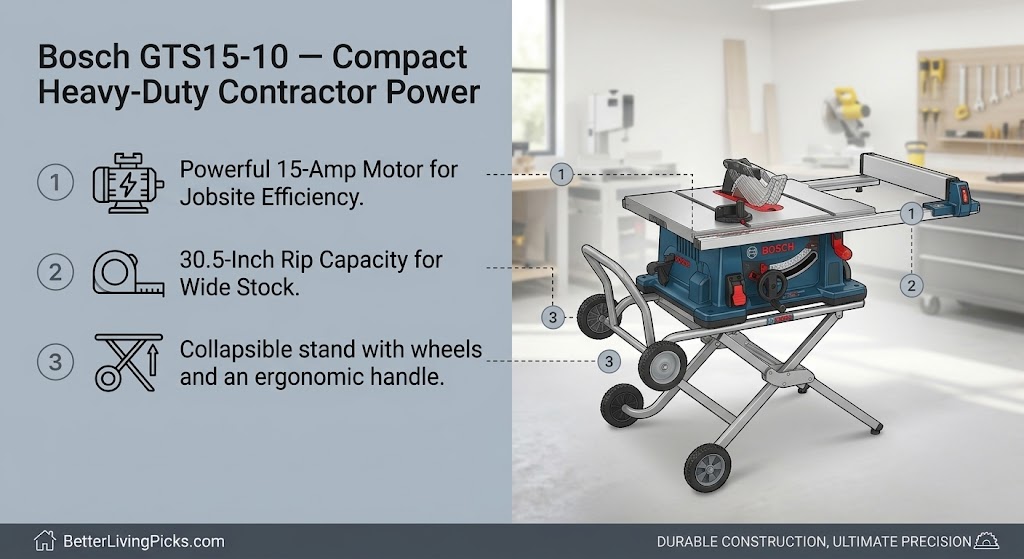
Bosch has long been respected for jobsite engineering, and the GTS15-10 offers a solid mid-range solution for craftsmen who prefer a traditional, rigid aluminum frame and exceptional dust control.
- Motor Power & Cut Quality: The 15-amp, 4,500 RPM motor includes soft-start circuitry, reducing startup torque surges that can trip garage breakers. Its motor brake stops the blade rapidly after cut completion.
- Guard System: The Modular SmartGuard system features a quick-release riving knife, anti-kickback pawls, and a clear barrier guard that can be configured without tools in under 30 seconds.
- Storage Footprint: While slightly wider than benchtop units, its low-profile frame allows it to sit cleanly on top of a custom rolling workbench enclosure or dedicated mobile stand.
Key Specs
- Blade Diameter: 10 Inch
- Rip Capacity: 25 in.
- Depth of Cut at 90°: 3-1/8 in.
- Weight: 60 lbs
- Dado Capacity: Yes (Up to 1/2 in.)
Practical Pros & Cons
- Pros: Soft-start motor prevents breaker trips; highly adjustable riving knife system; rugged steel roll-cage base.
- Cons: Standard lock fence requires occasional parallelism double-checks; heavier than basic benchtops.
5. DeWalt DWE7485 — Ultra-Compact 8-1/4 Inch Benchtop Saw
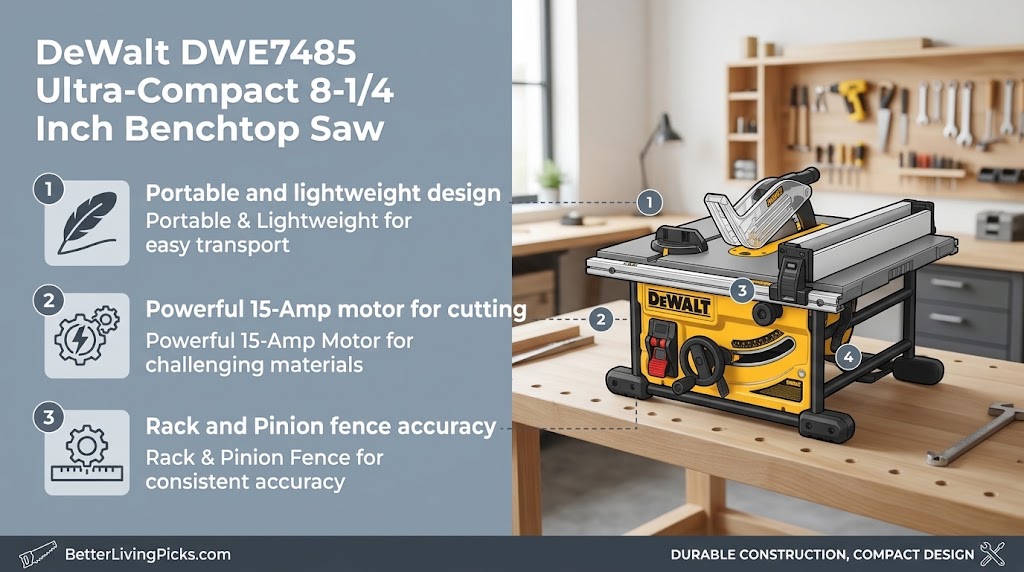
When available floor space in your garage is virtually zero, a compact contractor table saw like the 8-1/4 inch DeWalt DWE7485 delivers max portability without relinquishing rip-cut alignment.
- Size and Weight: Weighing just 46 pounds, this saw is easy to carry with one hand. It fits on a garage shelf, under a miter saw station, or inside a vehicle trunk.
- Cut Performance: Despite its reduced blade diameter, its 15-amp, 5,800 RPM motor yields clean, high-speed rips through 2x dimensional lumber and cabinet-grade plywood up to 2-9/16 inches thick.
- Rack-and-Pinion Fence: It retains DeWalt’s signature dual-gear rack-and-pinion fence system, ensuring your cuts stay accurate down to 1/32 of an inch.
Key Specs
- Blade Diameter: 8-1/4 Inch
- Rip Capacity: 24.5 in.
- Depth of Cut at 90°: 2-9/16 in.
- Weight: 46 lbs
- Dado Capacity: No
Practical Pros & Cons
- Pros: Ultra-lightweight and easy to store; high RPM motor yields smooth finish cuts; rock-solid rack-and-pinion fence.
- Cons: Cannot accept standard 10″ blades or dado stacks; max depth of cut will not handle 3″ stock in a single pass.
Buyer’s Guide: How to Choose a Table Saw for a Small Shop
1. Space & Mobility Requirements
Measure your garage floor layout before purchasing. If you park cars inside the garage overnight, prioritize a table saw with rolling stand that features a fold-away vertical kick-stand. If you already have a modular mobile workbench with a built-in drop-in cavity, an ultra-compact benchtop unit (like the DWE7485) is the space-saving path forward.
2. Fence Quality over Motor Horsepower
For fine woodworking, a straight, deflection-free fence is far more critical than raw motor horsepower. A 15-amp motor on a budget saw will cut through 3/4-inch hardwood smoothly if fed properly, but a loose or misaligned fence will create dangerous kickback or burn marks on your stock. Rack-and-pinion systems are highly recommended for compact saws.
3. Electrical Considerations in Tier-1 Residential Garages
Most standard garage outlets in US, CA, UK, and AU homes share a 15-amp or 20-amp 120V circuit with overhead lighting and garage door openers. High-draw contractor saws can trip breakers during high-load hardwood rips. Choose saws with soft-start electronic feedback motors, and avoid running heavy extension cords or use thick 10-gauge short cords if necessary.
- Rack-and-Pinion Fences are Essential: Look for telescoping rack-and-pinion fence mechanisms to eliminate misalignment and fence drift on compact saws.
- Prioritize Vertical Storage: Mobile gravity-rise folding stands permit heavy 10-inch jobsite saws to store upright against garage walls, saving floor footprint.
- Check Dado Compatibility: If cabinet joinery is in your project scope, choose a 10-inch saw with an extended arbor; 8-1/4-inch compact units generally do not take dado stacks.
- Manage Circuit Load: Ensure your 15-amp table saw runs on a dedicated outlet branch to prevent breaker trips during heavy rips.
Final Recommendation
For most small garage woodworkers, the DeWalt DWE7491RS provides the best blend of workshop capability and space conservation. Its 32.5-inch rip capacity, dependable rack-and-pinion fence, and folding rolling stand make it a capable centerpiece for tight spaces.
If budget is your primary constraint, the Skil TS6307-00 offers incredible value by delivering rack-and-pinion accuracy and dado capability at a lower price point. For woodworkers who demand premium safety, heavy cast-iron dampening, and top-tier accuracy, pairing a SawStop PCS 1.75HP with an industrial mobile base gives you cabinet-saw performance while retaining mobility.
Frequently Asked Questions
1. Is a jobsite table saw good enough for fine woodworking?
Yes. Modern jobsite table saws equipped with rack-and-pinion fences provide plenty of accuracy for furniture making and cabinetry. To get clean results, replace the coarse stock blade with a high-quality 50-tooth or 60-tooth carbide combination blade and calibrate the fence parallel to the blade slot.
2. What is the minimum rip capacity needed for sheet goods?
A rip capacity of 24.5 inches allows you to cut a standard 4×8-foot sheet of plywood down the middle lengthwise. If you work with full sheet goods regularly, a saw with a 30-inch to 32.5-inch rip capacity (such as the DeWalt DWE7491RS) makes processing panel goods much safer and easier.
3. Can I put a 10-inch blade on an 8-1/4-inch table saw?
No. You must never install a blade size larger than what the saw manufacturer specifies. The blade guard, riving knife, arbor gearing, and motor housing are built specifically for the designated blade diameter.
4. How do I stop my table saw from sliding when cutting heavy lumber?
If using a benchtop saw without a heavy stand, mount the saw frame onto a 3/4-inch plywood base plate and clamp it securely to your workbench. For rolling jobsite stands, ensure the rubber foot pads are fully engaged and locked in place before feeding long stock.
5. Why is a rack-and-pinion fence so highly recommended?
Standard friction-clamping fences rely on manual alignment at both ends, which can introduce subtle skew. Rack-and-pinion fences use geared tracks at the front and back of the table that move in perfect sync via a turning knob, keeping the fence parallel to the blade automatically.
6. Can I use an extension cord with a 15-amp jobsite table saw?
Yes, but you must use a heavy-duty cord. A 25-foot extension cord should be at least 12-gauge (12/3 AWG), while a 50-foot run requires a 10-gauge (10/3 AWG) cord. Standard light-duty household cords cause voltage drops that can overheat the motor and trip your breaker.
7. What is the difference between a contractor saw and a jobsite saw?
Jobsite table saws feature lightweight aluminum tops, folding steel tubular bases, and direct-drive universal motors for maximum portability. Traditional contractor saws feature larger cast-iron tables and belt-driven induction motors, making them heavier and quieter, though harder to stow away in small shops.
8. How do I connect a shop vacuum to my table saw dust port?
Most jobsite saws feature a 2.5-inch dust port on the rear guard shroud. Use a standard 2.5-inch flexible dust hose to connect the saw directly to a shop vac or an inline cyclone dust separator.
Final Thought
Working in a small garage workshop doesn’t mean you have to settle for inaccurate cuts or dangerous setups. By choosing a table saw designed with a stable fence system, an efficient footprint, and built-in mobility, you can transform a single garage bay into an efficient, precision woodworking space.