
Concrete requires at least 3,000 PSI and 2.0 GPM to blast away embedded dirt, moss, and oil stains efficiently without requiring multiple passes.
2. Is a gas or electric pressure washer better for concrete?
Gas pressure washers offer superior cleaning speed and power for large areas, while modern high-output electric pressure washers excel in low-maintenance, quiet, light-to-medium concrete cleaning.
3. Do I need a surface cleaner attachment?
Yes. Using a pressure washer surface cleaner attachment reduces cleaning time by up to 70% and prevents the streak lines commonly left by standard spray nozzles.
4. What is the best pressure washer for a patio and driveway?
A unit delivering between 3,000 to 3,400 PSI paired with a 12 to 15-inch rotating surface cleaner offers the perfect balance of cleaning force, speed, and surface protection.
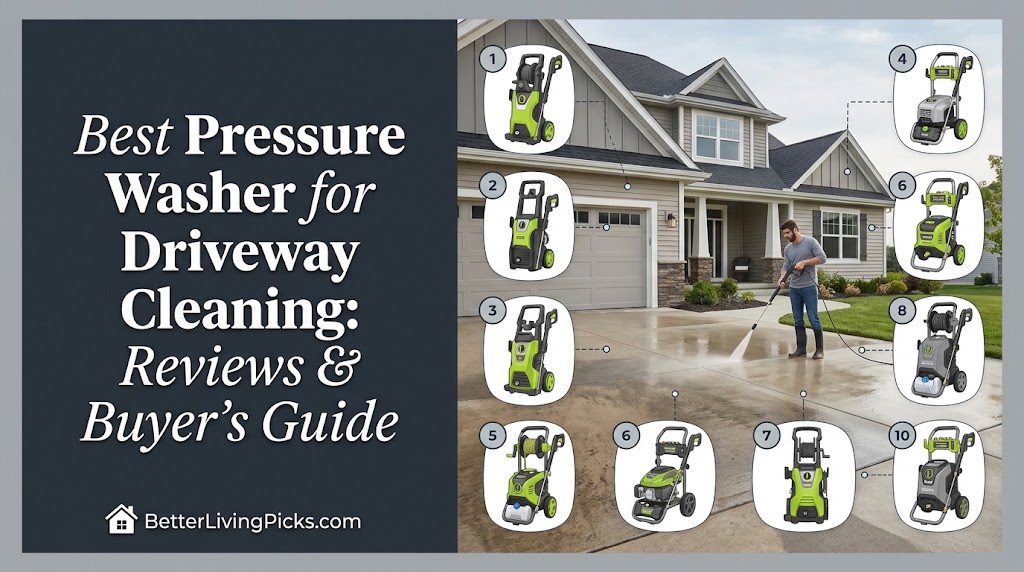
Cleaning a dirty, oil-stained, or moss-covered concrete surface requires serious power and the right setup. Choosing the best pressure washer for driveway maintenance comes down to matching your budget, physical stamina, and surface area with the ideal pressure output and flow rate. While lighter exterior chores like washing a sedan or rinsing patio chairs require modest power, concrete is porous and stubborn, demanding consistent pressure and high water volume to lift deep-seated grime without leaving striping marks behind.
Whether you need a heavy-duty gas pressure washer for concrete surface restoration, an easy-starting electric pressure washer 3000 psi unit for routine home maintenance, or a specialized pressure washer surface cleaner setup to cut your project time in half, this guide evaluates the top models across every budget tier.
Quick Picks & Verdict Summary Table
Powered by a reliable Honda GC190 engine, this 3200 PSI, 2.5 GPM gas pressure washer provides unbeatable commercial-grade cleaning power for residential driveways. Its welded steel frame and premium OEM axial pump ensure years of dependable performance on concrete, stone, and brick surfaces.
| Model | Power Type | PSI / GPM | Cleaning Units (CU) | Best For | Key Feature |
| Simpson MSH3125 MegaShot | Gas (Honda Engine) | 3200 PSI / 2.5 GPM | 8,000 CU | Overall Best | Premium Honda GC190 Engine |
| Westinghouse WPX3200 | Gas | 3200 PSI / 2.5 GPM | 8,000 CU | Best Value Gas | 212cc Engine & EnduraPump |
| Greenworks Pro 3000 PSI | Electric (Brushless) | 3000 PSI / 2.0 GPM | 6,000 CU | Best Electric | Smart Flow Brushless Motor |
| Craftsman CMXGWAS020733 | Gas | 3100 PSI / 2.3 GPM | 7,130 CU | Easiest Starting | Easy Start Technology |
| Sun Joe SPX3000 MAX | Electric | 2800 PSI / 1.3 GPM | 3,640 CU | Best Budget Choice | Dual Detergent Tank System |
Dynamic Feature Analysis & Key Metrics
When shopping for the best pressure washer for driveway projects, focusing solely on PSI (Pounds per Square Inch) is a common mistake. True cleaning effectiveness depends on how pressure works in tandem with water flow volume.
- PSI (Pounds per Square Inch): Determines the stripping force. High PSI breaks the bond between dirt, oil, and hard concrete surfaces.
- GPM (Gallons per Minute): Measures water volume. High GPM flushes debris away quickly; higher GPM directly translates to faster cleaning speeds over large square footage.
- Cleaning Units (CU): Multiplying PSI by GPM gives you the total Cleaning Units. For example, a 3200 PSI washer with 2.5 GPM yields 8,000 CU, making quick work of large, dirty driveways.
Individual Product Reviews: Best Pressure Washers for Concrete Driveways
1. Simpson Cleaning MSH3125 MegaShot (Best Overall Gas Pressure Washer)
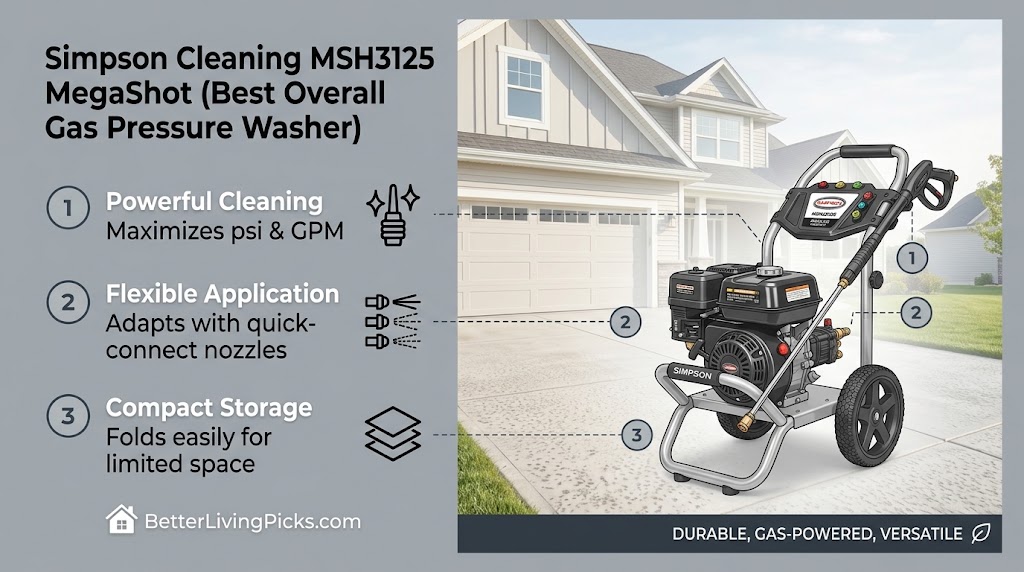
If you need raw stripping power for long concrete driveways, oil drips, and deeply embedded grime, the Simpson MegaShot MSH3125 stands as the gold standard for home use.
- Performance: 3200 PSI at 2.5 GPM (8,000 Cleaning Units)
- Engine: Honda GC190 Premium Residential Engine
- Hose: 25-foot MorFlex High-Pressure Hose
- Nozzles: 5 Quick-Connect Tips (0°, 15°, 25°, 40°, Soap)
The heart of this machine is its Honda GC190 engine, which starts reliably on the first or second pull. Combined with an OEM Technologies axial cam pump, it pushes enough water volume to run a 15-inch pressure washer surface cleaner effortlessly. The heavy-duty welded steel construction ensures stability across uneven terrain, and the kink-resistant MorFlex hose eliminates frustrating line twists during long cleaning sessions.
- Pros: Exceptional engine reliability, superior cleaning power for concrete, robust steel frame construction.
- Cons: Exhaust can run hot; gas maintenance required (oil changes, fuel stabilizer).
2. Westinghouse WPX3200 (Best Value Gas Pressure Washer for Concrete)
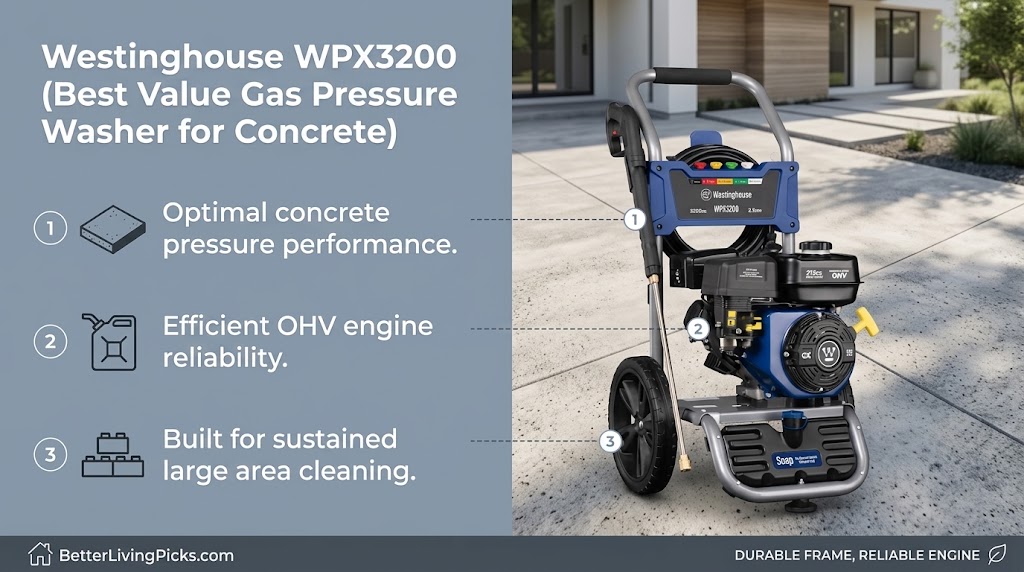
The Westinghouse WPX3200 delivers commercial-style performance at a price point that makes it accessible for average homeowners tackling multi-car driveways and large patios.
- Performance: 3200 PSI at 2.5 GPM (8,000 Cleaning Units)
- Engine: 212cc 4-Stroke Westinghouse OHV Engine
- Fuel Capacity: 1.0 Gallon Tank
- Nozzles: 5 Quick-Connect Tips including Soap Nozzle
This gas pressure washer for concrete provides high torque to break through baked-on tree sap, moss, and tire marks. Equipped with 12-inch high-profile never-flat wheels, it rolls smoothly over lawn edges and steps. The onboard 0.5-gallon detergent tank lets you pre-treat heavy stains with concrete cleaner without needing a separate soap bucket.
- Pros: High fuel capacity for uninterrupted cleaning, excellent price-to-power ratio, sturdy frame design.
- Cons: Slightly heavier frame (63 lbs) requiring extra effort to load into truck beds.
3. Greenworks Pro 3000 PSI Brushless (Best High-Output Electric Pressure Washer)
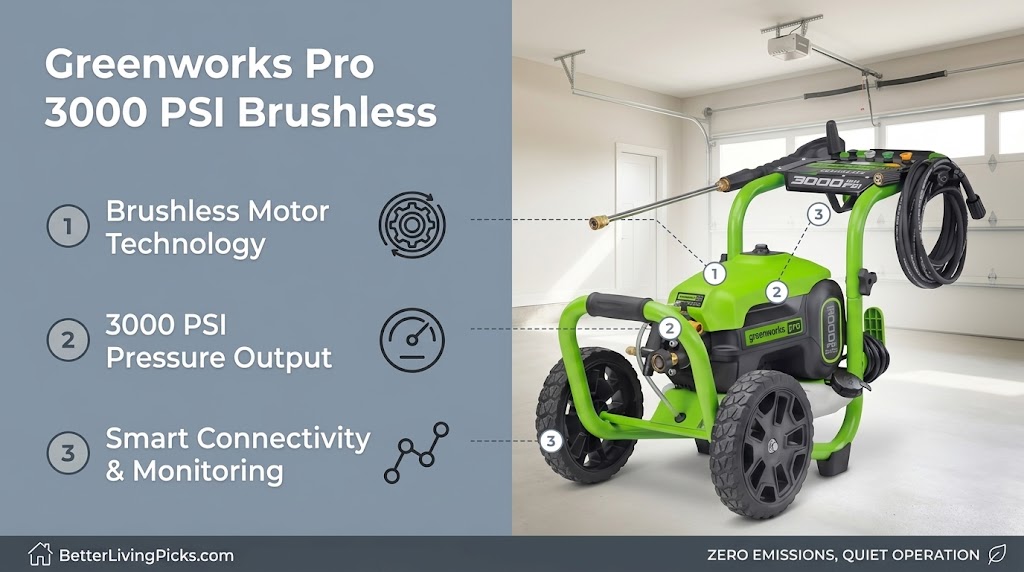
For homeowners who want strong output without dealing with gasoline, spark plugs, or engine oil, the Greenworks Pro 3000 PSI stands as the top electric pressure washer 3000 psi option available.
- Performance: 3000 PSI at 2.0 GPM (6,000 Cleaning Units)
- Motor: Heavy-Duty Brushless Motor with Smart Flow Technology
- Hose: 25-foot Steel-Reinforced High-Pressure Hose
- Frame: Hand-Truck Heavy-Duty Wheel Design
Driven by a commercial-grade brushless motor and digital smart controls, this machine adjusts water pressure automatically based on nozzle selection. Delivering 2.0 GPM, it pushes significantly more water volume than standard electric washers, giving it real concrete-cleaning capability. It starts with the press of a button, runs quietly, and stores vertically in tight garage spaces.
- Pros: No gas engine maintenance, quiet push-button operation, strong 2.0 GPM water flow rate.
- Cons: Requires proximity to a dedicated 15A/20A electrical outlet; power cord management required.
4. Craftsman CMXGWAS020733 (Easiest Starting Gas Washer)
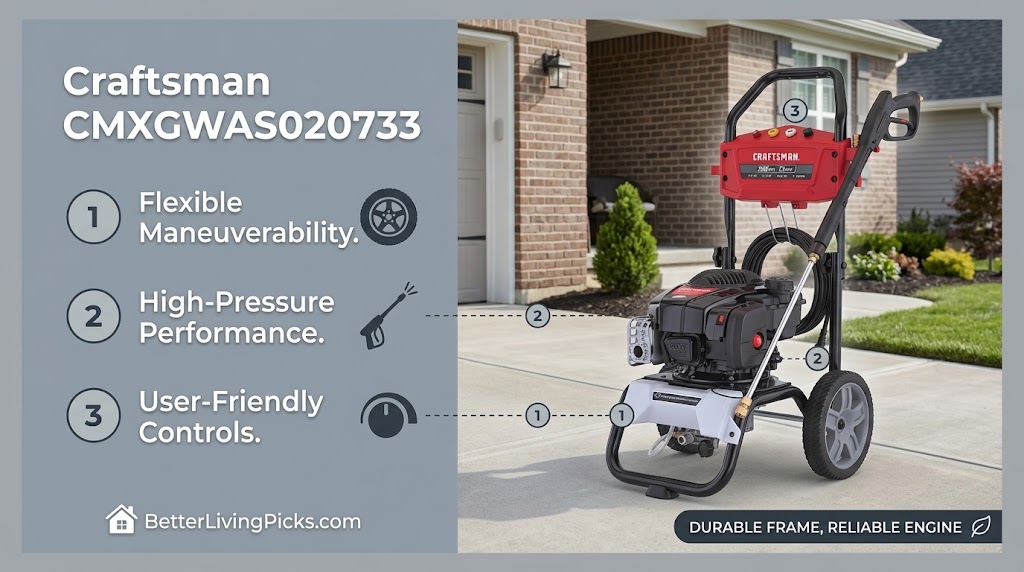
If you prefer gas power but hate pull-cord strain, the Craftsman 3100 PSI unit features specialized starting assist technology that reduces cord resistance.
- Performance: 3100 PSI at 2.3 GPM (7,130 Cleaning Units)
- Engine: CR950 208cc Briggs & Stratton Engine
- Special Feature: Easy Start Technology for effortless pulling
- Nozzles: 4 Quick-Connect Tips
This unit excels on concrete walkways, aggregate driveways, and back patios. The high-axial pump features easy cold-start valves, eliminating pressure back-up inside the pump during starting. Its fold-down handle allows compact storage beneath garage shelving.
- Pros: Effortless pull starting, compact folding frame, excellent performance as a best pressure washer for patio and driveway maintenance.
- Cons: Includes 4 spray tips instead of 5 (omits the 0-degree jet tip).
5. Sun Joe SPX3000 MAX (Best Budget Electric Washer for Light Concrete)
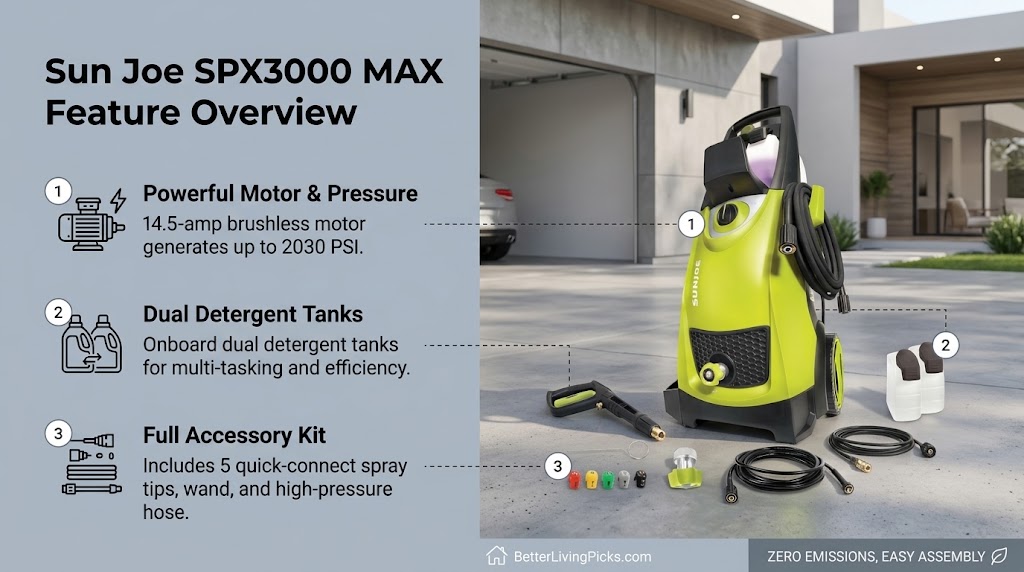
Homeowners on a strict budget who need a compact unit for small driveways, walkways, and patio tiles will find great value in the Sun Joe SPX3000 MAX.
- Performance: 2800 PSI (Max) at 1.3 GPM (3,640 Cleaning Units)
- Motor: 14.5-Amp / 1800-Watt Induction Motor
- Features: Dual Detergent Tanks with Selectable Dial
- Safety System: Total Stop System (TSS) shuts pump off when trigger is disengaged
While it takes longer to clean large concrete surfaces due to its lower GPM flow rate, the SPX3000 MAX offers plenty of power for removing surface dirt, light algae, and bird droppings. Its dual detergent tanks allow you to load two different cleaning solutions such as concrete degreaser and house wash and switch between them using a front selection dial.
- Pros: Very affordable, lightweight, low noise level, dual soap tank system.
- Cons: Slower cleaning speeds on large concrete pads due to 1.3 GPM output.
Buyer’s Guide: How to Choose the Right Pressure Washer for Concrete
Selecting the best pressure washer for driveway projects depends on several key technical factors:
1. Gas vs. Electric Power
- Power Output: 3,000–4,400 PSI / 2.5+ GPM
- Best For: Large, multi-car driveways & heavy oil stains
- Trade-off: Requires gas, oil, and routine motor maintenance
- Power Output: 2,000–3,000 PSI / 1.3–2.0 GPM
- Best For: Small driveways, patios, and seasonal cleanup
- Trade-off: Instant push-button start, zero gas exhaust or oil changes
- Gas Pressure Washers: Offer 3,000 to 4,400 PSI and 2.3 to 4.0 GPM. They operate anywhere without power cords and finish large concrete jobs quickly. However, they require gas, oil changes, winterizing, and produce exhaust.
- Electric Pressure Washers: Deliver 1,800 to 3,000 PSI and 1.1 to 2.0 GPM. They start instantly, require zero engine maintenance, and operate quietly. They are ideal for small-to-medium driveways, townhome pads, and patios, though they are limited by power cord reach.
2. Nozzle Selection for Concrete Surface Protection
- 0° (Red): Pinpoint high-force stream. Use only for tough spot stains on unpainted concrete. Never hold in one spot.
- 15° (Yellow): Chisel tip. Excellent for stripping stubborn concrete stains, mud, and heavy algae growth.
- 25° (Green): Standard cleaning tip. Perfect general-purpose option for driveways, brick pavers, and concrete sidewalks.
- 40° (White): Wide spray pattern. Ideal for delicate surfaces, outdoor furniture, or rinsing away loosened dirt.
- Soap Nozzle (Black): Low-pressure tip designed to pull chemical detergents from onboard tanks.
Final Recommendation & Verdict
For most homeowners tackling multi-car concrete driveways, the Simpson Cleaning MSH3125 MegaShot is the top overall performer. Its Honda GC190 engine delivers consistent, professional-grade output that makes quick work of deep oil stains, moss, and dirt when paired with a surface cleaner.
If you prefer zero gas engine maintenance, push-button starting, and quiet operation, upgrade to the Greenworks Pro 3000 PSI Brushless Electric Washer. It provides the highest GPM water flow in the electric category, delivering genuine concrete cleaning capability without the hassle of gasoline.
- Target 3,000+ PSI & 2.0+ GPM: Concrete demands significant stripping power and high water flow to clear embedded dirt efficiently.
- Gas Wins on Speed: Gas washers remain superior for large multi-car driveways due to higher GPM water volume.
- Electric Wins on Convenience: High-end electric units (3000 PSI) provide low-maintenance cleaning for modest driveways and patios.
- Use a Surface Cleaner: A rotating deck attachment prevents striping lines and cuts cleaning time in half.
Frequently Asked Questions (FAQs)
1. What is the best pressure washer for driveway cleaning overall?
The Simpson Cleaning MSH3125 MegaShot is widely considered the best pressure washer for driveways due to its 3200 PSI pressure rating, 2.5 GPM water flow, and dependable Honda GC190 engine.
2. Can an electric pressure washer clean a concrete driveway effectively?
Yes, provided the unit delivers at least 2,500 to 3,000 PSI and a flow rate near 2.0 GPM (such as the Greenworks Pro 3000 PSI). Lower-output electric units can clean concrete, but the process takes significantly longer.
3. Will a pressure washer remove oil stains from concrete?
High pressure alone helps, but removing deep oil stains usually requires pre-treating the concrete with an alkaline degreaser or concrete cleaner before pressure washing with a 15° or 25° nozzle.
4. What size surface cleaner do I need for my pressure washer?
A general rule is 4 inches of surface cleaner diameter per 1 GPM of machine output. A 2.5 GPM pressure washer operates best with a 10 to 14-inch surface cleaner attachment.
5. Can pressure washing damage a concrete driveway?
Yes. Using a 0° spray tip too close to the surface or pressure washing concrete that has cured for less than one year can etch the surface and strip away the protective outer finish.
6. What is the difference between PSI and GPM?
PSI (Pounds per Square Inch) represents stripping force, while GPM (Gallons per Minute) measures water volume. GPM determines how fast debris flushes away; higher GPM reduces total cleaning time.
7. Do I need detergent to pressure wash a driveway?
For general dirt and light dust, plain water works well. For mildew, mold, algae, or automotive fluids, applying a specialized concrete cleaner or pressure washer soap yields much cleaner results.
8. How often should I pressure wash my driveway?
Most concrete driveways benefit from pressure washing once per year typically in late spring to remove winter salt, grime, and mold growth.
Final Thoughts
Investing in the right pressure washer turns an exhausting weekend chore into an easy, satisfying home improvement project. Matching your machine’s PSI and GPM to the size of your driveway ensures fast, streak-free results while protecting your concrete surface for years to come.