
Woodworking requires precise clutch settings to prevent over-driving screws, minimal chuck runout for clean holes, an ergonomically balanced body, and smooth variable-speed triggers rather than just maximum raw torque.
2. Is 12V or 18V/20V better for joinery and furniture making?
A 12V compact cordless drill offers unmatched maneuverability inside cabinet carcasses and overhead work, while 18V/20V platforms are essential for heavy-duty tasks like boring large Forstner bits or hole saws into thick hardwoods.
3. Why should woodworkers choose a brushless motor drill?
A brushless drill driver set delivers up to 50% longer battery run-time, generates significantly less heat during repetitive drilling, and provides smoother digital electronic speed control under load.
4. Is an impact driver a substitute for a woodworking drill driver?
No. Impact drivers lack a mechanical clutch and will easily snap small brass screws or counterbore past your depth setting. A dedicated drill driver gives you exact torque control.
Finding the best cordless drill for woodworking isn’t just about buying the tool with the highest voltage or the most aggressive torque rating. In a fine woodworking or cabinetry shop, raw power takes a backseat to precision control, chuck runout, variable speed sensitivity, ergonomic balance, and clutch consistency. Whether you are building custom cabinets, setting up pocket-hole joinery in hardwood, or driving delicate brass screws into finished stock, having the right drill driver makes the difference between flawless craftsmanship and split wood or stripped heads.
In this comprehensive guide, we review and analyze the top-performing cordless drills engineered specifically for the demands of joinery, furniture making, and general shop tasks.
Quick Picks & Verdict Summary
The DeWalt DCD800 stands out as the overall top pick for woodworkers. It combines a highly compact 6.37-inch head length with an ultra-reliable 1/2-inch metal ratcheting chuck, an innovative 3-position pivoting LED light, and exceptional clutch sensitivity. It handles delicate hardwood screws and heavy Forstner bits with equal mastery.
| Model | Voltage | Motor Type | Key Woodworking Strengths | Best For |
| DeWalt 20V MAX XR DCD800 | 20V Max | Brushless | High power, 6.37″ head, 3-mode pivoting LED | Best Overall Woodworking Drill |
| Milwaukee M12 FUEL 2503-20 | 12V | Brushless | Ultra-compact, all-metal chuck, incredible balance | Best Compact 12V for Cabinetry |
| Makita 18V LXT Sub-Compact XFD11ZB | 18V | Brushless | 12V size with 18V battery power, ultra-smooth trigger | Best Ergonomics & Balance |
| Festool CXS 18 | 18V | Brushless | FastFix chuck system, zero chuck runout, extreme precision | Ultimate Precision / Fine Joinery |
| Bosch 12V Max FlexiClick GSR12V-140FC | 12V | Brushless | 5-in-1 chamfer, offset, & right-angle attachments | Best Versatility & Tight Spaces |
| Craftsman V20 Cordless Drill (CMCD700C1) | 20V Max | Brushed | Great budget entry, solid clutch, reliable output | Best Budget Option for Beginners |
| DeWalt 12V MAX Xtreme DCD701F2 | 12V | Brushless | Extremely lightweight, excellent trigger feathering | Best Lightweight Shop Drill |
| Ridgid 18V SubCompact R86001 | 18V | Brushless | Lifetime Service Agreement, high torque-to-weight ratio | Best Value 18V System |
| Kobalt 24V Max KDD 1424A-03 | 24V Max | Brushless | Outstanding raw torque for timber framing & heavy stock | Heavy-Duty Hole Boring |
| Ryobi 18V ONE+ HP PBLDD01B | 18V | Brushless | Enormous battery ecosystem, budget-friendly brushless power | Best DIY & Home Workshop Value |
Dynamic Feature Analysis for Woodworkers
Unlike general construction framing, woodworking demands specific technical features from a power drill:
- Mechanical Clutch Resolution: A drill with 15 to 22 distinct clutch positions allows you to calibrate torque down to tiny inch-pounds, ensuring brass fasteners or soft pine stock never strip out.
- Chuck Runout & Jaws: Metal keyless chucks with carbide inserts grip smooth-shank drill bits securely without slipping or wobbling, guaranteeing clean entry and exit holes for dowels and plugs.
- Trigger Modulation: A featherable variable-speed trigger lets you start holes slowly on slick or curved surfaces without the drill bit wandering across your grain line.
- Head Length & Form Factor: Compact head lengths under 7 inches permit easy pocket-hole driving inside narrow cabinet boxes and assembled drawers.
Individual Product Reviews
1. DeWalt 20V MAX XR Brushless Drill/Driver (DCD800) – Best Overall
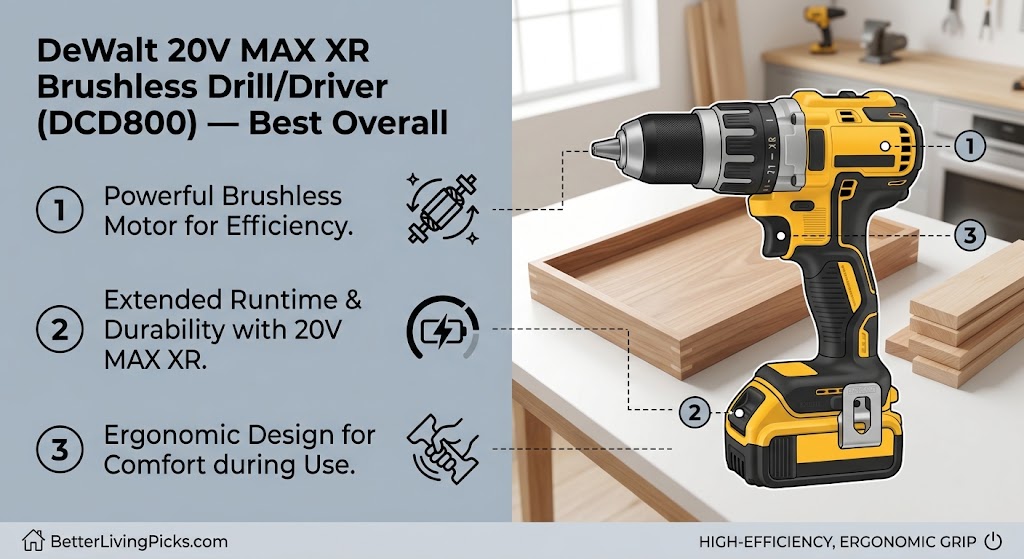
The DeWalt DCD800 represents the sweet spot between high-torque performance and compact maneuvering. Delivering up to 2,000 RPM in high-speed mode, this compact 20v cordless drill powers through dense hardwoods like sugar maple and white oak effortlessly.
- Woodworking Performance: The 1/2-inch heavy-duty metal ratcheting chuck grips driver bits tightly, virtually eliminating bit slippage during high-torque spade bit or Forstner bit passes.
- Standout Feature: A 3-position, 70-lumen pivoting LED headlight allows you to illuminate inside dark cabinet carcasses without shadows blocking your layout mark.
- Pros: Exceptional power density, extremely short 6.37-inch front-to-back length, outstanding clutch tuning.
- Cons: Bare tool costs slightly more than entry-level 20V options.
2. Milwaukee M12 FUEL 1/2″ Drill Driver (2503-20) – Best Compact 12V for Cabinetry
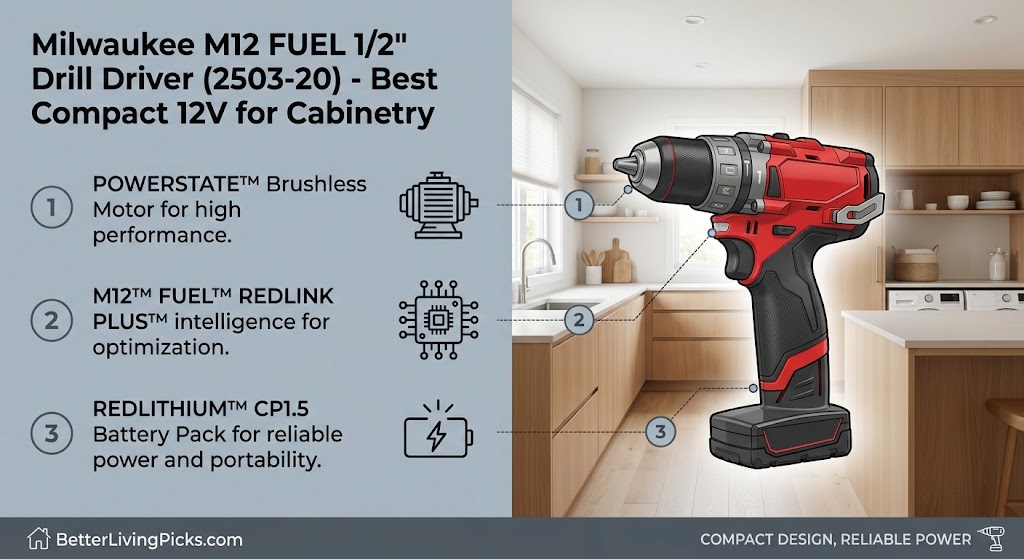
When building drawers or setting up face frames, heavy 18V batteries can tire your wrist quickly. The Milwaukee M12 FUEL 2503-20 delivers near-18V performance in an agile 12V package, making it an incredible cordless drill for beginners and master cabinetmakers alike.
- Woodworking Performance: Despite its diminutive 12V size, it features a full 1/2-inch metal chuck capable of turning 2-inch Forstner bits through softwoods without stalling out.
- Standout Feature: POWERSTATE brushless motor coupled with REDLINK PLUS intelligence prevents motor burn-out during continuous pocket-hole drilling runs.
- Pros: Compact footprint fits effortlessly between 12-inch center shelf spans, comfortable ergonomic grip, solid metal chuck.
- Cons: 12V battery system requires higher amp-hour batteries (4.0Ah+) for prolonged heavy boring operations.
3. Makita 18V LXT Sub-Compact Brushless (XFD11ZB) – Best Ergonomics & Balance
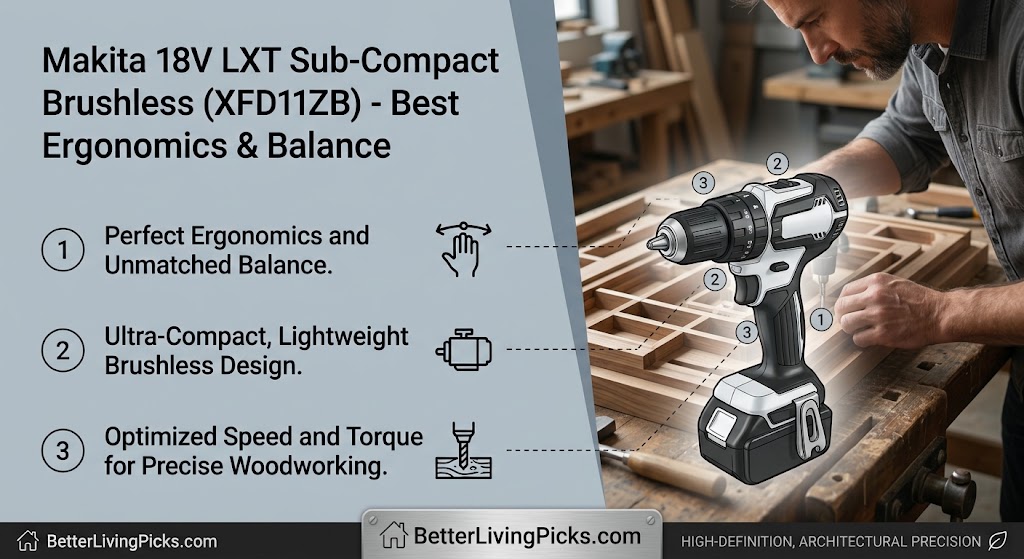
Makita created the sub-compact category by housing an 18V motor inside a 12V-sized chassis. The XFD11ZB is widely regarded by furniture makers for having the smoothest variable speed trigger on the market.
- Woodworking Performance: Ideal for delicate surface assembly work where erratic speed jumps can cause a bit to slip off the screw head and gouge expensive wood surfaces.
- Standout Feature: Dual LED lights with pre-glow and after-glow functions illuminate the exact point of bit entry.
- Pros: Exceptional wrist balance, dark black tactical design, feather-light weight (just 2.8 lbs with battery).
- Cons: Lower overall top-end torque compared to full-sized 18V heavy-duty models.
4. Festool CXS 18 Compact Cordless Drill – Ultimate Precision for Fine Joinery
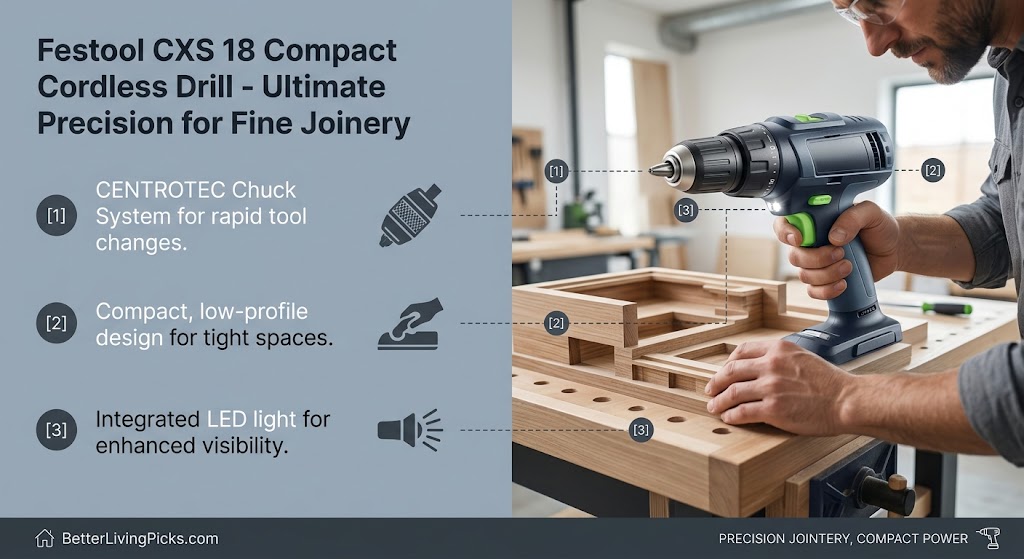
For professional woodworkers who require absolute precision, zero chuck wobble, and seamless quick-change chuck systems, the Festool CXS 18 is an unmatched piece of German engineering.
- Woodworking Performance: The FastFix system allows woodworkers to swap between a standard keyless chuck, a bit holder, an offset attachment, and a right-angle chuck in seconds without tools.
- Standout Feature: Electronic clutch setting with precise digital torque shut-off guarantees exact repeatability across hundreds of hinge screws.
- Pros: Zero runout, unmatched system integration with Systainer storage, versatile chuck heads included.
- Cons: Premium price point; best suited for serious woodworkers and trade professionals.
5. Bosch 12V Max FlexiClick System (GSR12V-140FC) – Best Versatility for Tight Spaces
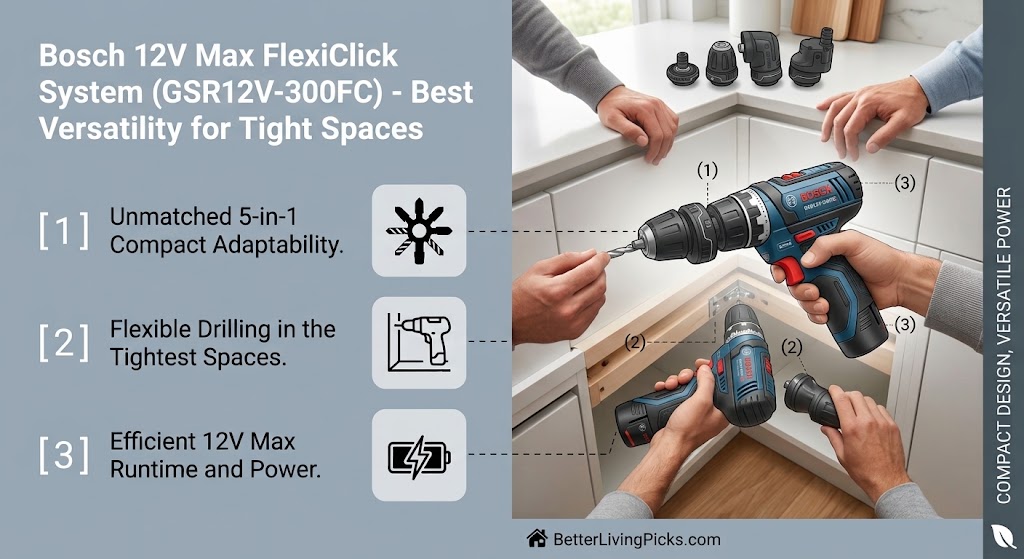
Installing cabinet face hinges, drawer slides, and interior corner brackets often requires drilling in impossible angles. The Bosch FlexiClick system solves this problem with its modular 5-in-1 head design.
👍 What We Like
- Compact 6.37″ Head: Fits easily into tight cabinet boxes.
- Pivoting LED Light: Eliminates chuck shadows on workpieces.
- All-Metal Chuck: Zero bit slippage during high-torque passes.
👎 What to Consider
- Bare Tool Price: Higher upfront investment for tool-only kits.
- Slight Weight: Heavier than standard 12V compact units.
- Woodworking Performance: Comes with a keyless chuck, locking bit holder, right-angle attachment, and an offset angle head that lets you drive screws a mere 1/2-inch away from an edge.
- Standout Feature: The right-angle attachment can rotate into 16 different positions without removing it from the tool body.
- Pros: Solves difficult architectural woodworking problems, compact 12V footprint, light shop weight.
- Cons: 3/8-inch chuck capacity limits use with extra-large drill shanks.
6. Craftsman V20 Cordless Drill Set (CMCD700C1) – Best Budget Choice for Beginners
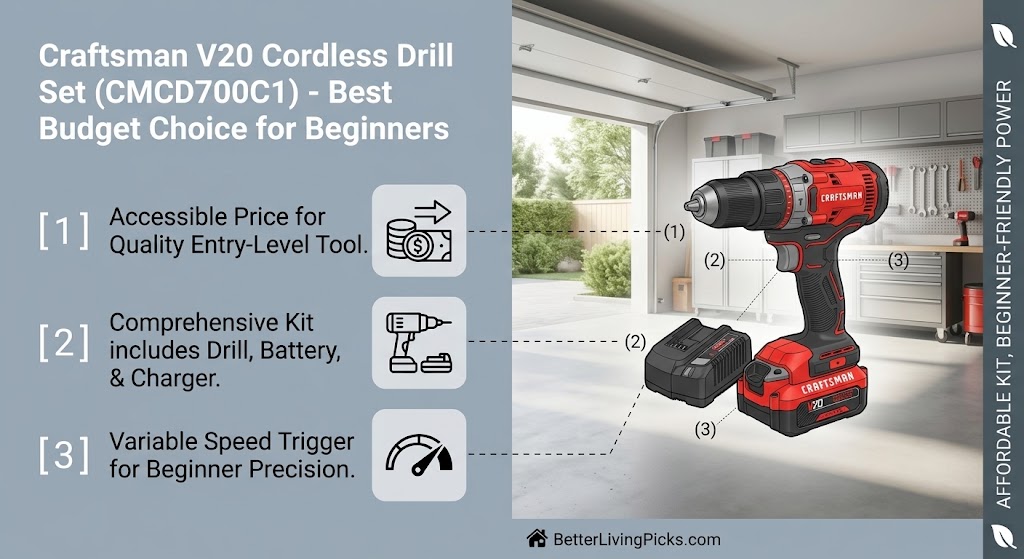
If you are starting your woodworking journey and need a reliable, affordable best power drill for home use and hobby projects, this Craftsman V20 kit offers exceptional value without sacrificing practical strength.
- Woodworking Performance: Delivers 280 unit watts out (UWO), providing ample power for drilling pine dowel holes, assembling workbench frames, and making basic furniture.
- Standout Feature: Includes a double-ended bit tip holder on the base and a smooth 2-speed gearbox (0-350 / 0-1,500 RPM).
- Pros: Highly affordable entry point, easy-to-find battery platform, ergonomic rubber overmold grip.
- Cons: Uses a brushed motor and plastic chuck sleeve; higher chuck runout than premium models.
7. DeWalt 12V MAX Xtreme Drill Driver (DCD701F2) – Best Lightweight Shop Drill
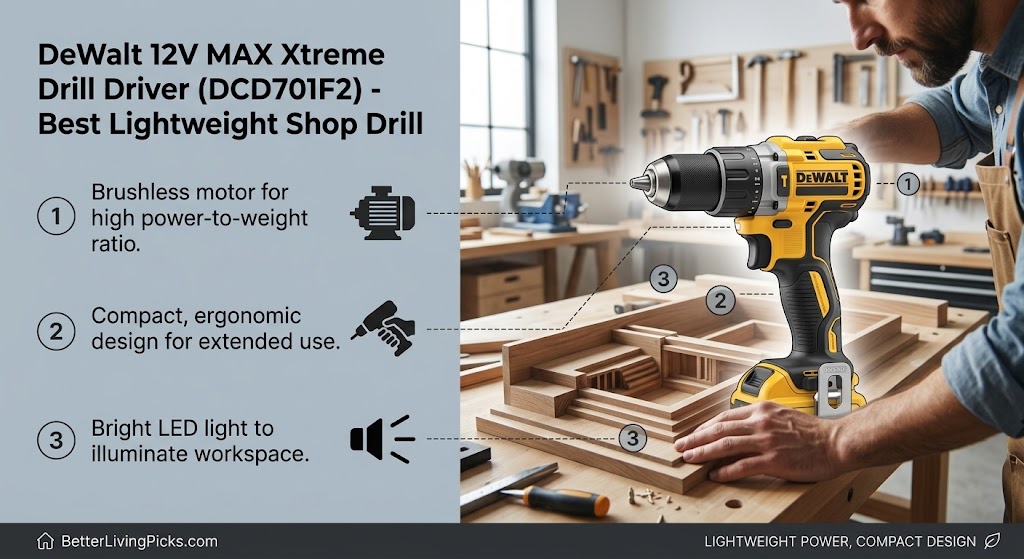
For woodworkers who already own 20V tools for heavy cutting but want a dedicated light-duty drilling companion, the DeWalt 12V Xtreme drill driver weighs just 1.9 lbs (bare tool).
- Woodworking Performance: Performs flawlessly for driving pocket screws, drilling pin holes, and pre-drilling pilot holes all day without arm fatigue.
- Standout Feature: 20% shorter than previous generation 12V tools with an upgraded brushless motor that yields 32% more power.
- Pros: Exceptionally light, fits into tight shop aprons, surprisingly high torque for a 12V tool.
- Cons: Limited to 3/8-inch chuck size; not suitable for large hole saws.
8. Ridgid 18V SubCompact Brushless Drill (R86001) – Best Value 18V Platform
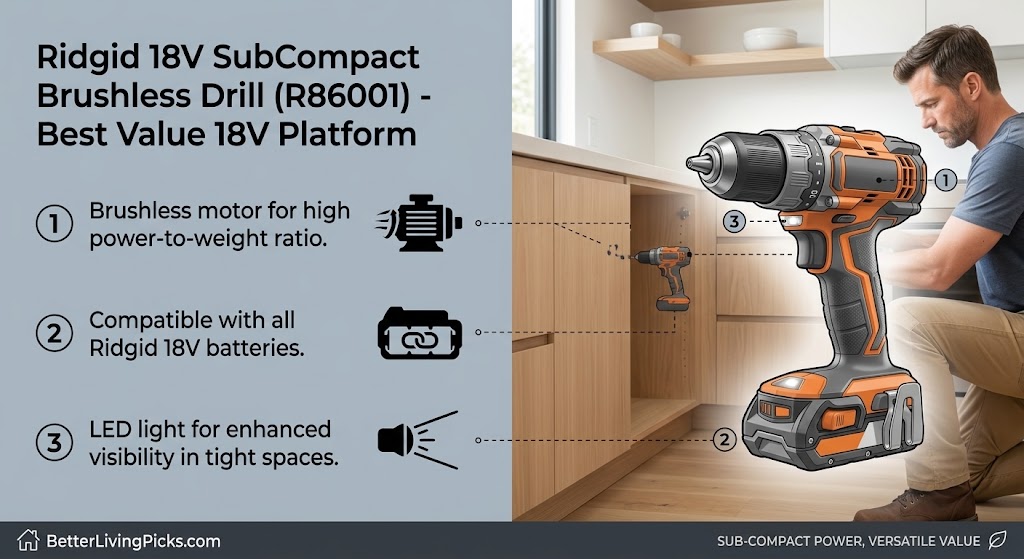
Ridgid’s SubCompact line delivers high power in a small body, backstopped by one of the best warranties in the tool industry: the Lifetime Service Agreement (LSA) with free batteries for life upon registration.
- Max Voltage20V Max (18V Nominal)
- Head Length6.37 Inches
- Max RPM0–650 / 0–2,000 RPM
- Chuck Size & Type1/2″ All-Metal Ratcheting
- Clutch Settings15 Mechanical Positions
- Bare Tool Weight2.82 lbs
- Woodworking Performance: The all-metal gear construction easily drives long wood screws into oak post legs and bores cleanly with Brad point bits.
- Standout Feature: 400 in-lbs of torque packed inside a sub-compact 18V tool frame.
- Pros: Free battery replacements for life (with registration), sturdy construction, solid chuck grip.
- Cons: Slightly heavier than competitive 12V models.
9. Kobalt 24V Max Brushless Drill Driver (KDD 1424A-03) – Heavy-Duty Hole Boring
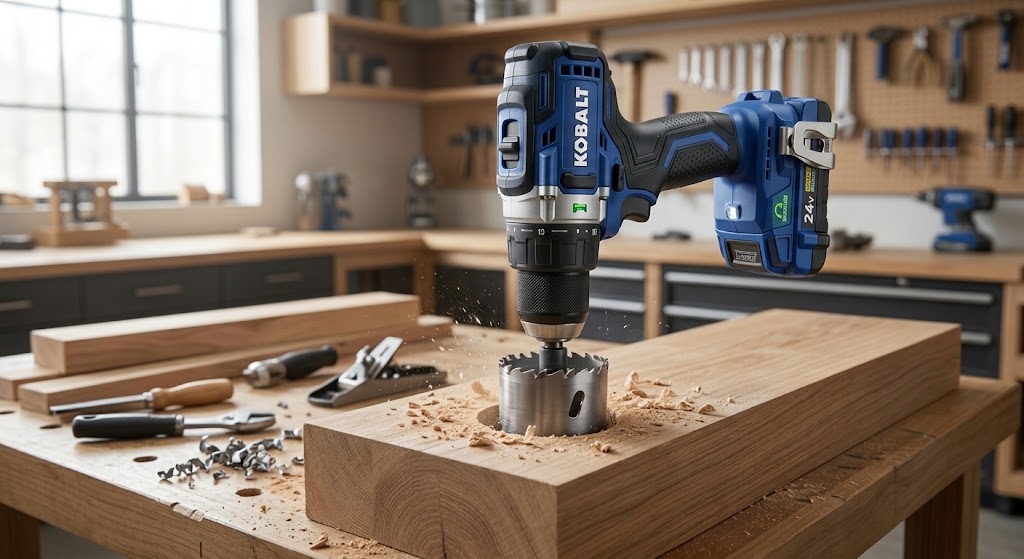
When building heavy outdoor timber projects, thick workbench tops, or boring deep holes using large auger bits, low-voltage drills can bog down. Kobalt’s 24V platform provides brute power at an accessible price.
- Woodworking Performance: Generates up to 650 in-lbs of torque, easily handling heavy duty drill driver tasks that stall standard 18V drills.
- Standout Feature: High-efficiency 24-volt brushless motor paired with an all-metal 1/2-inch keyless chuck.
- Pros: Massive torque output, budget-friendly replacement batteries, durable build.
- Cons: Larger battery footprint adds weight to the base; less suited for delicate small-scale joinery.
10. Ryobi 18V ONE+ HP Brushless Drill (PBLDD01B) – Best DIY & Workshop Ecosystem
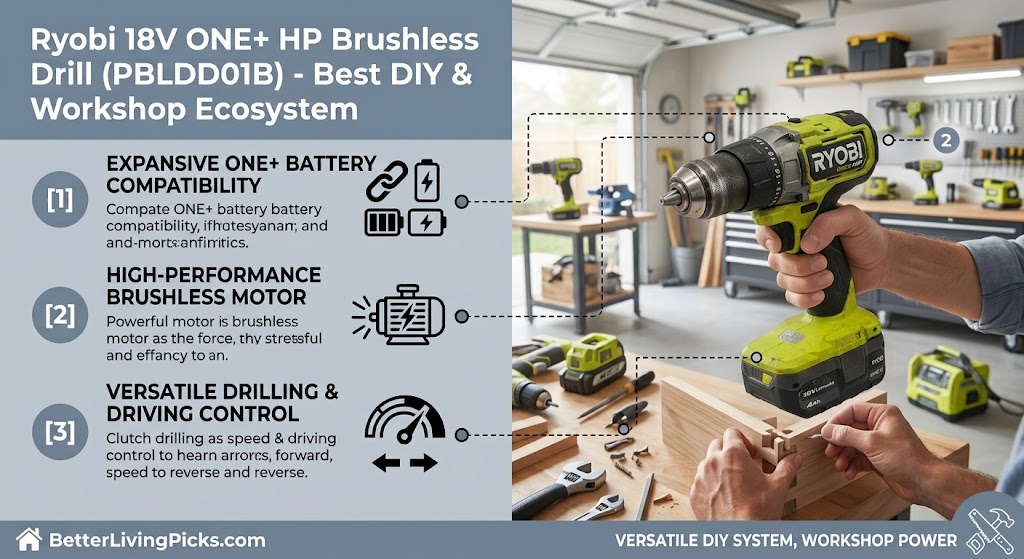
Ryobi’s High Performance (HP) series elevated their tool line into serious DIY and semi-pro territory. The PBLDD01B offers impressive brushless motor performance compatible with over 280 ONE+ tools.
- Woodworking Performance: Provides up to 750 in-lbs of torque and 2,100 RPM, making it an excellent all-rounder for everything from building garage storage to building tables.
- Standout Feature: Brushless motor technology delivers faster drilling speeds under heavy timber resistance.
- Pros: Unmatched tool system compatibility, incredible price-to-performance ratio, solid 1/2-inch metal chuck.
- Cons: Larger battery design makes it slightly bulkier in tight cabinet interiors.
Comprehensive Buyer’s Guide: How to Choose the Best Cordless Drill for Woodworking
Selecting the right drill driver requires evaluating how your specific woodworking projects match up with a tool’s specifications:
1. Chuck Size & Runout: 3/8-Inch vs. 1/2-Inch
- 3/8-Inch Chucks: Found primarily on 12V compact drills. Excellent for drill bit shanks up to 3/8″, drivers, and small countersinks. Ideal for light furniture assembly and cabinetry.
- 1/2-Inch Chucks: Necessary if you regularly use large Forstner bits, hole saws, or heavy-duty auger bits with 1/2″ shanks. Look for all-metal chucks with carbide jaws to prevent bit slippage during deep cuts.
2. Motor Technology: Brushless vs. Brushed
Always opt for a brushless drill driver set if your budget allows. Brushless motors adjust power draw based on wood density, run significantly cooler during repetitive work, and offer up to double the operational lifespan of older brushed motors.
3. Torque Control & Clutch Sensitivity
In general construction, raw torque is king. In woodworking, clutch control reigns supreme. A refined mechanical clutch breaks power transmission smoothly when preset resistance is reached, ensuring screw heads set perfectly flush with the wood surface every single time.
- Precision Over Raw Torque: Fine woodworking demands chuck accuracy, responsive trigger feathering, and detailed clutch control over maximum foot-pounds of torque.
- 12V for Cabinets, 18V for Boring: Choose a 12V compact drill for assembling cabinet drawers and tight spaces; step up to 18V/20V for heavy timber joinery and large Forstner bits.
- Invest in Brushless: Brushless motors run cooler, conserve battery charge during long shop sessions, and provide cleaner motor speed regulation under variable wood grain loads.
- Protect Delicate Hardware: Never drive brass fasteners without pre-threading holes with a matching steel screw first.
Final Recommendation
- For Overall Superior Performance: Choose the DeWalt 20V MAX XR (DCD800) for its unbeatable blend of high torque, compact length, and outstanding 3-mode LED visibility.
- For Cabinet Makers & Tight Spaces: Choose the Milwaukee M12 FUEL (2503-20) or Bosch FlexiClick (GSR12V-140FC) for lightweight maneuverability without sacrificing drilling strength.
- For Ultimate Precision Woodworking: Choose the Festool CXS 18 for zero runout, German precision engineering, and fast chuck interchangeable systems.
Frequently Asked Questions (FAQs)
What is the primary difference between a drill driver and an impact driver in woodworking?
A drill driver uses a keyless chuck and a mechanical torque clutch designed to drill smooth holes and drive fasteners with controlled stopping depth. An impact driver uses a 1/4″ hex quick-release collet and delivers rotational impacts for driving long lag screws into structural lumber; it lacks a clutch and can easily split fine hardwoods or ruin screw countersinks.
Can a 12V cordless drill handle heavy hardwoods like oak and maple?
Yes. Modern 12V brushless drills produce impressive torque and can easily drill twist bits and drive screws into dense hardwoods. However, if you plan to repeatedly bore large holes (over 1-1/2 inches) using Forstner bits, an 18V/20V drill is recommended to prevent thermal overload.
Why does my drill bit wobble when I start drilling holes in wood?
Bit wobble (known as chuck runout) occurs due to low-quality chuck construction, bent drill bits, or improper seating inside the chuck jaws. Choosing a drill with a high-grade, all-metal ratcheting chuck drastically reduces runout for precision joinery.
Is a brushless drill driver worth the extra money for a hobbyist woodworker?
Absolutley. Brushless drills generate less heat, deliver up to 50% longer runtime per battery charge, and maintain consistent rotation speeds under changing load conditions, preventing motor stalls in sticky wood grain.
What speed setting should I use on my drill for woodworking?
Use High Speed (Speed 2, higher RPM) for drilling small twist holes and driving small fasteners. Use Low Speed (Speed 1, lower RPM / high torque) when boring large holes with spade bits, hole saws, or Forstner bits to avoid burning the wood fibers.
How do I stop wood from splitting when driving screws near an edge?
Always drill a pilot hole using a bit matched to the root diameter (shank width) of your screw. Additionally, countersink the hole top so the screw head sits flush without forcing the wood grain apart.
Can I use my woodworking drill driver for light masonry or brickwork?
Standard drill drivers lack a hammer function. While you can drive special masonry bits through brick on standard drill mode slowly, a dedicated hammer drill (or combination drill-hammer driver) is recommended for concrete or brick.
What RPM range is ideal for woodworking drill drivers?
A versatile woodworking drill should offer a 2-speed transmission providing 0-450/500 RPM on Speed 1 for heavy torque driving and 0-1,800/2,000 RPM on Speed 2 for fast, clean hole drilling.
Final Thoughts
Investing in the best cordless drill for woodworking ultimately comes down to matching the tool’s physical ergonomics, clutch responsiveness, and battery ecosystem to your specific workshop projects. Prioritizing control and chuck precision over raw framing power will pay immediate dividends in cleaner joinery, undamaged finished surfaces, and a far more enjoyable crafting experience.