
An HVLP paint sprayer for furniture and cabinets offers the ultimate precision and control. It delivers maximum transfer efficiency with minimal overspray, making it ideal for creating ultra-smooth cabinet doors.
2. Can I use an airless sprayer on cabinet doors?
Yes. An airless paint sprayer for cabinets allows you to spray unthinned paints rapidly. Using fine-finish low-pressure (FFLP) tips ensures a smooth finish cabinet sprayer result without excessive atomization clouding.
3. Do I need to thin paint before spraying cabinets?
HVLP systems generally require thinning thick latex or enamel paints by 10% to 20% using water or Floetrol. High-powered airless sprayers can atomize heavy paints without thinning.
4. What is the best DIY cabinet paint sprayer for beginners?
Self-contained turbine HVLP sprayers are the best DIY cabinet paint sprayer options for homeowners. They offer simple flow adjustments, minimal setup overhead, and easy clean paint sprayer routines.
Refinishing wood cabinets by hand with a brush or roller often leaves behind unsightly lap marks, brush strokes, and uneven textures. Finding the best paint sprayer for cabinets is the single most critical decision you can make to achieve a glass-smooth, factory-grade finish on your kitchen cabinetry. Whether you are aiming for a modern satin conversion varnish or updating solid oak doors with a durable enamel, using the correct spraying equipment turns a tedious multi-week ordeal into an efficient weekend DIY project.
In this comprehensive testing review and buying guide, we analyze the top-rated paint sprayers designed specifically for cabinetry, furniture, and detailed woodworking. We break down the differences between High-Volume Low-Pressure (HVLP) systems, airless spray units, and versatile direct-drive setups so you can select the perfect tool for your skill level, project scale, and budget.
Quick Picks / Verdict Summary Table
The Earlex HV5500 strikes the ultimate balance between professional transfer efficiency, precise fluid control, and long-term durability. Featuring a dedicated 650-watt turbine, stainless steel needle set, and intuitive controls, it produces a flawless, glass-smooth factory finish on wood cabinet doors without requiring expensive external air compressors.
| Model | Technology Type | Ideal User Level | Key Highlight | Best For |
| Earlex Spray Station 5500 | HVLP (Turbine) | DIY to Pro | Stainless steel needle & fluid tip | Overall Cabinet Refinishing |
| Fuji Spray 2202 Semi-PRO 2 | HVLP (2-Stage) | Semi-Pro / Craftsman | Non-bleed gun, professional fan control | Ultra-Fine Factory Finishes |
| Graco Magnum 257025 Project Painter Plus | Airless | DIY Homeowner | Direct intake, RAC IV fine finish compatible | Large Kitchen Projects |
| Wagner FLEXIO 5000 | Direct-Drive HVLP | DIYer | Station base, flexible detail nozzle | Budget-Friendly Versatility |
| Graco Ultra Cordless Airless (17M363) | Cordless Airless | Professional / Advanced | Triax triple piston pump, RAC X FFLP tips | Portable High-End Precision |
| Wagner Control Spray Double Duty | HVLP (Handheld) | Beginner DIYer | Lightweight, two-stage trigger setting | Small Vanity & Detail Jobs |
| Fuji Spray 2904-T70 Mini-MITE 4 | HVLP (4-Stage) | Professional Cabinetmaker | High atomization pressure, handles thick coatings | Unthinned Enamels & Lacquers |
| HomeRight Finish Max (C800766) | HVLP (Direct-Drive) | Budget DIYer | Brass spray tip components, simple setup | Low-Cost Cabinet Projects |
| Titan ControlMax 150 High Efficiency Airless | HEA (Airless) | Intermediate DIY | Up to 55% less overspray than standard airless | Complete Kitchen Renovations |
| California Air Tools + HVLP Gravity Gun | Pneumatic HVLP | Advanced Woodworker | Ultra-quiet compressor setup, professional control | Shop-Based Cabinet Coating |
Dynamic Feature Analysis & Sprayer Selection Matrix
Selecting the proper spray equipment depends directly on understanding the underlying atomization technology. Paint sprayers fall into three main operating categories:
- HVLP (High-Volume Low-Pressure) Turbine Systems: These systems push high volumes of air at low pressures (typically 2 to 10 PSI). High air volume atomizes paint into a fine mist, resulting in minimal overspray and high coating transfer efficiency. They are widely considered the gold standard for detailed trim, furniture, and cabinet doors.
- Airless Paint Sprayers: These pumps force fluid through a tiny nozzle opening under immense hydraulic pressure (1,500 to 3,000 PSI). They handle heavy, unthinned latex and waterborne alkyd enamels effortlessly. When fitted with fine-finish low-pressure (FFLP) tips, an airless paint sprayer for cabinets delivers rapid coverage and exceptional lay-down.
- Direct-Drive Electric Sprayers: These self-contained handheld or base-station units use a compact high-speed motor to generate air flow right at the gun. They offer an accessible entry point for home improvement projects and simple DIY cabinet painting.
Top 10 Paint Sprayers for Kitchen Cabinets: In-Depth Reviews
1. Earlex Spray Station 5500 (Best Overall Cabinet Sprayer)
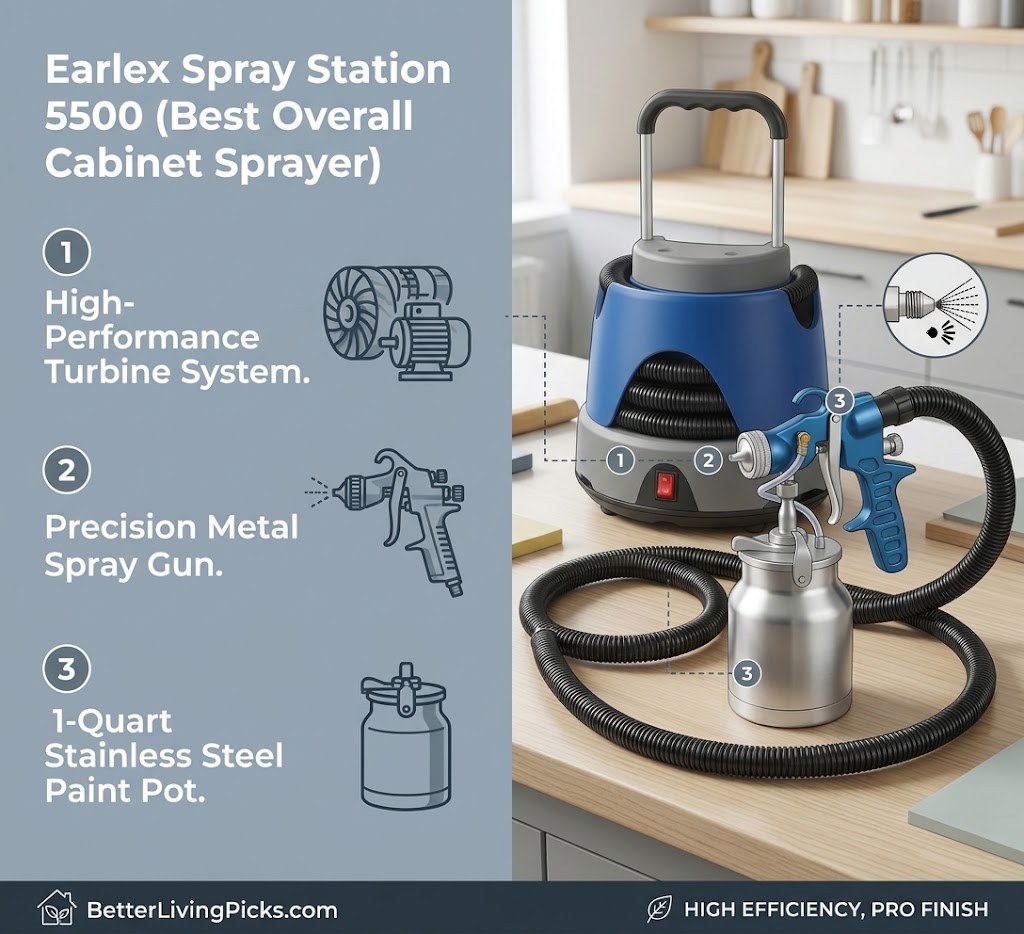
The Earlex HV5500 is a purpose-built HVLP turbine system designed specifically for woodworkers, refinishers, and serious home improvers. Built around a powerful 650-watt turbine, this unit delivers consistent air pressure that creates a uniform, silky finish across flat doors, recessed panels, and face frames.
                    +--------------------------------+
                    |      Earlex HV5500 Turbine     |
                    +---------------+----------------+
                                    |
                            [High-Volume Air]
                                    v
                    +---------------+----------------+
                    |  Pro-Duty Metal Spray Gun      |
                    |  (1.3mm Stainless Needle Set)  |
                    +---------------+----------------+
                                    |
                           [Precision Spray]
                                    v
                    +---------------+----------------+
                    |  Glass-Smooth Cabinet Finish   |
                    +--------------------------------+
Key Performance Metrics
- Atomization Quality: 9.5/10
- Overspray Control: 9.2/10
- Build Quality & Durability: 9.4/10
- Ease of Cleaning: 8.8/10
Practical Breakdown
The standout feature of the Earlex 5500 is its pro-duty metal spray gun paired with a 1.3mm stainless steel needle and fluid tip. Unlike plastic components that wear down or degrade when exposed to solvent-based cleaners, the stainless steel needle maintains precise tolerances over years of use. The push-click spray pattern adjustment allows you to alternate between vertical fan, horizontal fan, and round detail patterns instantly.
When spraying waterborne enamel or waterborne lacquer, thinning the paint by approximately 10% to 15% yields flawless atomization without sag or orange peel texture.
- Pros:
- Stainless steel fluid components resist wear and corrosion.
- Dedicated 13-foot air hose and onboard gun storage keep the workspace tidy.
- Push-click changing between vertical, horizontal, and circular patterns.
- Cons:
- Requires viscosity adjustment (thinning) for thick latex paints.
2. Fuji Spray 2202 Semi-PRO 2 (Best Ultra-Fine Factory Finish)
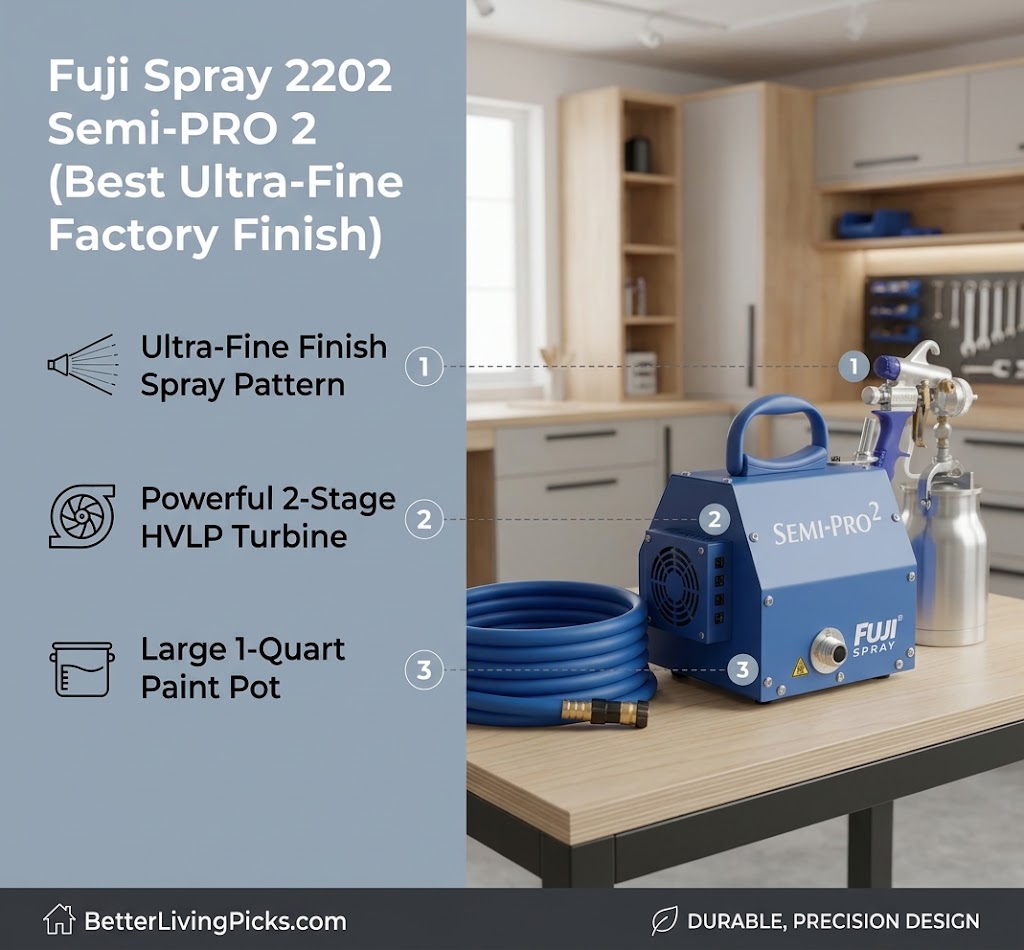
For woodworkers seeking a true cabinet shop finish at home, the Fuji Spray 2202 Semi-PRO 2 offers industrial engineering in a portable package. Featuring a robust 1400-watt 2-stage turbine enclosed in a heavy-duty metal case, the Semi-PRO 2 generates ample pressure to atomize fine woodworking finishes effortlessly.
Key Performance Metrics
- Atomization Quality: 9.8/10
- Overspray Control: 9.6/10
- Build Quality & Durability: 9.7/10
- Ease of Cleaning: 8.5/10
Practical Breakdown
The Semi-PRO 2 comes equipped with the professional-grade Fuji M-Model spray gun. It features a non-bleed design, meaning air flows through the tip only when the trigger is pulled, preventing dust blowback on wet cabinet surfaces. The rear fan control knob allows continuous pattern adjustments from a tiny 1-inch spot up to a wide 12-inch fan pattern.
- Pros:
- Industrial 2-stage turbine casing with washable air intake filters.
- Non-bleed spray gun prevents air turbulence from disturbing unpainted dust.
- Exceptional transfer efficiency drastically reduces mask and booth residue.
- Cons:
- Premium price point compared to entry-level consumer sprayers.
3. Graco Magnum 257025 Project Painter Plus (Best Airless Sprayer for Large Kitchens)
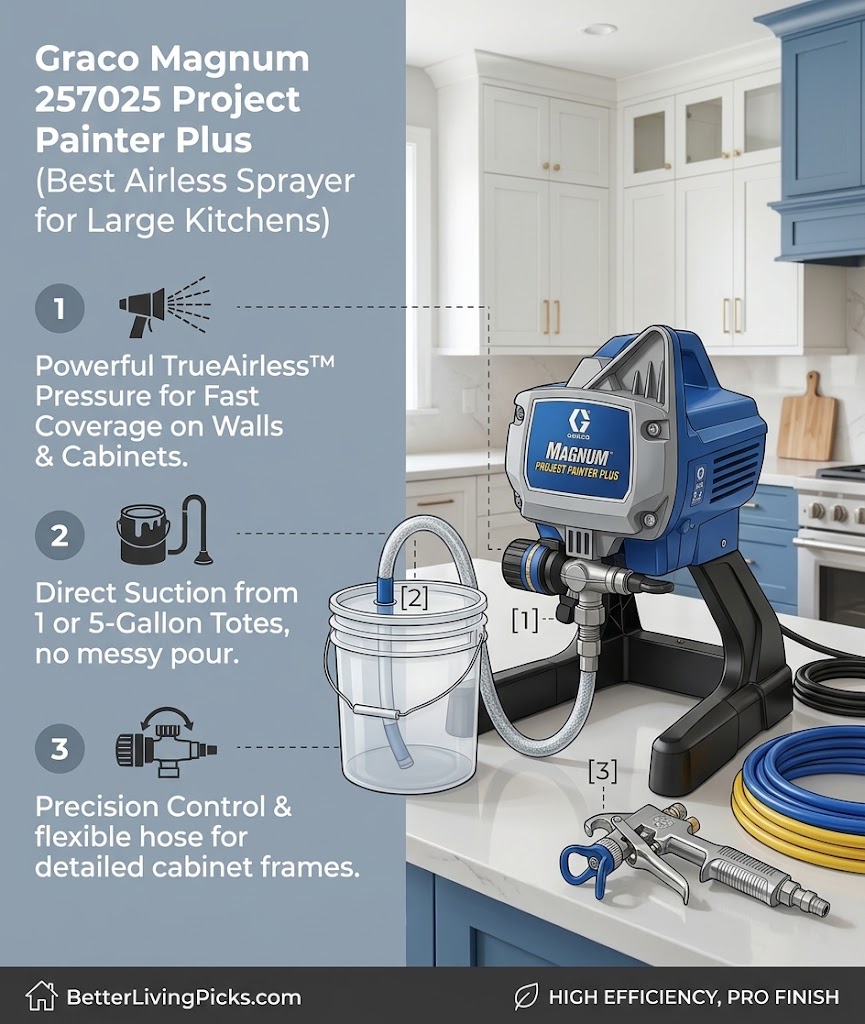
If you need to paint a full kitchen setup with dozens of cabinet doors, drawers, and face frames, an airless paint sprayer for cabinets like the Graco Magnum Project Painter Plus delivers unmatched speed.
Key Performance Metrics
- Atomization Quality: 8.9/10
- Overspray Control: 8.0/10
- Build Quality & Durability: 9.1/10
- Ease of Cleaning: 8.7/10
Practical Breakdown
Operating directly from a 1-gallon or 5-gallon paint bucket via a flexible suction tube, the Project Painter Plus eliminates constant fluid cup refilling. It handles unthinned heavy interior primers and modern acrylic enamel cabinet paints with ease. To achieve a smooth finish on cabinet doors using this unit, swap out standard high-production tips for a Graco RAC IV or RAC X Fine Finish Low Pressure (FFLP) spray tip (such as a 210 or 310 size).
- Pros:
- Pulls paint straight from original paint cans, reducing prep and refilling time.
- Fully adjustable pressure control allows fine-tuning to minimize overspray.
- PowerFlush adapter connects to a standard garden hose for rapid water cleanup.
- Cons:
- Higher overspray volume requires thorough masking of non-painted areas.
4. Wagner FLEXIO 5000 (Best DIY Cabinet Paint Sprayer for Versatility)
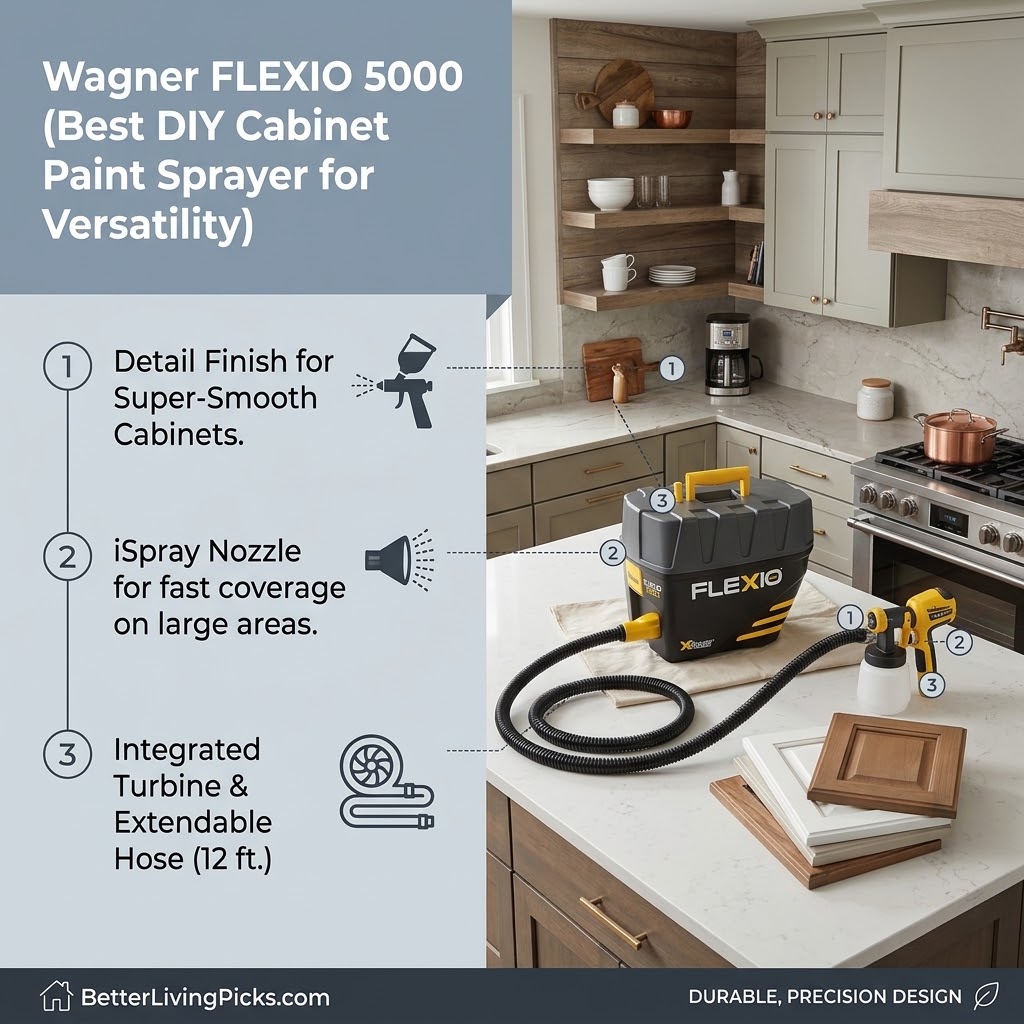
The Wagner FLEXIO 5000 is an all-in-one flexible solution built for homeowners taking on diverse DIY projects. Its stationary base sits on the floor to keep the motor weight off your hands, feeding power to two specialized nozzles included in the kit.
Key Performance Metrics
- Atomization Quality: 8.7/10
- Overspray Control: 8.6/10
- Build Quality & Durability: 8.5/10
- Ease of Cleaning: 8.9/10
Practical Breakdown
The kit includes the iSpray Nozzle for broad surface coverage and the Detail Finish Nozzle, which is uniquely engineered for intricate trim, furniture, and cabinet doors. The Detail Finish Nozzle provides narrow fan control and refined fluid delivery, allowing you to lay down smooth waterborne enamel coats with minimal orange peel.
- Pros:
- Floor-standing turbine base reduces hand fatigue during extended spraying sessions.
- Includes dedicated Detail Finish Nozzle specifically tuned for fine cabinet work.
- Variable X-Boost turbine power switch accommodates varying paint weights.
- Cons:
- Hose can feel slightly stiff when maneuvering around tight panel corners.
5. Graco Ultra Cordless Airless 17M363 (Best Portable Pro Sprayer)
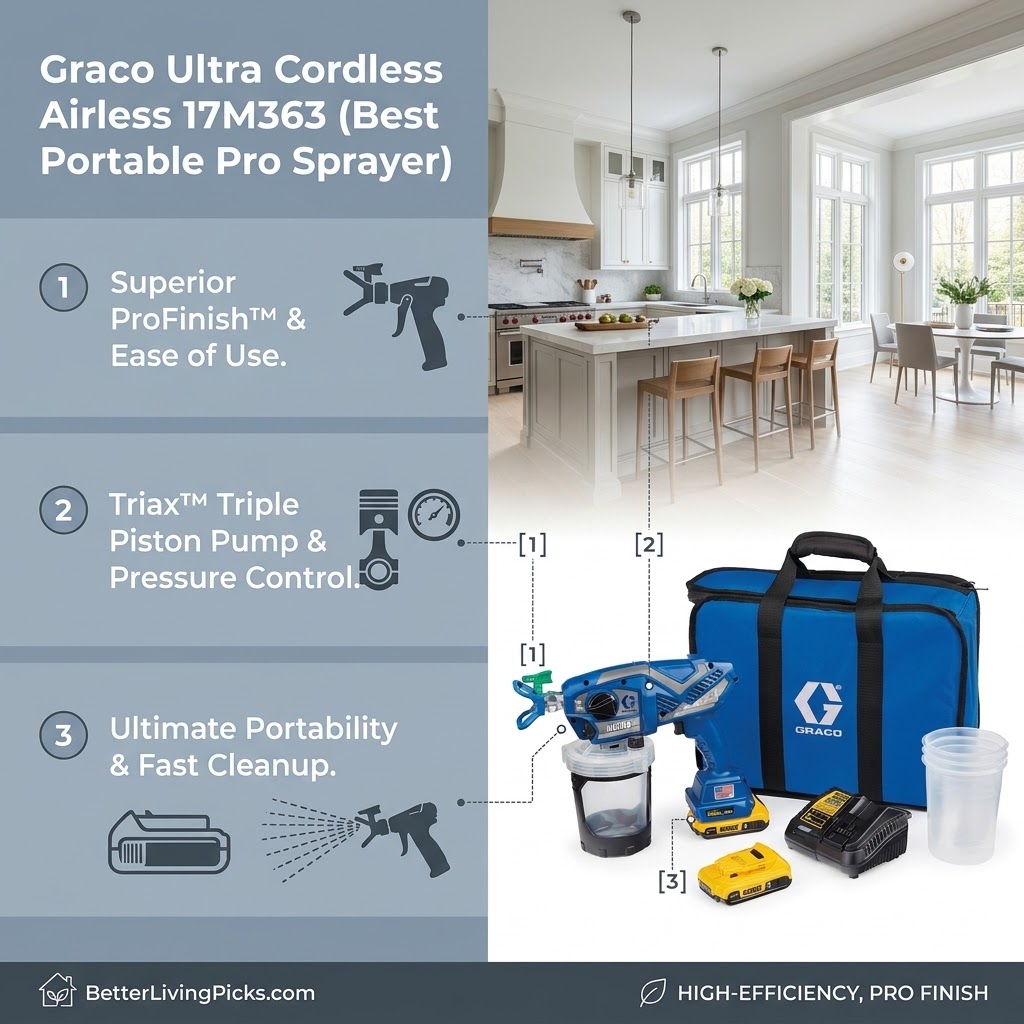
For advanced DIYers and professional tradespeople who demand true airless performance without power cords or large turbine units, the Graco Ultra Cordless stands out as a market leader. Powered by DeWalt 20V MAX lithium-ion batteries, this handheld airless unit generates up to 2,000 PSI of fluid pressure.
Key Performance Metrics
- Atomization Quality: 9.6/10
- Overspray Control: 8.7/10
- Build Quality & Durability: 9.5/10
- Ease of Cleaning: 9.0/10
Practical Breakdown
The Ultra Cordless uses Graco’s Triax Triple Piston Pump with ProConnect, allowing for modular field replacement. Crucially for cabinet work, it operates with Graco RAC X FFLP tips, creating atomization at half the working pressure of conventional airless units. It utilizes FlexLiner bag systems, allowing you to tilt and spray the gun upside down when coating upper frame undersides or horizontal door panels.
- Pros:
- Completely cordless freedom eliminates tripping hazards and line tugs.
- Full-pressure airless atomization handles unthinned cabinet enamels cleanly.
- FlexLiner bag system allows full 360-degree rotation spraying.
- Cons:
- Heavy in the hand when loaded with paint and battery.
6. Wagner Control Spray Double Duty (Best Budget Handheld Sprayer)
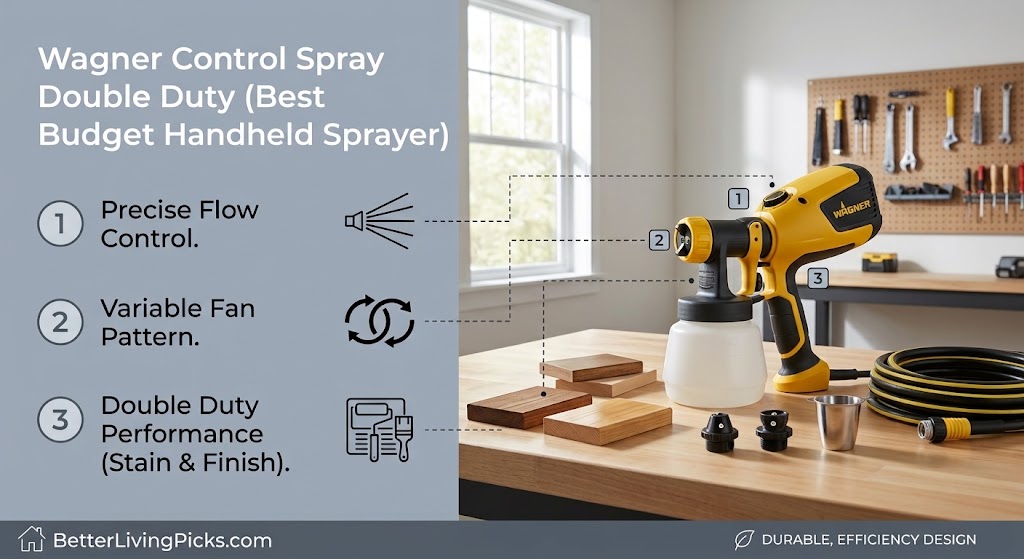
For smaller kitchen updating projects or bathroom vanity restorations, the Wagner Control Spray Double Duty delivers reliable performance at an affordable price point.
Key Performance Metrics
- Atomization Quality: 8.2/10
- Overspray Control: 8.4/10
- Build Quality & Durability: 8.0/10
- Ease of Cleaning: 9.2/10
Practical Breakdown
This compact unit utilizes a two-stage air turbine to spray lightweight materials like stains, lacquers, sealers, and thinned enamels. It features a variable flow trigger setting and three adjustable spray patterns (horizontal, vertical, circular). Because it relies on a smaller internal air turbine, paint thinning is required when using standard latex products.
- Pros:
- Highly affordable entry point for small DIY projects.
- Simple disassembly makes it an easy clean paint sprayer.
- Lightweight, compact design reduces strain during short jobs.
- Cons:
- Requires precise paint thinning to prevent spatters with heavy paint.
7. Fuji Spray 2904-T70 Mini-MITE 4 (Best High-Output Pro Turbine)
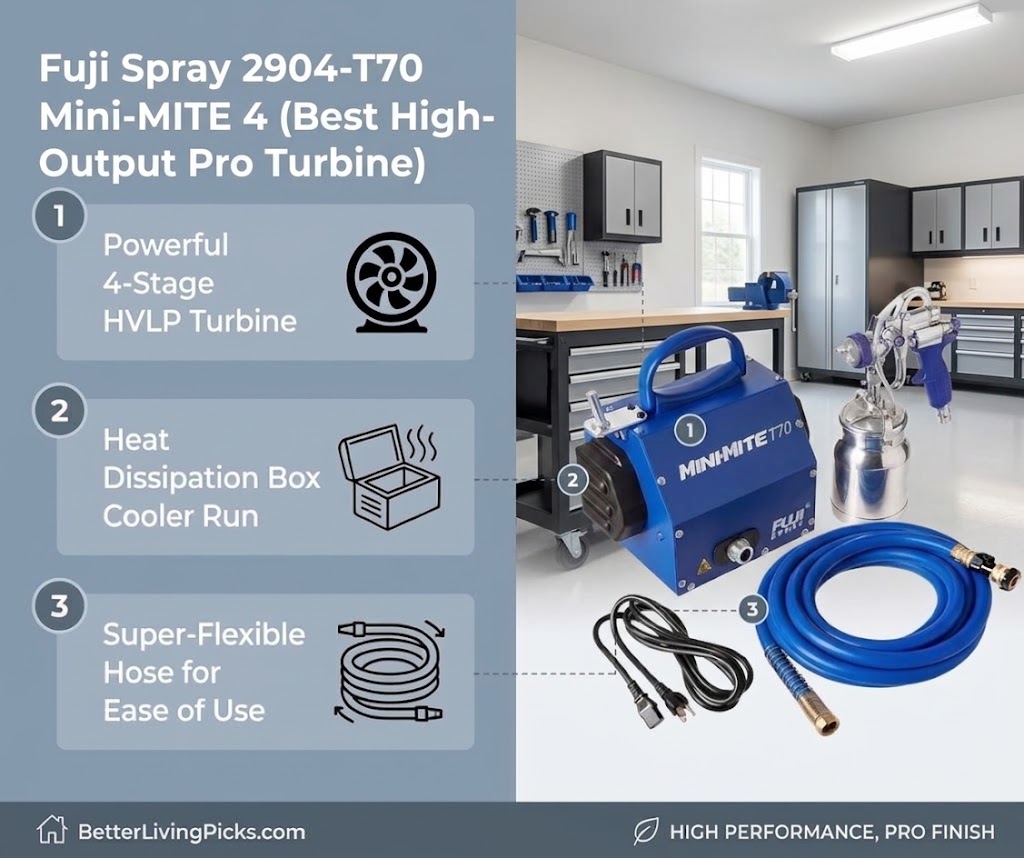
Designed for ultimate atomization energy, the Fuji Mini-MITE 4 features a powerful 4-stage turbine system generating approximately 8.5 PSI at the air cap. This added power allows the unit to atomize unthinned or minimally thinned heavy coatings with complete precision.
Key Performance Metrics
- Atomization Quality: 9.9/10
- Overspray Control: 9.4/10
- Build Quality & Durability: 9.8/10
- Ease of Cleaning: 8.8/10
Practical Breakdown
Equipped with the T-70 non-bleed spray gun, the Mini-MITE 4 includes side pattern control to adjust fan size seamlessly. Woodworking shops and custom cabinet builders rely on 4-stage turbines because they deliver atomization energy equivalent to heavy pneumatic setups without requiring industrial air compressor lines.
- Pros:
- 4-stage turbine easily atomizes thick waterborne paints, lacquers, and polyurethane.
- Heavy-gauge aluminum turbine case built for decades of active use.
- Ergonomic T-70 spray gun offers tactile pattern control.
- Cons:
- Higher noise level during operation due to the 4-stage turbine motor.
8. HomeRight Finish Max C800766 (Best Low-Cost Entry Option)
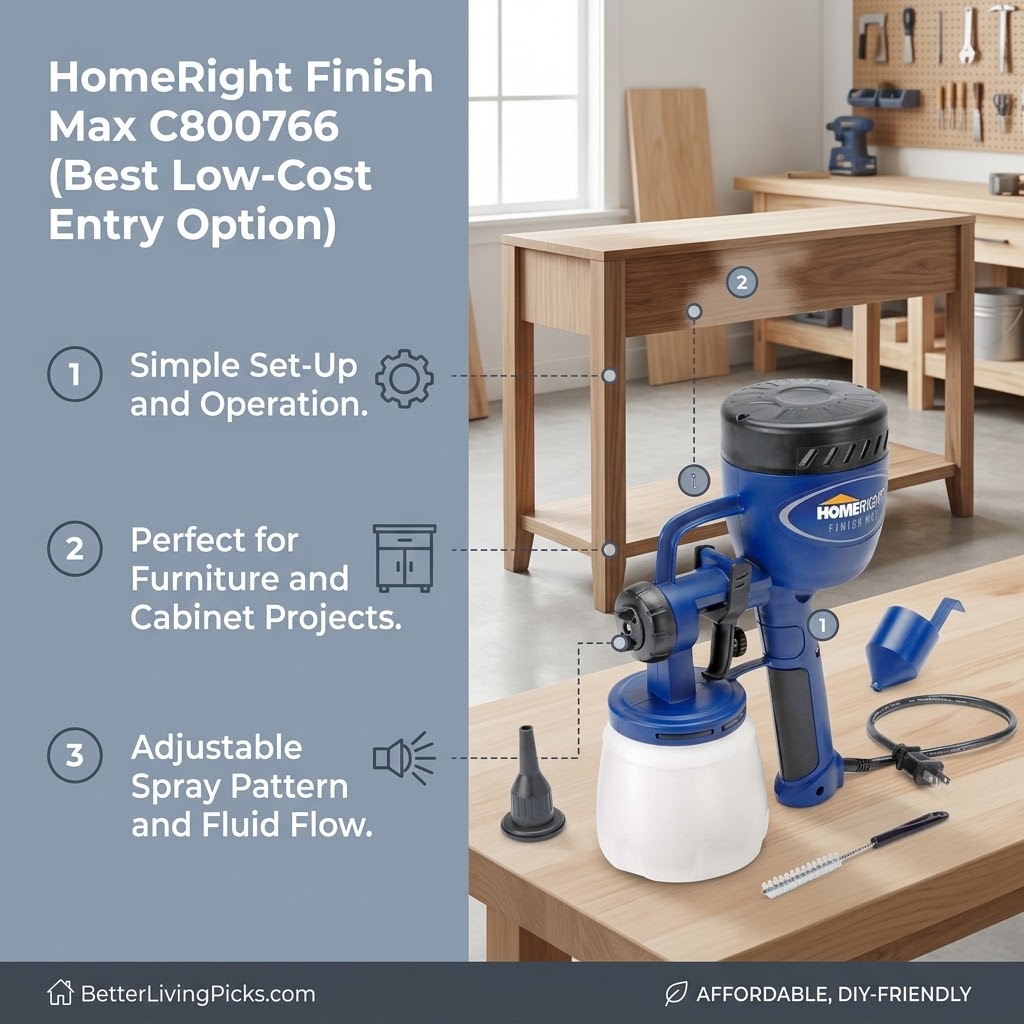
The HomeRight Finish Max (C800766) is a popular self-contained HVLP paint sprayer for furniture and smaller cabinet projects. It offers brass spray needle components in an accessible, low-cost tool.
Key Performance Metrics
- Atomization Quality: 8.0/10
- Overspray Control: 8.3/10
- Build Quality & Durability: 8.1/10
- Ease of Cleaning: 9.0/10
Practical Breakdown
Unlike many entry-level sprayers that use soft plastic nozzles, the Finish Max features a 2.0mm brass spray tip and needle. Brass offers improved wear resistance and consistent precision over plastic components. It is simple to disassemble, making it easy to flush waterborne primer and paints after completing your project.
- Pros:
- Brass fluid tip provides accurate spray patterns and durability.
- Lightweight self-contained design requires no separate hoses or turbines.
- Extremely economical for budget-conscious homeowners.
- Cons:
- Small fluid container requires frequent refilling on large kitchen builds.
9. Titan ControlMax 150 High Efficiency Airless (Best Reduced-Overspray Airless)
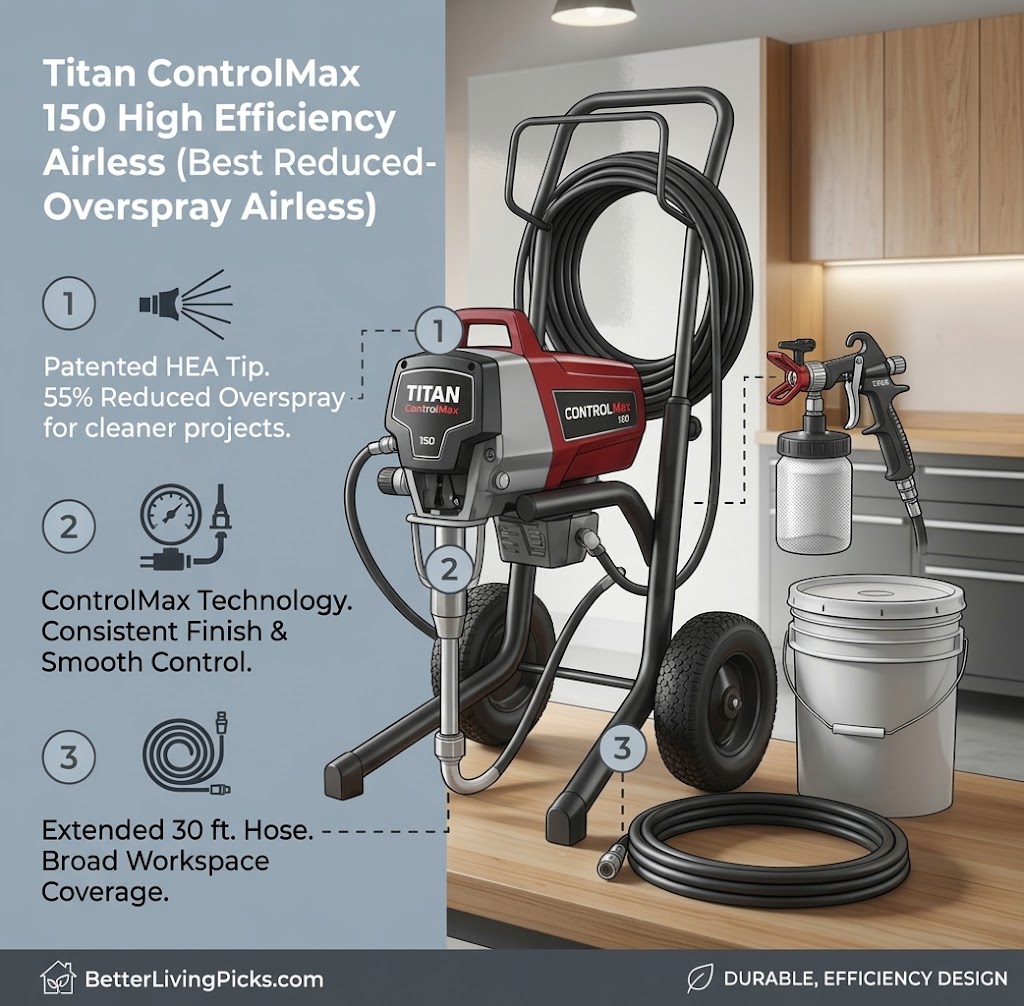
The Titan ControlMax 150 utilizes High Efficiency Airless (HEA) technology, reducing operating pressure by up to 55% compared to standard airless sprayers while maintaining high fluid flow rates.
Key Performance Metrics
- Atomization Quality: 9.0/10
- Overspray Control: 8.8/10
- Build Quality & Durability: 9.0/10
- Ease of Cleaning: 8.6/10
Practical Breakdown
By spraying at lower hydraulic pressure, the HEA tip creates a softer fan pattern with feathered edges. This feathered edge makes overlapping passes forgiving, reducing harsh lines or runs on cabinet door faces while generating up to 55% less overspray fog than traditional airless sprayers.
- Pros:
- Softer fan edges simplify coat overlapping for seamless finishes.
- Noticeable reduction in overspray fog compared to standard airless models.
- Direct suction from standard paint cans.
- Cons:
- Spray tip options are limited exclusively to Titan HEA tips.
10. California Air Tools Quiet Compressor + HVLP Gravity Gun (Best Compressed-Air Setup)
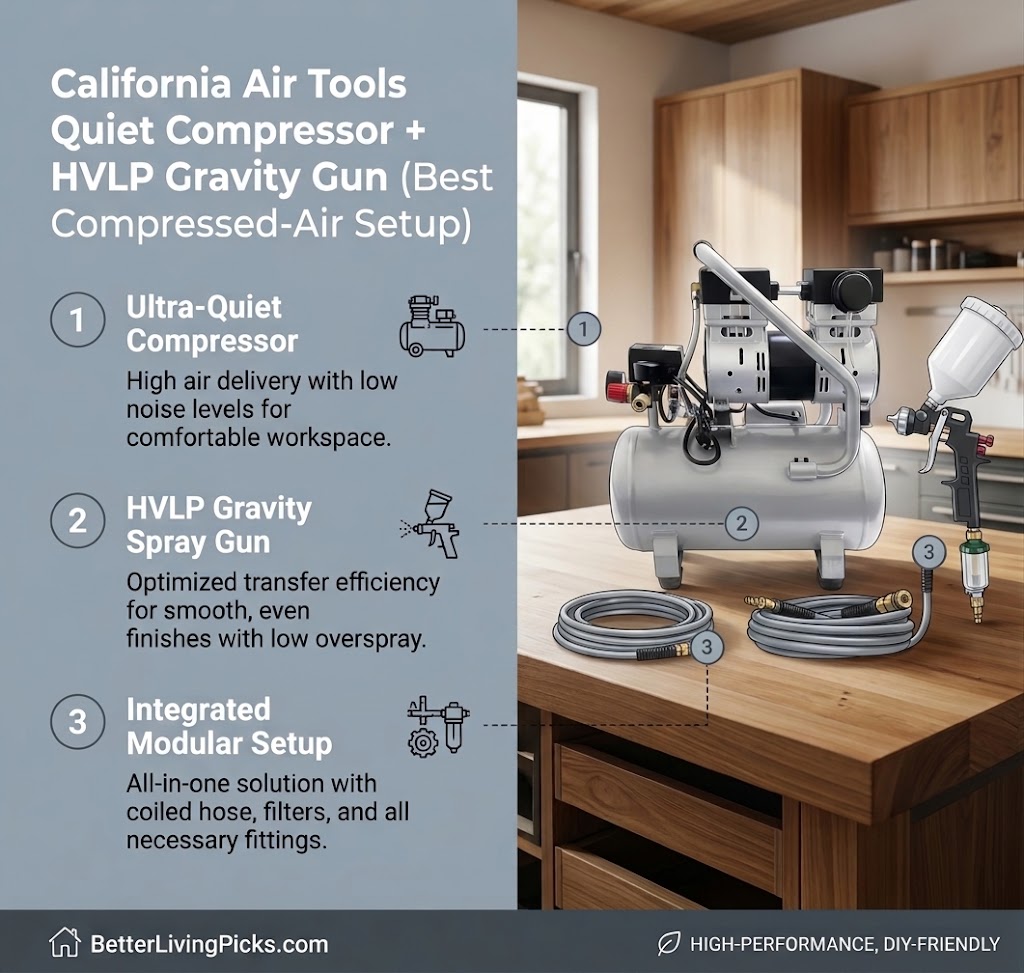
For woodworkers who already own or prefer an air compressor setup, pairing a quiet air compressor with an HVLP gravity-feed spray gun offers precise, professional-grade control.
Key Performance Metrics
- Atomization Quality: 9.4/10
- Overspray Control: 9.1/10
- Build Quality & Durability: 9.3/10
- Ease of Cleaning: 8.7/10
Practical Breakdown
A gravity-feed HVLP gun relies on top-mounted fluid cups that feed paint downward via gravity, requiring less air pressure to pull paint into the air stream. When paired with an ultra-quiet compressor (operating around 60 decibels), this configuration provides a calm, highly controlled workspace suited for fine finishing.
- Pros:
- Top-mounted gravity cup feeds paint efficiently with minimal fluid waste.
- Compressor setup can be re-purposed for pneumatic nailers and tires.
- High level of fine tuning for both air pressure and fluid delivery.
- Cons:
- Requires maintaining a dedicated air line, moisture filter, and regulator.
Complete Buyer’s Guide: How to Select the Ideal Cabinet Sprayer
1. HVLP vs. Airless: Choosing the Right Engine
Selecting between an HVLP turbine and an airless sprayer depends primarily on project scope, workspace setup, and your desired finish:
- Choose HVLP if: You want maximum transfer efficiency, precise control over detailed moldings, minimal overspray inside residential rooms, and a smooth finish that rivals factory-sprayed furniture.
- Choose Airless if: You want to spray unthinned paints across a large volume of cabinet doors, face frames, or wall paneling in a fully masked environment where speed is a top priority.
2. Needle Sizes & Tip Selection Guide
Matching the correct needle size or tip orifice to your paint viscosity is crucial for avoiding orange peel or paint runs:
- 1.0mm – 1.3mm (HVLP): Ideal for thin lacquers, clear topcoats, stain, and shellac.
- 1.5mm – 1.8mm (HVLP): Ideal for thinned cabinet enamels, waterborne acrylics, and latex primers.
- 2.0mm + (HVLP): Suitable for thicker wall paints and heavy primers.
- 208 – 310 FFLP Tips (Airless): Ideal for cabinet doors, providing a 4-to-6-inch fan pattern with minimal fluid output for ultimate control.
3. Paint Formulation Considerations
- Waterborne Acrylic Alkyds: The industry standard for cabinet painting. They dry hard like traditional oil paints but clean up easily with soap and water.
- Lacquer & Conversion Varnish: Requires excellent ventilation, proper respirator gear, and solvent-rated spray equipment with solvent-resistant seals.
Final Recommendation & Verdict
- HVLP Precision: High-Volume Low-Pressure sprayers offer unmatched transfer efficiency and low overspray, making them ideal for detailed cabinet doors.
- Fine Finish Tips are Essential: When using an airless sprayer, always equip a Fine Finish Low Pressure (FFLP) tip to eliminate tailing and heavy edge lines.
- Surface Prep Matters Most: Degreasing, sanding with 220-grit paper, and applying a bonding primer are essential for long-term paint adhesion.
- Maintain Clean Gear: Flush your spray gun with the appropriate solvent immediately after use to prevent clogged internal fluid passages.
For the vast majority of homeowners and DIY woodworkers, the Earlex Spray Station 5500 stands out as the best paint sprayer for cabinets. Its dedicated turbine, stainless steel needle construction, and intuitive controls deliver a smooth finish without requiring an external compressor.
If you are a serious woodworker seeking maximum precision, invest in the Fuji Spray 2202 Semi-PRO 2. For large-scale projects where speed is critical, an airless sprayer like the Graco Magnum Project Painter Plus equipped with a RAC X FFLP tip offers unmatched coverage speed.
Frequently Asked Questions (FAQs)
1. Is an HVLP or airless sprayer better for kitchen cabinets?
HVLP sprayers are generally superior for kitchen cabinets because they operate at lower air pressures, resulting in higher transfer efficiency, less bounce-back, and finer control over detail work. However, airless sprayers fitted with fine-finish low-pressure (FFLP) tips are excellent for rapid coverage on large cabinet builds.
2. What paint viscosity is best for spraying cabinets?
Waterborne acrylic alkyd enamels thinned slightly to a flow rate of 25 to 30 seconds through a standard Ford #4 viscosity cup provide optimal leveling and durability without running.
3. How do I avoid orange peel texture when spraying cabinet doors?
Orange peel typically results from improper paint viscosity, incorrect spray tip sizing, or low air pressure. Ensure your paint is properly thinned according to your sprayer’s manual, keep your distance around 6 to 8 inches from the door, and maintain steady, overlapping passes.
4. Should I spray cabinet doors lying down flat or hanging vertically?
Spraying cabinet doors flat on a drying rack or turntable allows paint to level out naturally without running or dripping. Hanging doors vertically saves space, but requires thinner coats to prevent sags.
5. Can I spray latex paint through an HVLP sprayer?
Yes, but standard latex paint usually requires thinning with water or a specialized conditioner like Floetrol (typically 10% to 20%) to pass smoothly through standard HVLP fluid tips without spitting.
6. What tip size should I use for spraying cabinets with an airless sprayer?
A 210, 310, or 312 Fine Finish Low Pressure (FFLP) tip is ideal. The first digit represents half the fan width (a ‘3’ produces a 6-inch fan pattern), while the last two digits represent the orifice size in thousandths of an inch (.010 inch).
7. How many coats of paint should I spray on kitchen cabinets?
A standard high-durability finish requires one coat of stain-blocking bonding primer followed by two thin topcoats of cabinet-grade acrylic enamel, with light block sanding (320-grit) between coats.
8. How long should cabinet doors dry before handling or reinstalling?
Allow doors to dry for at least 24 hours before light handling, and wait 3 to 5 days before reinstalling hardware. Full chemical curing for acrylic alkyd enamels takes between 14 and 30 days.
Final Thought
Transforming worn kitchen cabinets into a sleek, factory-finished centerpiece is one of the highest-value DIY projects you can undertake. By choosing a dedicated paint sprayer matched to your project scope and taking time to prep the surface thoroughly, you will achieve professional, long-lasting results.