
The DeWalt 20V MAX XR (DCS356B) stands out as the overall top pick due to its 3-speed selector, tool-free quick-change system, dual-grip variable speed trigger, and exceptional ergonomics across tough demolition tasks.
Yes, modern budget models like the Bauer 20V or Ryobi ONE+ 18V provide ample power for door jamb undercutting, drywall cutouts, and detail sanding, though they may transfer slightly higher vibration to your hands during prolonged use.
Lever-action quick-change systems—such as DeWalt’s Quick-Change trigger system or the Starlock system used by Fein and Bosch—allow fast, tool-free blade swaps without requiring separate Allen wrenches.
While brushed motors work fine for occasional home repairs, brushless motors delivered higher runtime, less heat generation, and greater power under load, making them essential for extensive home remodeling projects.
When tackling home renovation projects, having the best oscillating multi tool on hand can mean the difference between a clean, professional finish and hours of tedious manual labor. Whether you are undercutting door jambs, plunge-cutting through stubborn drywall, flush-cutting copper pipes, or removing dried grout, these versatile power tools handle delicate and aggressive cuts where traditional saws simply cannot reach.
Choosing the right model depends heavily on your project scope, battery platform preferences, and budget constraints. In this guide, we evaluate the top-performing multi-tools across all price tiers from budget-friendly DIY options to heavy-duty professional units to help you select the precise tool for your remodeling toolkit.
The DeWalt DCS356B delivers an unbeatable combination of low vibration, a 3-speed control switch, and a comfortable dual-grip variable speed trigger. Its tool-free accessory system speeds up blade changes significantly, making it the most dependable choice for both seasoned trade professionals and active home remodelers.
Quick Picks / Verdict Summary
| Model | Tier / Category | Power Source | Oscillation Angle | Speed Range (OPM) | Key Feature |
| DeWalt 20V MAX XR (DCS356B) | Overall Best | Cordless (20V) | 1.6° | 0 – 20,000 | 3-Speed Selector & Quick-Change Trigger |
| Milwaukee M18 FUEL (2526-20) | Professional / Heavy Duty | Cordless (18V) | 4.2° | 10,000 – 20,000 | Ultra-Fast Cutting & Starlock Auto-Load |
| Fein MultiMaster MM 500 Plus | Premium / Low Vibration | Corded (350W) | 2 x 1.7° | 10,000 – 19,500 | Anti-Vibration StarlockPlus System |
| Ryobi ONE+ 18V (P343B) | Best Budget Cordless | Cordless (18V) | 3.2° | 0 – 20,000 | Tool-Free Blade Latch & Great Value |
| Rockwell Sonicrafter F50 (RK5142K) | Best Heavy-Duty Corded | Corded (4.0 Amp) | 5.0° | 10,000 – 21,000 | Hyperlock 1-Ton Clamping Force |
Dynamic Feature Analysis: What Separates the Best Multi-Tools
When evaluating oscillating multi-tools for remodeling tasks, four critical engineering metrics dictate how well a tool performs under real-world conditions:
- Oscillation Angle & Speed Control: A wider oscillation angle (3.2° to 5.0°) removes material faster, making it ideal for rough plunge cuts or heavy demolition. A narrower angle (1.6°) provides finer precision for detail sanding and clean trim cuts. A responsive variable speed multi tool allows you to adjust speed based on material density preventing heat buildup on wood or melting plastic components.
- Vibration Dampening: Uncontrolled vibration causes hand fatigue during extended use and reduces cutting accuracy. Top-tier professional models isolate the internal motor housing from the outer handle to minimize vibration transfer.
- Accessory Mount Compatibility: Multi-tool versatility relies on quick blade changes. Standard OIS (Oscillating Interface System) mounts work broadly with universal adapters, while Starlock snap-on systems eliminate touch points when switching hot blades.
- Motor Efficiency: Brushless motors adjust power output dynamically based on resistance, maintaining consistent blade speed through dense lumber or embedded nails without stalling.
Top Oscillating Multi-Tools Reviewed for Remodelers
1. DeWalt 20V MAX XR Brushless Multi-Tool (DCS356B) — Overall Best
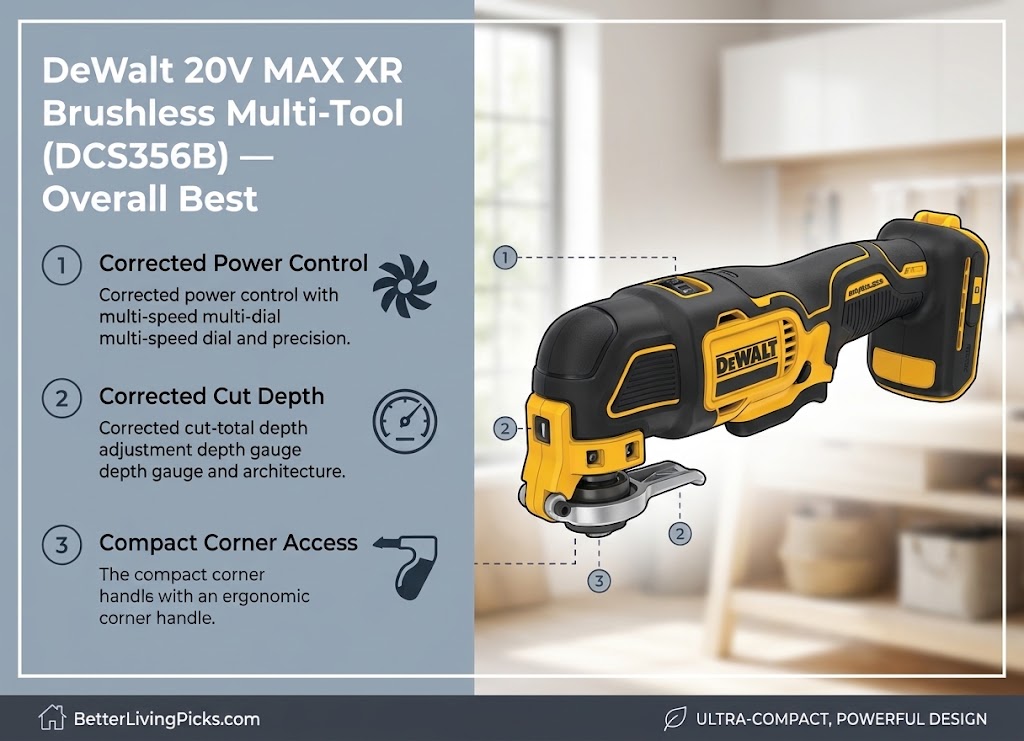
The DeWalt DCS356B sets the industry standard for balance, control, and ergonomic handling. Designed with a 3-speed application switch, it lets users match tool output directly to the task whether performing high-speed drywall removal or controlled detail trimming.
DeWalt 20V MAX XR (DCS356B)
Overall Top PickKey Specifications:
• Voltage: 20V MAX
• Motor Type: Brushless
• Oscillation Speed: 0 – 20,000 OPM
• Oscillation Angle: 1.6°
• Weight: 2.33 lbs (Bare Tool)
Hands-On Performance: During hands-on door jamb undercutting tests, the dual-grip variable speed trigger gave unmatched control. Instead of stopping to dial speed knobs mid-cut, pressure on the paddle switch smoothly adjusts blade speed on the fly. The integrated LED light illuminates dark work areas under baseboards effectively.
- Pros:
- Exceptional ergonomics with comfortable dual-grip trigger control.
- Fast tool-free accessory changes without loose pins or wrenches.
- Bright forward-facing LED headlight.
- Cons:
- Uses a 1.6° angle, prioritizing cut smoothness over aggressive demolition speed.
2. Milwaukee M18 FUEL Oscillating Multi-Tool (2526-20) — Best for Heavy Demolition
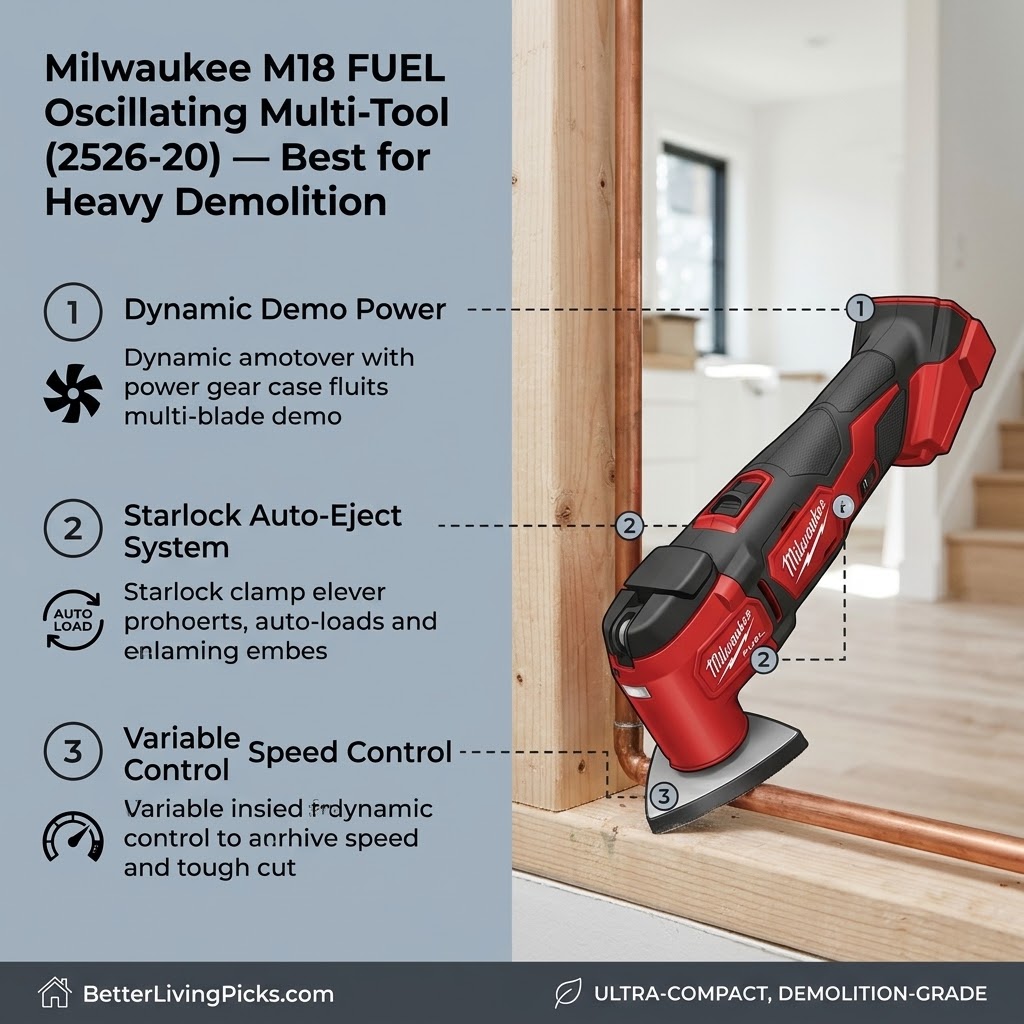
If maximum cut speed and aggressive material removal are top priorities, the Milwaukee M18 FUEL delivers performance matching or exceeding corded units. Driven by a POWERSTATE brushless motor, it pairs a wide 4.2° oscillation angle with 10,000 to 20,000 OPM to power through tough materials effortlessly.
Key Specifications:
• Voltage: 18V
• Motor Type: Brushless
• Oscillation Speed: 10,000 – 20,000 OPM
• Oscillation Angle: 4.2°
• Accessory Mount: Starlock Auto-Load Compatible
Hands-On Performance: In speed tests cutting through nail-embedded 2×4 framing lumber, the M18 FUEL completed plunge cuts nearly twice as fast as basic DIY models. Its advanced vibration-dampening system isolates the tool body, keeping hand fatigue low even during aggressive cutting.
- Pros:
- Extremely fast cutting speed powered by a wide 4.2° oscillation arc.
- Starlock compatibility for instant, hands-free blade snap-ins.
- 10-position variable speed dial with auto-load control.
- Cons:
- Heavy battery profile adds weight when working overhead for extended periods.
3. Fein MultiMaster MM 500 Plus — Best Low-Vibration Corded Option
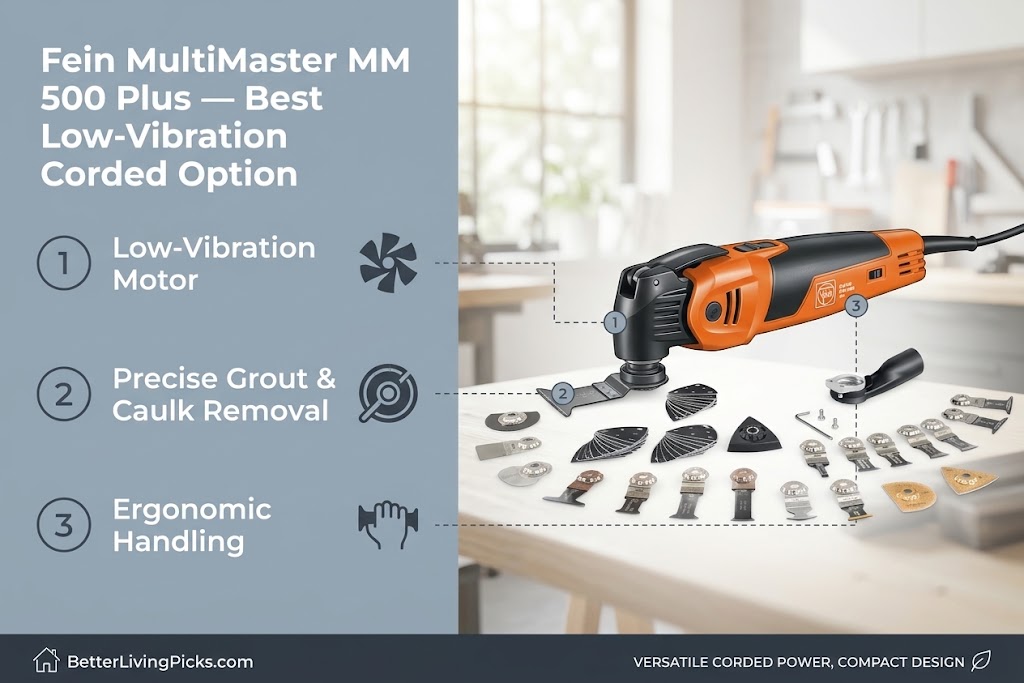
Fein invented the oscillating tool, and their MultiMaster MM 500 Plus remains a benchmark for precision, build quality, and smooth operation. Powered by a 350-watt motor mounted on an isolated self-supporting frame, it reduces housing vibration to near zero.
Key Specifications:
• Power: 350W Corded Electric
• Oscillation Speed: 10,000 – 19,500 OPM
• Interface: StarlockPlus
• Cord Length: 16 ft Industrial Rubber
Hands-On Performance: The Fein MM 500 excels in continuous detail work like grout removal, cabinet notch cuts, and floor restoration. Because it runs on corded power, it delivers steady performance all day without requiring battery swaps or suffering thermal slowdowns.
- Pros:
- Industry-leading anti-vibration technology reduces hand fatigue.
- StarlockPlus direct connection ensures maximum power transfer to the blade.
- Metal gearbox housing stands up to severe jobsite conditions.
- Cons:
- Higher initial cost; requires corded power management.
4. Ryobi ONE+ 18V Oscillating Multi-Tool (P343B) — Best Value for DIYers
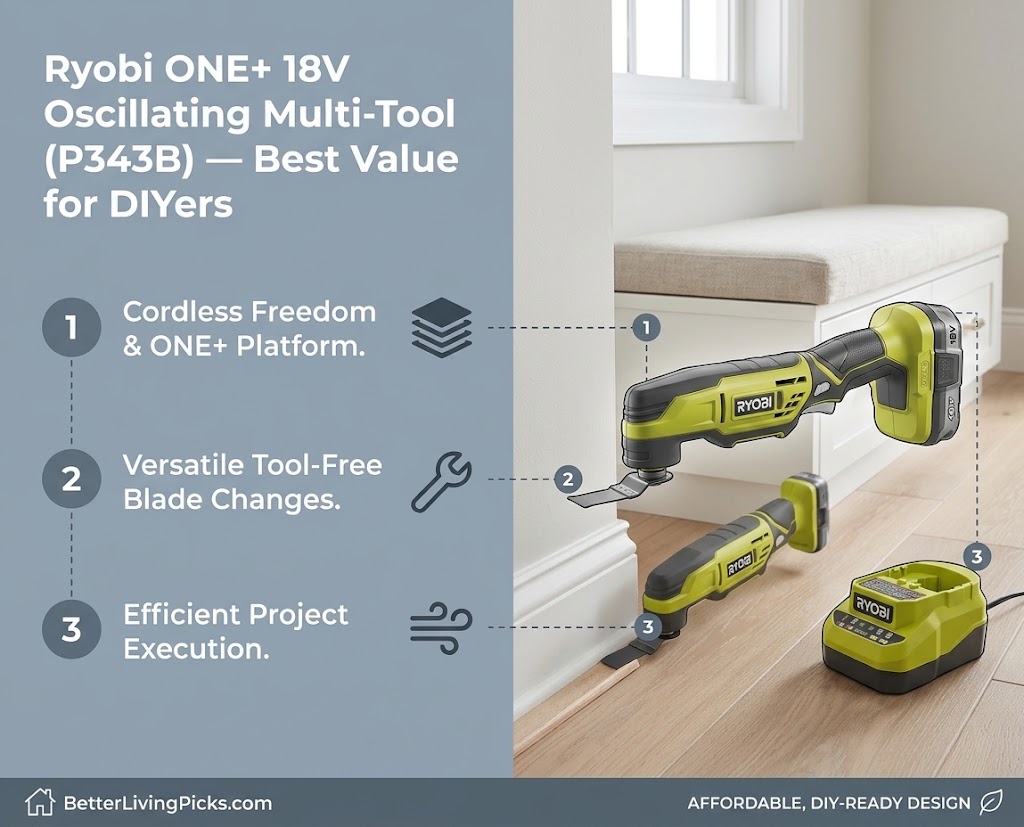
For homeowners tackling weekend upgrades, flooring installs, or minor bath repairs, the Ryobi P343B provides reliable cordless utility without breaking the bank. Compatible with the entire Ryobi ONE+ 18V battery lineup, this tool is an ideal addition for existing platform users.
Key Specifications:
• Voltage: 18V
• Oscillation Speed: Up to 20,000 OPM
• Oscillation Angle: 3.2°
• Tool-Free Blade Release: Yes
Hands-On Performance: The P343B easily handles tasks like trimming casing during laminate flooring installations and flush-cutting PVC pipe. While it produces slightly more operational noise and vibration than premium models, its cutting speed and tool-free blade lock lever make it a capable budget choice.
- Pros:
- Affordable entry price for light to medium home remodeling.
- Tool-free latch system makes changing blades straightforward.
- Convenient speed dial located on top of handle.
- Cons:
- High vibration under heavy loads.
- Brushed motor runs hotter during long, continuous cuts.
5. Rockwell Sonicrafter F50 (RK5142K) — Heavy-Duty Corded Powerhouse
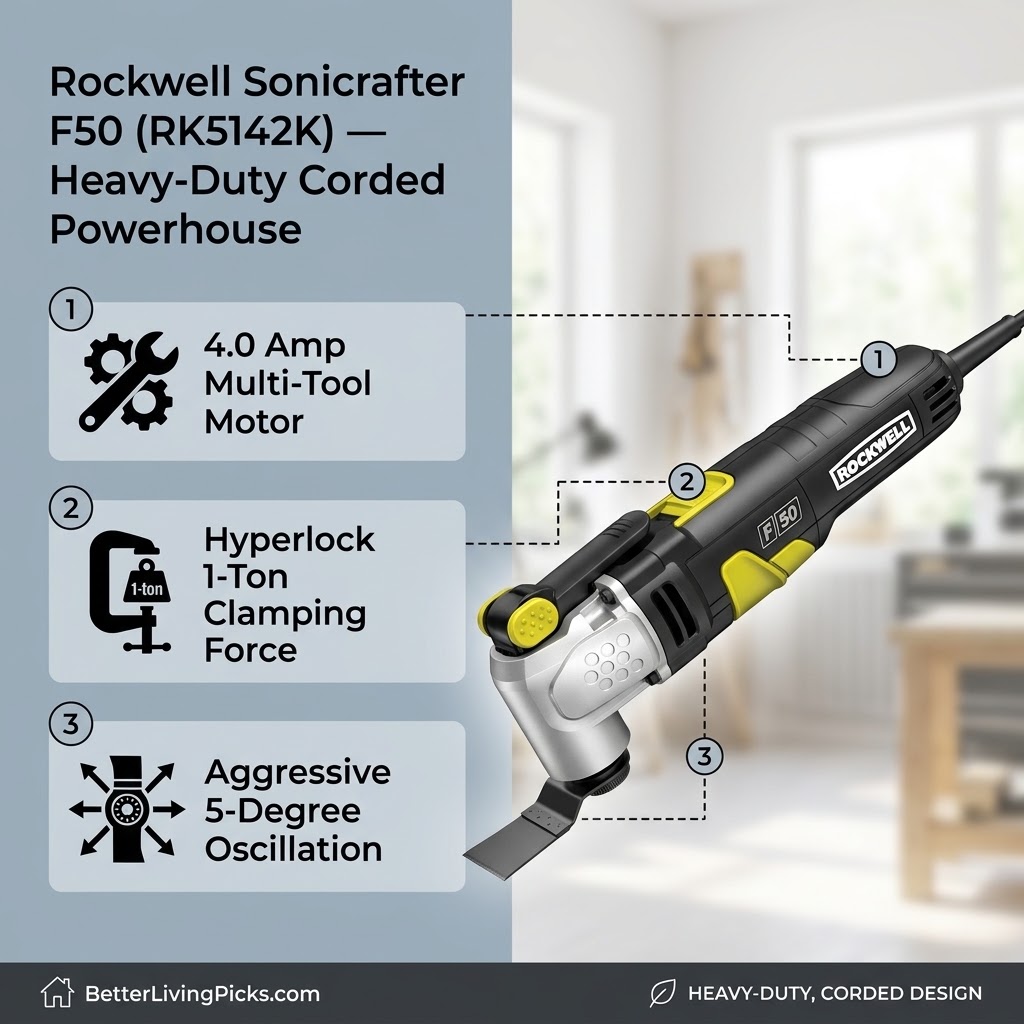
The Rockwell Sonicrafter F50 is designed for high-load applications where battery tools can stall. Featuring a powerful 4.0-amp motor and an aggressive 5.0° oscillation angle, this corded model delivers incredible cutting speed through thick hardwoods and sheet metal.
Key Specifications:
• Amperage: 4.0 Amps
• Oscillation Angle: 5.0°
• Oscillation Speed: 10,000 – 21,000 OPM
• Clamping System: Hyperlock Tool-Free (1 Ton Holding Force)
Hands-On Performance: The standout feature of the F50 is its Hyperlock clamping system, which applies up to 1 ton of force to prevent blade slippage under heavy torque. Its wide 5.0° angle cuts rapidly, making short work of subfloor notch cuts and framing modifications.
- Pros:
- High-torque 4.0 Amp motor handles heavy-duty cutting without stalling.
- Hyperlock system accepts almost all competitor blade brands without adapters.
- Extremely fast cutting speed on framing lumber and thick plastics.
- Cons:
- Bulkier body size reduces maneuverability in tight cabinet corners.
Buyer’s Guide: How to Choose the Ideal Multi-Tool
Select the right oscillating tool for your project requirements using these key decision factors:
- Match the Tool to the Project Scope: Professional contractors benefit from high-efficiency brushless cordless models (like DeWalt or Milwaukee), while budget-conscious homeowners can save with proven corded or DIY platform tools.
- Blades Control Cut Quality: Buying specialized carbide or bi-metal blades improves cutting speed and precision far more than upgrading motor wattage alone.
- Vibration Control Protects Accuracy: Isolated motor housings keep hands steady, ensuring straight, accurate plunge cuts along cabinet trim and tile lines.
- Safety First: Set clear cutting depth limits when cutting into drywall or subflooring to protect hidden utilities.
Corded vs. Cordless Mobility
- Cordless (18V / 20V): Essential for jobsite mobility, attic work, exterior trim repairs, and quick cuts in tight spaces without running extension cords. Modern high-capacity batteries provide ample runtime for most tasks.
- Corded (3.5A – 4.0A): Best for non-stop work sessions like removing floor grout, sanding whole furniture pieces, or cutting thick material where uninterrupted power is necessary.
Blade Attachment Systems
- Tool-Free Lever Clamps: Quick-release handles speed up blade changes without requiring separate hand tools.
- Starlock System: Features a 3D snap-on connection that maximizes torque transfer from motor to blade and allows hands-free ejecting of hot blades.
- Bolt & Allen Key Systems: Common on entry-level tools. Secure, but requires keeping a wrench nearby for blade changes.
Essential Accessories for Remodeling
Recommended Starter Blade Kit Components:
├── Flush Cut Wood Blades (Japanese Tooth) -> Door jambs, baseboard trim
├── Bi-Metal Plunge Blades                 -> Nail-embedded wood, copper pipes
├── Carbide Grit Segment Blades            -> Tile grout removal, masonry
├── Rigid Scraper Blades                   -> Dried adhesive, vinyl tile, old caulk
└── Delta Sanding Pad & Sheets             -> Cabinet corners, tight wood detail
When tackling flooring, making a clean flush cut oscillating saw pass against wood flooring undercuts ensures clean plank transitions without damaging neighboring drywall or finish trim.
Final Recommendation & Verdict
For most homeowners and remodeling pros, the DeWalt 20V MAX XR (DCS356B) is the top overall choice. Its variable-speed trigger, low hand vibration, and convenient tool-free blade clamp provide the precise control needed for clean remodeling cuts.
If you already own 18V batteries from Milwaukee or Ryobi, adding their respective bare tool options (the ultra-fast Milwaukee M18 FUEL for high-power jobs, or the budget-friendly Ryobi ONE+ P343B for light DIY tasks) offers great value while keeping you on a single battery platform.
Frequently Asked Questions
1. What makes an oscillating tool better than a jigsaw or reciprocating saw for remodeling?
An oscillating tool uses a tight back-and-forth movement rather than an orbital or reciprocating motion. This small arc makes it safer to control in tight spaces, allowing precise plunge cuts directly into flat surfaces without requiring starter holes.
2. Can I use blades from different brands on my multi-tool?
Yes, most modern multi-tools accept universal OIS blades or include adapter washers in the box. However, Starlock-specific blades fit native Starlock tools directly, while standard OIS blades require adapters to fit Starlock mounts.
3. How do I cut door jambs cleanly when installing new flooring?
Lay a scrap piece of your new flooring flat on the subfloor right against the door jamb, then rest a wood flush-cut blade flat against the top of the flooring scrap. Guide the running multi-tool horizontally through the jamb casing for a clean notch that fits the new floor perfectly.
4. Why do my multi-tool blades wear down or burn wood quickly?
Blade burning usually happens from excessive forward force or running high speeds on hard material. Let the teeth cut at their own pace, sweep the blade slightly side-to-side to clear sawdust, and lower speed settings when cutting hardwoods or dense plastics.
5. What speed setting should I use for detail sanding?
Use low-to-medium speed settings (10,000 – 14,000 OPM) with detail sanding pads. Running at full speed generates high friction heat, melting the hook-and-loop backing on the sanding pad and backing paper.
6. Can an oscillating tool cut through steel bolts or cast iron?
Multi-tools with bi-metal or carbide-grit blades easily cut through soft metals like copper pipes, aluminum trim, and soft steel nails. However, cutting through thick hardened steel bolts or cast iron drain pipes will dull blades quickly; use a reciprocating saw with a carbide-thick metal blade for those materials instead.
7. How do I remove tile grout without chipping the surrounding tile edges?
Attach a carbide-grit or diamond segment blade, set the speed to medium-high, and let the blade face rest centered in the grout joint. Move the tool steadily along the joint without forcing side pressure against the ceramic tile edges.
8. Is a complete cordless oscillating tool kit worth buying over a bare tool?
If you are already on a battery platform (like DeWalt 20V or Milwaukee M18), buying a bare tool saves money. If you do not own compatible batteries, buying a kit with a battery, charger, and storage bag is usually much more cost-effective than purchasing those components separately.
Final Thought
An oscillating multi-tool is one of the most versatile power tools you can add to your workshop. By pairing a capable tool with quality blades matched to your task, you can finish home remodeling projects faster, cleaner, and with professional precision.