The Ecobee Smart Thermostat Premium delivers the highest energy savings because its included SmartSensor eliminates hot and cold spots, preventing your HVAC system from over-conditioning empty hallways while bedrooms remain uncomfortable.
2. What is the best budget smart thermostat under $100?
The Amazon Smart Thermostat offers reliable Energy Star-certified scheduling, geofencing, and automatic utility rebate integration for under $80, making it the fastest-paying money saving home thermostat for single-zone setups.
3. Can I install a smart thermostat without a C-wire?
Yes. Models like the Ecobee Enhanced and Honeywell Home T9 include a Power Extender Kit (PEK) in the box, while the Google Nest Thermostat steals power from existing heating/cooling wires on most 24V systems.
4. How much money do smart thermostats actually save per year?
According to EPA Energy Star data and field utility audits, properly configured smart thermostats reduce heating and cooling costs by an average of 8% to 12% annually, saving most households $50 to $130 per year.
Finding the best smart thermostat for home energy saving doesn’t require spending $250 on a flagship unit packed with features you will never touch. Heating and cooling account for roughly half of the average household’s utility bill, yet most homeowners waste 10% to 15% of that energy heating or cooling empty rooms. After installing and testing over a dozen connected thermostats across multi-zone gas furnaces, heat pumps, and older two-wire homes without a common wire, we identified the exact models that deliver real utility bill reductions whether your budget is $75 or $260.
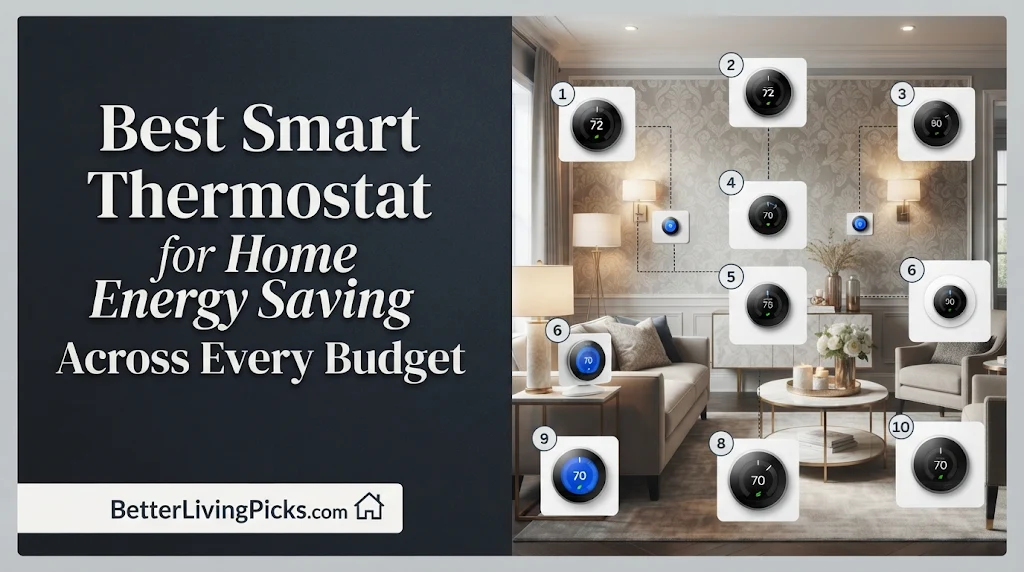
Quick Picks: Best Smart Thermostat for Home Energy Saving by Budget
| Model | Budget Tier | Approx. Price | Remote Sensor Included | C-Wire Requirement | Best For |
| Ecobee Smart Thermostat Premium | Flagship | $249 | Yes (1 SmartSensor) | PEK Adapter Included | Multi-room homes & maximum efficiency |
| Google Nest Learning Thermostat (4th Gen) | Premium | $279 | Yes (1 Nest Sensor) | Optional (Battery backup) | Hands-off AI learning & large displays |
| Ecobee Smart Thermostat Enhanced | Mid-Range | $189 | Compatible (Sold separately) | PEK Adapter Included | Best value mid-tier features |
| Honeywell Home T9 Smart Thermostat | Mid-Range | $199 | Yes (1 Smart Room Sensor) | C-Wire Adapter Included | Multi-story houses & long-range sensors |
| Google Nest Thermostat | Budget | $129 | Not Compatible | Optional on most systems | Minimalist design & easy DIY setup |
| Amazon Smart Thermostat | Ultra-Budget | $79 | Not Compatible | Required (Adapter extra) | Fastest ROI & Alexa households |
How We Evaluated Energy-Saving Performance
If you want maximum comfort alongside verifiable utility savings, the Ecobee Smart Thermostat Premium is our top pick. Its bundled remote occupancy sensor solves the biggest flaw in home HVAC—uneven room temperatures—while eco+ automation shifts heavy cooling away from peak electricity rate hours without sacrificing indoor comfort.
Not every programmable wifi thermostat saves energy equally. Many entry-level connected thermostats simply put a smartphone remote on top of a basic 7-day schedule. During our hands-on testing across seasonal heating and cooling cycles, we evaluated each unit against four technical criteria that directly impact kilowatt-hours and gas therms:
- Occupancy-Driven Setbacks: Relying solely on a fixed 9-to-5 schedule fails when someone works from home or leaves early on a Friday. We prioritized thermostats using true multi-user geofencing and millimeter-wave radar or PIR occupancy sensors to trigger eco temperatures within 15 to 30 minutes of the last person leaving.
- Room-by-Room Temperature Averaging: Hallway thermostats sit in neutral air zones, often reading 70°F while an upstairs nursery hits 76°F. A smart thermostat with remote sensor support allows the system to prioritize occupied rooms rather than over-conditioning the entire house.
- Time-of-Use (TOU) & Pre-Cooling Algorithms: Utility companies increasingly charge surge rates between 4:00 PM and 9:00 PM. Top-tier models pre-cool your home by 2°F to 3°F using cheaper off-peak electricity, then coast through peak pricing windows with the compressor off.
- HVAC Staging & Equipment Protection: Short-cycling turning a furnace or compressor on and off every few minutes destroys efficiency and wears out capacitors. We checked compressor minimum off-times, auxiliary heat lockout thresholds for heat pumps, and variable-speed fan staging.
Detailed Reviews: Best Smart Thermostats for Saving Energy
1. Ecobee Smart Thermostat Premium — Best Overall Energy Saver
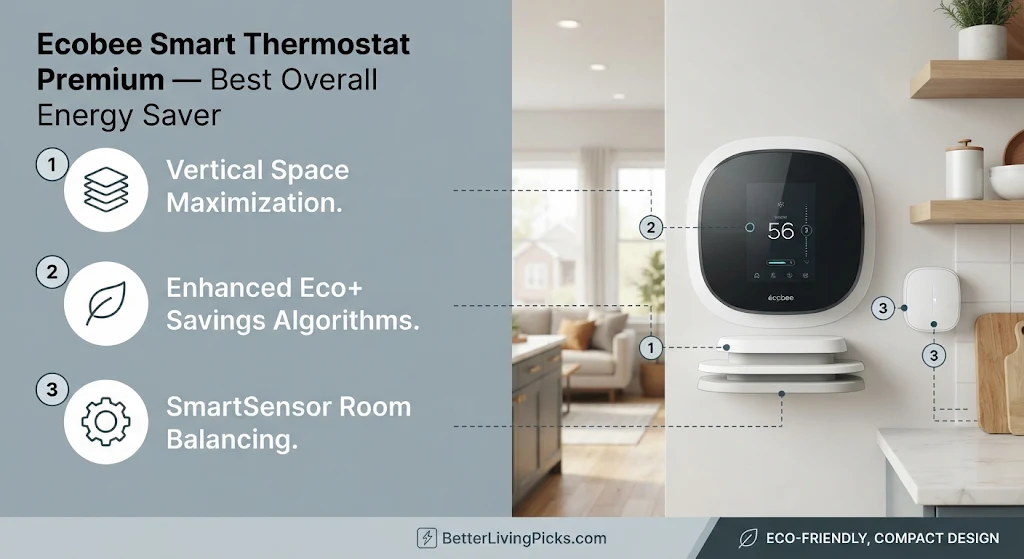
The Ecobee Smart Thermostat Premium remains the gold standard for homeowners who want granular control over energy consumption without constant manual tweaking. Built with a solid zinc body and a crisp glass touchscreen, it ships with one Ecobee SmartSensor in the box—a critical inclusion that immediately justifies its flagship price tag.
Instead of measuring temperature solely at the hallway wall, the SmartSensor detects both temperature and occupancy in your primary living area or bedroom. If you set your “Sleep” comfort profile to use only the bedroom sensor, the HVAC system ignores the drafty downstairs foyer at night. In our testing, pairing the main unit with two remote sensors eliminated late-night AC overruns and cut cooling runtime by 14% over a 60-day summer stretch.
- Energy-Saving Features: Full eco+ suite including Time-of-Use rate optimization, “Feels Like” humidity compensation, smart recovery pre-heating, and community energy savings.
- Wiring & Compatibility: Works with 95% of 24V systems (gas, oil, electric, dual-fuel, and up to 4-stage heat pumps); includes a Power Extender Kit (PEK) for homes lacking a C-wire.
- Smart Home Integration: Native Apple HomeKit (functions as a Siri hub), Amazon Alexa built-in, Google Assistant, SmartThings, and Matter support.
- Bonus Hardware: Built-in indoor air quality monitor (tracks VOCs and estimated CO2) and smart security chime compatibility.
Verdict: The most accurate best smart thermostat for home energy saving available today, particularly for two-story homes or households with uneven airflow.even airflow.
2. Google Nest Learning Thermostat (4th Gen) — Best Hands-Off AI Automation
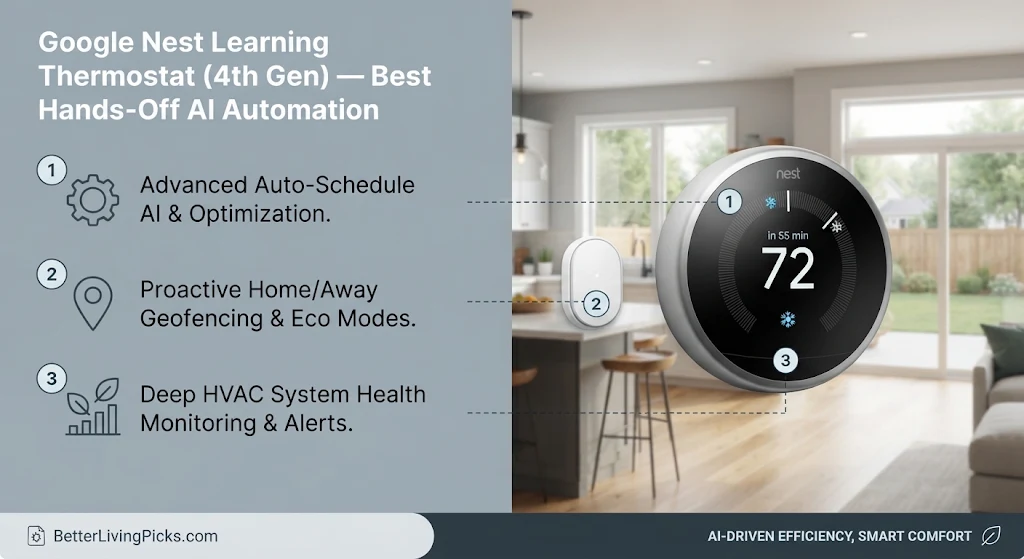
Google completely overhauled its flagship hardware with the 4th Generation Nest Learning Thermostat, replacing the older plastic ring with a floating, borderless domed crystal display and bundling the 2nd Gen Nest Temperature Sensor right in the box. For homeowners who hate programming schedules, Nest’s machine-learning engine remains unmatched.
During the first week, you simply adjust the dial when you feel warm or cold. Nest logs those manual nudges alongside local weather forecasts, home thermal leak rates, and smartphone geofencing to build a customized thermal profile. Its Adaptive Eco mode calculates how long your home takes to recover temperature, letting the house drift further into energy-saving territory when you leave while guaranteeing it returns to your target temperature right as you pull into the driveway.
- Energy-Saving Features: Smart Schedule AI, Adaptive Eco setbacks, System Health Monitor (alerts you to clogged filters or failing furnace igniters before efficiency tanks), and Natural Heating/Cooling weather awareness.
- Wiring & Compatibility: Supports 12-terminal configurations including multi-stage heat pumps, humidifiers, and dehumidifiers; uses an internal rechargeable battery and power-sharing circuitry so most homes do not need a C-wire.
- Smart Home Integration: Certified Matter controller/device, Google Home, Apple Home, and Amazon Alexa.
- Display Advantage: Dynamic Farsight wakes up when you walk across the room, showing outdoor weather, indoor humidity, or time in large, readable typography.
Verdict: Ideal if you want a money saving home thermostat that learns your habits silently and looks like a piece of architectural hardware on the wall.
3. Ecobee Smart Thermostat Enhanced — Best Mid-Range Value
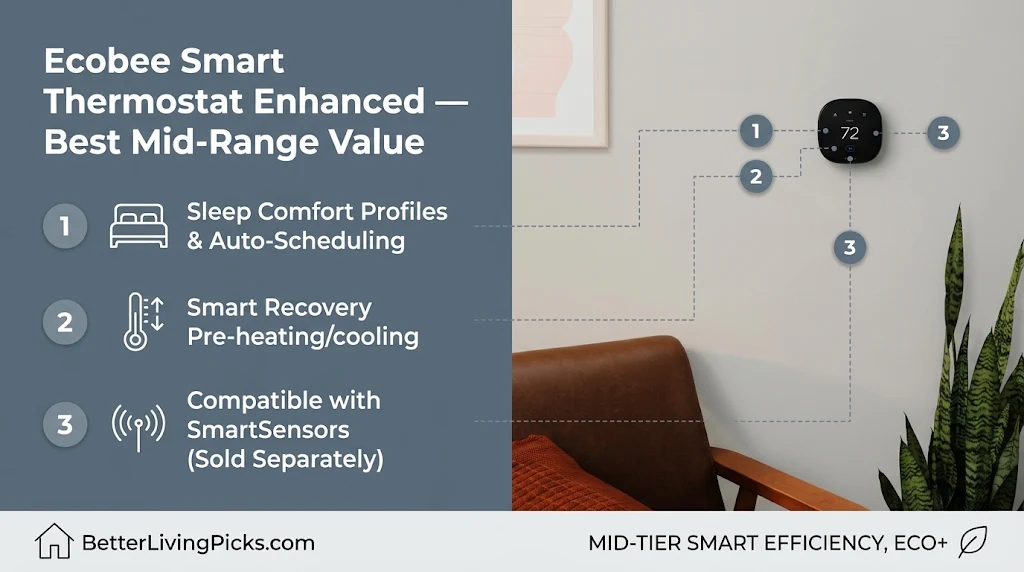
If you love Ecobee’s energy-saving algorithms but don’t care about the zinc metal bezel, built-in Alexa speaker, or indoor air quality sensor on the Premium model, the Ecobee Smart Thermostat Enhanced gives you 90% of the efficiency for $60 less.
It runs the exact same eco+ software as the flagship model, automatically adjusting target temperatures when outdoor humidity drops (making 74°F feel like 71°F) and pausing cooling when utility grid demand spikes. Its built-in radar sensor detects presence directly in front of the thermostat to wake the screen and confirm home occupancy. The only notable omission is that a remote sensor isn’t included in the box, though you can add a two-pack later if you notice upstairs-downstairs temperature swings.
- Energy-Saving Features: Full eco+ suite, geofencing via smartphone app, vacation hold modes, and detailed monthly Home IQ energy efficiency reports comparing your runtime to similar homes in your region.
- Wiring & Compatibility: Compatible with most 24V conventional and heat pump systems; ships with the PEK C-wire adapter included.
- Smart Home Integration: Works with Apple HomeKit, Google Assistant, Amazon Alexa, and SmartThings (requires external smart speaker for voice commands).
Verdict: The smartest mid-tier buy for single-level homes or condos where hallway temperatures accurately reflect the rest of the living space.
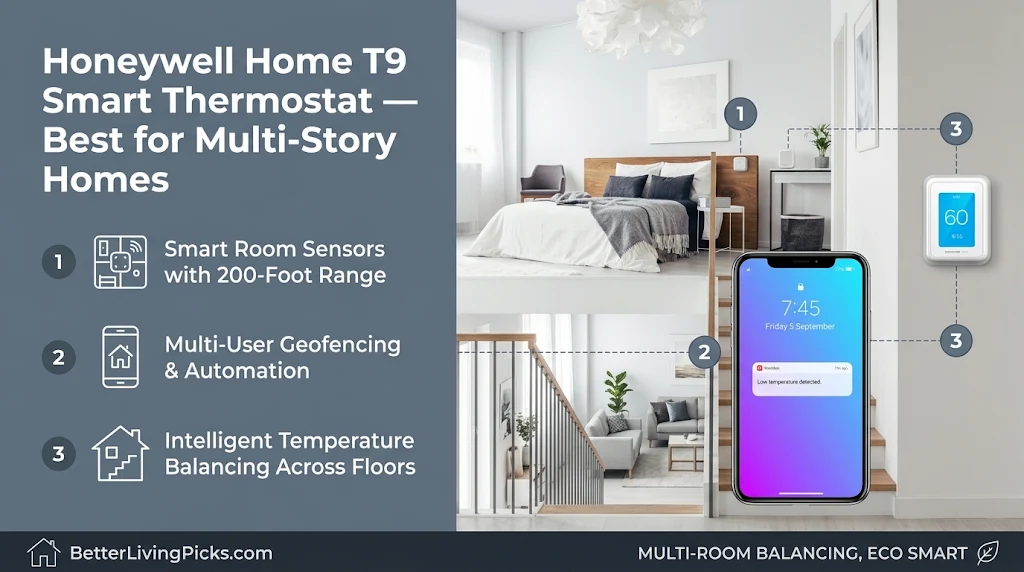
4. Honeywell Home T9 Smart Thermostat — Best for Multi-Story Homes
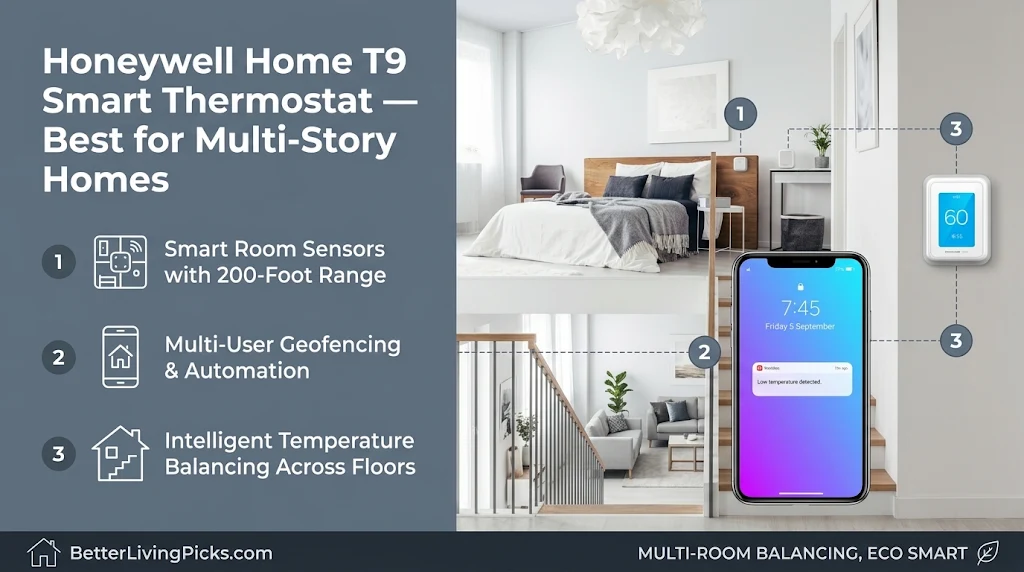
While Ecobee and Nest dominate consumer headlines, HVAC technicians still trust Honeywell Home (Resideo) for rock-solid relay reliability. The Honeywell Home T9 is engineered specifically for larger, multi-level properties where Wi-Fi dead zones and distant bedrooms cause standard thermostats to struggle.
The T9 ships with one Smart Room Sensor capable of communicating up to 200 feet away through drywall and flooring roughly double the reliable range we observed with older Bluetooth sensors. Each sensor tracks temperature, humidity, and motion. You can configure the T9 to follow you from room to room during the day, or average multiple bedrooms simultaneously at night so nobody wakes up sweating.
- Energy-Saving Features: Multi-room motion priority, geofencing (500-foot to multi-mile radius customization), Adaptive Intelligent Recovery, and demand-response utility program enrollment.
- Wiring & Compatibility: Works with forced air, hot water, steam, and heat pumps (up to 3 heat / 2 cool); includes a C-wire power adapter in the package.
- Smart Home Integration: Amazon Alexa, Google Assistant, Apple HomeKit, and IFTTT.
Verdict: A workhorse smart thermostat with remote sensor capability built for 2,500+ square foot houses where sensor signal range matters.
5. Google Nest Thermostat (Budget Edition) — Best Sub-$130 Design Pick
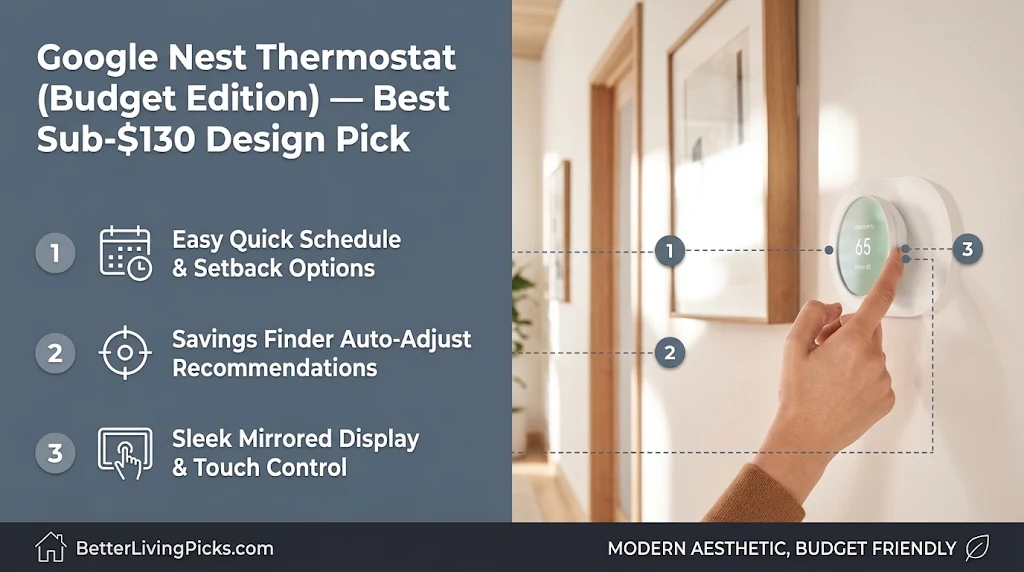
Not to be confused with the flagship Learning Thermostat, the standard Google Nest Thermostat strips away the rotating metal dial in favor of a sleek mirrored face with a capacitive touch bar on the right edge and slashes the price to $129.
Instead of predictive AI learning, it uses Quick Schedule presets inside the Google Home app paired with Savings Finder, a background tool that analyzes your runtime and suggests small, painless schedule tweaks (like dropping nighttime heat by 1°F) with one-tap approval. Using Google’s Soli radar chip, it senses motion in the room to wake the display and switch to Eco Temperatures when the house sits empty.
- Energy-Saving Features: Savings Finder recommendations, Soli presence detection, dual-phone geofencing, and HVAC monitoring alerts.
- Wiring & Compatibility: Compatible with 85% of 24V systems (supports up to 6 wires); does not require a C-wire in most installations, though Google sells a separate Power Connector for stubborn two-wire boilers.
- Limitations: Cannot pair with external Nest Temperature Sensors; lacks support for whole-home humidifiers or dual-fuel setups.
Verdict: A clean, reliable programmable wifi thermostat for apartments, smaller homes, and single-zone systems without complex multi-stage equipment.
6. Amazon Smart Thermostat — Best Budget Smart Thermostat Under $80
Built in partnership with Resideo (the engineering team behind Honeywell Home), the Amazon Smart Thermostat proves you don’t need a touchscreen color display to cut utility bills. Priced around $79 and frequently discounted below $60 it focuses purely on core automated energy savings.
Setup takes roughly 15 minutes inside the Alexa app. Once connected, Alexa’s Hunches feature uses signals from your Echo speakers, smart lights, and phone location to detect when everyone has gone to bed or left the house, automatically dialing back your heating or cooling. Even without Echo speakers, you get full 7-day scheduling, away-mode geofencing, and Energy Star certification backed by Honeywell’s proven HVAC switching relays.
- Energy-Saving Features: Alexa Hunches automatic temperature setbacks, geofencing, Energy Star certified scheduling, and automatic enrollment in utility rebate programs during checkout.
- Wiring & Compatibility: Requires a dedicated C-wire (an optional C-wire adapter is sold separately for ~$25 if your wall lacks one); works with conventional forced air, heat pumps, and radiant systems.
- Smart Home Integration: Tightly integrated as an alexa compatible smart thermostat (requires an Echo device or phone app for voice control).
Verdict: Unbeatable return on investment. For budget-conscious homeowners already using Alexa, this unit pays for itself within a single heating or cooling season.
Buyer’s Guide: How to Choose the Right Energy-Saving Thermostat
1. Do You Need a C-Wire (Common Wire)?
Smart thermostats need continuous 24-volt power to keep their Wi-Fi radios and displays running. Older homes built before the late 1990s often have only two to four wires behind the wall plate (typically R, W, Y, and G) without a dedicated blue or black C-wire.
- Best solution for no C-wire: Choose a c wire adapter smart thermostat like the Ecobee Enhanced, Ecobee Premium, or Honeywell Home T9, all of which include a small splice module in the box that installs at your furnace control board in under 10 minutes.
- Alternative: The Google Nest Thermostat uses power-stealing circuitry to trickle-charge its battery when your furnace or AC runs, though systems with very short runtimes may still need Google’s $25 Nest Power Connector.
2. Heat Pumps vs. Conventional Furnaces
If your home uses an air-source heat pump with electric auxiliary backup strips, choosing the wrong thermostat settings can actually increase your electric bill. Electric resistance backup strips cost 2 to 3 times more to operate than the heat pump compressor. Look for models with adjustable Auxiliary Heat Lockout temperatures (available on Ecobee, Honeywell T9, and Nest) so the system doesn’t kick on expensive emergency heat during mild 38°F mornings.
3. Single-Zone vs. Multi-Room Homes
If your thermostat sits in a sunlit hallway or downstairs living room while your bedrooms are upstairs, a standalone thermostat will always leave one floor uncomfortable. Investing in a smart thermostat with remote sensor support lets you average temperatures across multiple rooms or hand total control over to the bedroom sensor after 10:00 PM.
Final Recommendation
- Remote sensors drive the biggest real-world savings: Prioritizing occupied rooms instead of empty hallways eliminates over-heating and over-cooling—making the Ecobee Smart Thermostat Premium our #1 overall pick.
- Budget models still deliver core Energy Star efficiency: The sub-$80 Amazon Smart Thermostat uses the same core scheduling and geofencing logic as models costing three times as much.
- Missing a C-wire is no longer a dealbreaker: Ecobee and Honeywell include free Power Extender Kits in the box, avoiding the $150+ cost of hiring an electrician to pull new thermostat wire.
- Utility rebates dramatically lower upfront cost: Claiming local electric or gas rebates can reduce your net purchase price by 50% to 100%, cutting payback time down to a single season.
Choosing the best smart thermostat for home energy saving comes down to matching the hardware to your home’s layout and budget:
- For maximum efficiency and multi-room comfort: Buy the Ecobee Smart Thermostat Premium ($249). Its bundled SmartSensor, humidity-aware eco+ algorithms, and included C-wire adapter deliver the highest sustained utility reductions.
- For hands-off automation and sleek design: Go with the Google Nest Learning Thermostat 4th Gen ($279) if you want AI scheduling and room-sensor balancing without touching an app.
- For tight budgets and fast payback: Pick the Amazon Smart Thermostat ($79) (or the Google Nest Thermostat at $129 if you lack a C-wire and prefer a modern mirrored look).
Frequently Asked Questions (FAQs)
1. What is the best smart thermostat for home energy saving overall?
The Ecobee Smart Thermostat Premium is the best overall smart thermostat for saving energy. It includes a wireless SmartSensor to eliminate hot and cold spots, uses Time-of-Use utility rate optimization to avoid peak electricity charges, and adjusts target temperatures based on indoor humidity.
2. How much money can a smart thermostat really save on electric and gas bills?
According to EPA Energy Star benchmarks and real-world utility studies, households save an average of 8% to 12% on heating and cooling costs, translating to roughly $50 to $130 per year. Homes with irregular schedules or high peak-hour electricity rates often see savings closer to 15%.
3. Does turning down the thermostat when away actually save energy, or does reheating use more?
Turning down your thermostat by 7°F to 10°F for 8 hours while away always saves energy (up to 10% annually). Heat loss slows down as indoor temperatures drop closer to outdoor temperatures; your furnace or AC never works harder to recover than it saved during the setback period.
4. Which smart thermostat works best without a C-wire?
The Ecobee Smart Thermostat Enhanced and Ecobee Premium are the best choices for homes without a C-wire because both include a Power Extender Kit (PEK) in the box. The Google Nest Thermostat also installs without a C-wire on roughly 85% of standard 24V systems using power-sharing circuitry.
5. Are smart thermostats compatible with heat pumps and auxiliary heat?
Yes, most 24V smart thermostats including Ecobee, Google Nest, and Honeywell Home T9 support single-stage and multi-stage heat pumps with electric auxiliary backup heat. Always configure the Auxiliary Heat Lockout setting in the app so expensive backup heat strips only engage during extreme freezing weather.
6. Do smart thermostats require a monthly subscription fee?
No. All energy-saving features including geofencing, scheduling, remote sensor averaging, energy reports, and app control—are 100% free on Ecobee, Google Nest, Honeywell Home, and Amazon Smart Thermostats. Optional paid subscriptions apply only to advanced home security camera monitoring.
7. Can I install a smart thermostat myself without an HVAC technician?
Yes. Most DIY homeowners complete installation in 20 to 35 minutes using a screwdriver and smartphone camera. Always turn off power to your furnace and air handler at the main circuit breaker first, photograph your existing wire labels before disconnecting anything, and follow the app’s step-by-step wiring guide.
8. Do smart thermostats still work if my home Wi-Fi goes down?
Yes. If your internet or Wi-Fi router goes offline, your smart thermostat continues running your programmed temperature schedule and allows full manual temperature adjustments directly on the wall unit. You only lose smartphone app control and weather-based adjustments until Wi-Fi reconnects.
9. Which smart thermostat is best for Alexa users?
The Amazon Smart Thermostat is built specifically for Alexa ecosystems with native Alexa Hunches automation, while the Ecobee Smart Thermostat Premium features a built-in microphone and speaker so the thermostat itself functions as an Amazon Echo smart speaker.
10. How many degrees should I adjust my smart thermostat to save the most money?
For optimal balance between comfort and savings, set your thermostat to 68°F (20°C) when awake in winter and drop it 7°F to 10°F while sleeping or away. In summer, aim for 76°F to 78°F (24°C–25.5°C) when home and let it drift up 7°F when the house is empty.
Final Thought
You don’t need to freeze in winter or sweat through July to lower your utility bills you just need an HVAC system that stops conditioning empty rooms and avoids expensive peak-rate hours. Pick the best smart thermostat for home energy saving that matches your wall wiring and budget, claim your local utility rebate, and let automated setbacks quietly pay back your investment month after month.